
Tank Cleaning Robot Buyer’s Guide: Methods, Costs, and How to Choose
Two contractors can walk the same storage tank, and their quotations can differ by more than the price of the equipment that is supposed to do the work. That gap is seldom about the machine. It is about scope. One of them priced sludge removal; the other priced surface preparation to a coating standard. They wrote the same word — “cleaning” — on two different jobs.
This guide is written for the buyer who has to defend the number internally. It separates the four jobs buyers call tank cleaning, compares the methods that can actually do each one, and shows where the money in a tank cleaning campaign really sits. It also lists the cases where a robot is the wrong purchase. No price list appears below, because there is no single number that would be honest.
Tank Cleaning Is Four Different Jobs, Not One
“Tank cleaning” is a phrase, not a specification. Before you compare any quotation, decide which of four distinct scopes you are actually buying. They use different tools, different crews, different acceptance criteria and different waste streams.
| The job | What it removes | What it needs | What drives the bill |
|---|---|---|---|
| Sludge and sediment removal | Bottom sludge, wax, scale, settled product residue | Bulk removal tools, gas-freeing, washing, waste handling | Volume of waste; confined-space exposure hours |
| Surface preparation | Rust, mill scale, old coatings, failed lining | Abrasive blasting, water jetting, grinding to a stated standard | Target surface standard; coating film thickness |
| Inspection support | Loose debris hiding weld seams, plate and nozzles | Safe access plus a clean surface for close visual and NDT work | Inspection standard; access and entry hours |
| Product changeover | Residue that would contaminate the next product | Washing with water or chemistry; documented cleanliness | Product specification; residue compatibility |
This distinction matters commercially. A magnetic wall-climbing robot does surface preparation and inspection support very well, contributes to changeover work, and does not remove bulk bottom sludge — that is a separate operation with a separate cost line. Merging the four into one line item is the most common reason two tank cleaning quotations cannot be compared. If you are unsure where your job sits, the earlier guide on how to select tank maintenance equipment works through the equipment side of the same decision.
The Five Cleaning Methods and What Each One Can Reach
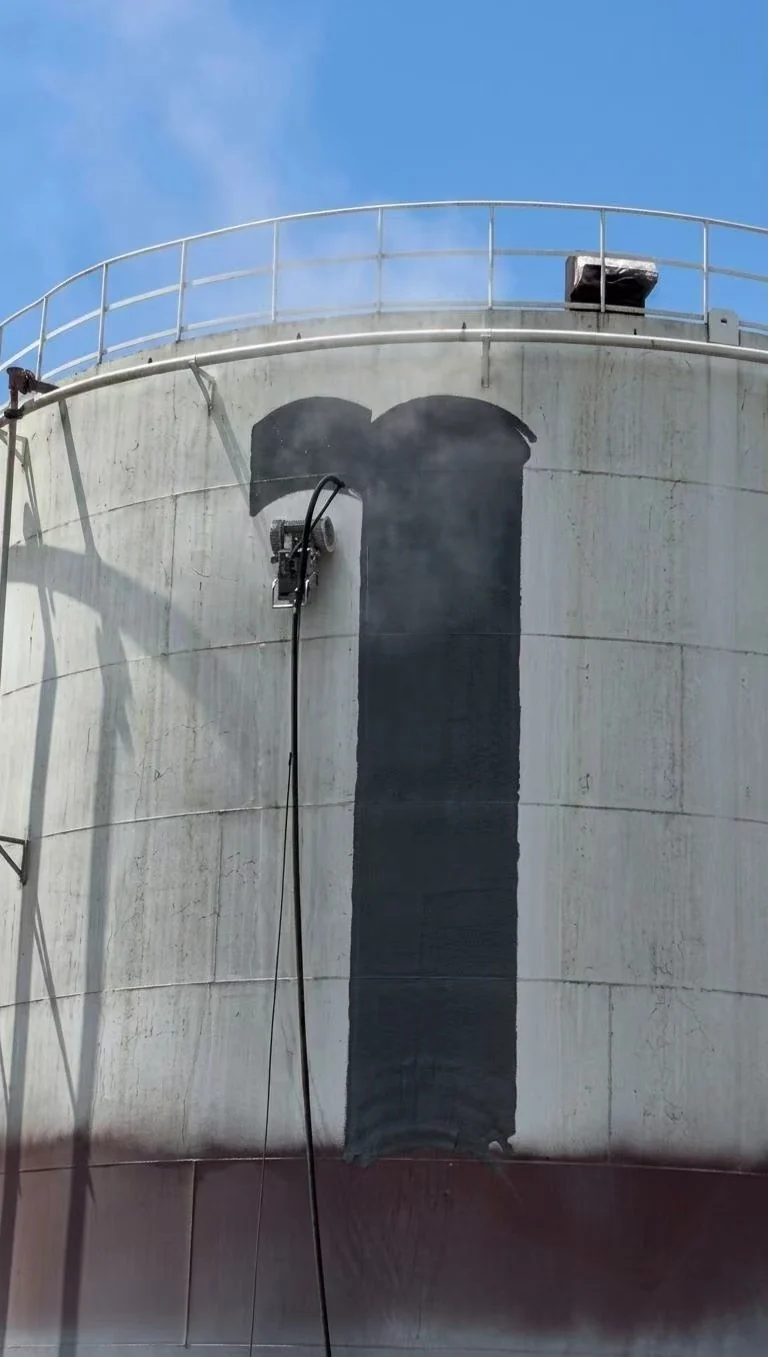
Once the job is defined, the method follows. Five approaches cover almost all industrial tank work. The table is a capability screen, not a preference: each row has a condition under which it is the right answer.
| Method | Removes | Crew inside the tank? | Waste stream | Main constraint |
|---|---|---|---|---|
| Manual entry | Sludge, scale, stubborn deposits | Yes – hours of permit-controlled entry | Hand-collected solids | Confined-space exposure; slow; hard to scale |
| Circulatory chemical | Hydrocarbons, light residue, some scale | Minimal | Chemical plus effluent | Product and effluent compatibility |
| High-pressure water jetting | Deposits, salts, light rust | Sometimes | Water plus contaminated effluent | Water supply; effluent treatment |
| Abrasive blasting | Rust, mill scale, coatings to bare steel | Often | Spent abrasive plus dust | Containment permission; compressed-air supply |
| Robotic (magnetic wall-climbing) | Coatings, rust, deposits, residue on a ferrous shell | No – crew stays outside | Collected or contained, per process | Ferrous shell; manway size; internal geometry |
The robot row and the blasting and jetting rows are not alternatives to each other — they are a platform and the processes it carries. The same chassis runs a grinding head, a high-pressure water jet or a blast nozzle, and the choice of process, not the robot, is what sets the surface standard you end up with. For the blasting-versus-jetting decision in depth, including the compressor bottleneck that limits both, the dedicated comparison of dry blasting vs wet water jetting for tank maintenance is the right next read.
One terminology trap is worth naming here. Cleaning removes what should not be present; surface preparation creates the profile that a coating needs to bond to. They have different acceptance criteria, and a quotation that does not state which one it covers cannot be benchmarked against another.
What Actually Drives the Cost of a Tank Cleaning Campaign
The invoice for a tank campaign is not a machine price with labour attached. It is six buckets, and in most projects the machine is not the largest of them. Buyers who model only the equipment line are usually surprised by the other five.
| Cost bucket | What scales it | How a robot changes it |
|---|---|---|
| Access and confinement regime | Manway size, entry hours, gas monitoring, standby attendant, rescue plan | Removes most of the in-tank entry hours; the regime still applies outside |
| Process and support equipment | Compressor or pump sized to the nozzle, hose runs, containment | Adds a machine line; removes some labour and access cost |
| Hazardous-area certification | Area classification of the tank | Adds the cost of a certified unit where the zone requires it |
| Downtime and production loss | Days out of service multiplied by throughput | Shortens the window, which is often the largest single saving |
| Waste handling and disposal | Sludge volume, waste classification, transport | Same volume; cleaner separation and containment |
| Labour exposure and welfare | Crew headcount inside the tank, PPE, medical surveillance, monitoring | Fewer people inside for fewer hours |
Read the third column as a shift, not as an elimination. A robot does not remove the permit, the gas monitor or the attendant — it removes the need for people to spend long shifts at the bottom of a tank, and it compresses the calendar. On assets where production loss dominates the cost, the calendar is the whole argument. On assets where it does not, the arithmetic may not close at all, which is why the sections below state the failure conditions explicitly.
The machine-side counterpart of this ledger — why a supplier cannot quote one figure for the hardware — is set out separately in wall climbing robot price: the seven factors that decide it. This article is deliberately the other half: the campaign, not the catalogue.
What Decides Whether a Robot Can Enter Your Tank
Before cost, feasibility. Five gates decide whether a magnetic wall-climbing platform is even applicable to a given tank. Any one of them can close the case.
| Gate | Passes when | Fails when |
|---|---|---|
| Shell material | Ferrous carbon steel | Fibre-reinforced plastic, aluminium, or non-magnetic alloy shells |
| Manway | At least 600 mm entry | Smaller openings – the machine cannot be introduced |
| Geometry | Turns within a 2 m diameter; heavy platform needs about 3 m curvature | Very tight or heavily obstructed shells |
| Internal fittings | Clear travel paths between coils, baffles and mixers | Dense internals that block the chassis |
| Area classification | Certified unit matches the zone marking | Zone exceeds the marking on the certificate |
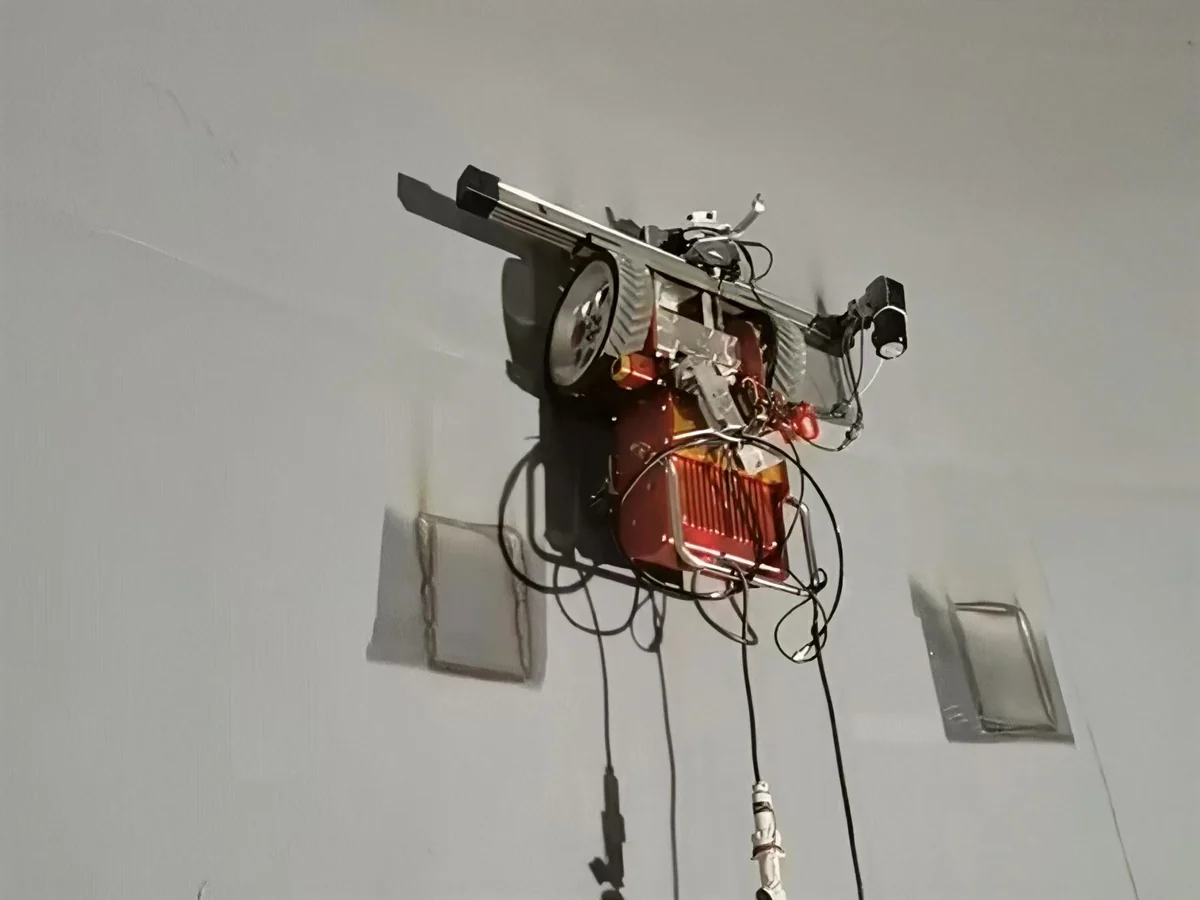
For the JT-1 Mini explosion-proof wall-climbing robot, entry is built around a 600 mm (24 in) manway and the chassis turns within a 2 m diameter, which is what makes internal work practical on typical above-ground tanks. Payload on a vertical face is 70 kg. Where a tank needs heavy blasting with long hose and abrasive runs, the larger JT-2 four-wheel-drive wall-climbing robot carries a nominal 150 kg, measured to about 200 kg, climbs 10 cm obstacles, and needs roughly a 3 m minimum curvature to work properly.
Certification interacts with all of this. Where the tank is a classified hazardous area, the equipment has to match the zone, and the marking on the certificate is what an inspector will read. The explosion-proof tank robot guide to ATEX, IECEx and Ex markings covers how to read that marking, which gas groups and temperature classes mean, and why a certificate that is valid in one jurisdiction may not be accepted in another.
How Robotic Cleaning Changes the Confined-Space Ledger
Entering a petroleum storage tank is not ordinary industrial work. Under the permit-required confined space rule, entry is a controlled activity: a permit, atmospheric testing before and during entry, a standby attendant outside the opening, and a rescue plan that does not depend on the entrant. The petroleum industry’s own standard for safe entry and cleaning of storage tanks builds on that regime and covers the sequence from taking a tank out of service to returning it.
None of those controls disappear when a robot is used. What changes is the number of hours people spend inside the space and how far into the tank they have to go. A magnetic platform works with the crew outside the manway, which moves the exposure from “people at the tank bottom for a shift” to “equipment on the shell, operators at the opening.” That is a change in exposure model, not a claim that the hazard is gone — and it is why the confined-space controls and the equipment certification have to be planned together, not bolted on afterwards.
The field record of a certified platform doing exactly this kind of work inside a classified tank is documented in the explosion-proof tank inspection case study.
How to Scope a Tank Cleaning Job So Quotes Are Comparable
Most tank cleaning quotations are not comparable, and the reason is upstream of the supplier. Each bidder scoped the job from a different starting point. The fix is to send every bidder the same data set. Nine items cover it.
| Send this | Why it moves the number |
|---|---|
| Tank diameter and height | Sets shell curvature, travel distance and machine class |
| Shell material and plate thickness | Magnetic feasibility; pressure that blasting can use |
| Product and residue history | Cleaning method; waste classification; gas-freeing effort |
| Area to be treated, in square metres | Converts coverage rate into days, which converts to downtime |
| Target surface standard | Distinguishes cleaning from preparation; sets process |
| Manway dimension | Determines whether a robot can be introduced at all |
| Area classification of the tank | Whether a certified unit is mandatory |
| Available power, air and water | Scope of the support package you must buy or hire |
| Campaign window and waste responsibility | Crew size and shifts; who pays for disposal |
A supplier given all nine can quote a configuration and a schedule. A supplier given a tank diameter and a deadline will quote a range wide enough to be useless, or will quote low and recover later. The precision is in the input.
Where Robotic Tank Cleaning Does Not Pay
A framework that never says no is a sales document. Robotic tank cleaning is the wrong answer in a specific and predictable set of cases, and it is worth saying so plainly.
Short one-off jobs. A campaign measured in a few days of work rarely justifies the capital line, the spares holding and the training behind a platform.
Non-ferrous shells. Magnetic adhesion requires a ferrous shell. Fibre-reinforced plastic, aluminium and non-magnetic alloy tanks are out of scope for this platform.
Manways below the minimum entry. If the machine cannot be introduced, nothing else on this page applies.
Tanks crowded with internals. Heating coils, baffles and mixers can block travel paths badly enough that a crew is faster.
Jobs that are really bulk sludge removal. A wall-climbing platform works the shell and floor plate; it is not a sludge-removal system, and buying one to remove bottom volume is a category error.
Sites that cannot permit the process. Where containment permission for blasting is unavailable and water use is restricted, the process itself may be ruled out regardless of the delivery platform.
Stating these limits is not modesty. A buyer who discovers them after the purchase has been sold the wrong machine, and that is a worse outcome for both sides than a lost order.
A Practical Decision Sequence
Run the six steps in order. Each one can stop the process, which is the point.
1. Classify the job. Decide whether this is sludge removal, surface preparation, inspection support or product changeover. This single step removes most of the ambiguity in the quotations you will receive.
2. Check the feasibility gates. Shell material, manway size, geometry, internals and area classification. If any gate fails, choose a different method before spending time on cost.
3. Select the process, then the platform. Blasting, water jetting or grinding sets the surface standard; the chassis is whatever carries it into the tank.
4. Scope with the nine data points above, and send the same set to every bidder.
5. Model the campaign, not the machine. Access, downtime, waste and labour exposure usually outweigh the equipment line.
6. Compare quotes line by line against the same scope, and ask what each one excludes. Exclusions, not inclusions, are where two bids diverge.
Frequently Asked Questions
What does an industrial tank cleaning robot actually do?
On a ferrous shell it performs surface work: removing coatings, rust, deposits and residue from the shell, the floor plate and welds. Cleaning runs at about 300 m squared per hour with a matched high-pressure pump. Abrasive blasting reaches 20 to 30 m squared per hour on new thin-film steel and 10 to 15 m squared per hour on older 400 to 500 micrometre coatings. It does not remove bulk bottom sludge, which is a separate operation.
How much does tank cleaning cost?
There is no single figure, and a supplier who gives one has not scoped your tank. The invoice is dominated by access and confinement controls, downtime and production loss, waste handling, and the process support package rather than by the machine line. Two quotations on the same tank can differ by more than the equipment cost when one priced surface preparation and the other priced sludge removal.
Can a robot clean the inside of a storage tank?
Only if it fits through the manway. The JT-1 Mini platform is built around a 600 mm entry and turns within a 2 m diameter, which is what makes internal work possible on typical above-ground tanks. Dense internals such as heating coils, baffles and mixers can still block the path, so the travel route matters as much as the opening.
Do I need an explosion-proof tank cleaning robot?
It depends on the area classification of the tank, not on the brand. Where the work area is classified, the equipment has to match the zone. The JT-1 platform carries a Chinese GB certification, Ex db ib IIB T4 Gb, certificate ZJEx23.0915 valid to 10 July 2028, tested to GB/T 3836.1, GB/T 3836.2 and GB/T 3836.4-2021, supported by a CNAS report under ILAC-MRA mutual recognition. That is a GB certification, not an ATEX or IECEx certificate. If your site requires ATEX or IECEx, raise it at the enquiry stage so the route can be confirmed before anything is committed.
What is the difference between tank cleaning and surface preparation?
Cleaning removes what should not be present, such as sludge, residue and deposits. Surface preparation creates the profile that a coating needs to bond to, to a stated standard. They use different tools and different acceptance criteria, and a quotation that does not say which one it covers cannot be compared with another. Confusing the two is the most common reason tank cleaning bids look inconsistent.
How fast can a robot clean a tank?
Budget from daily coverage rather than an hourly rate. On this platform family, practical daily coverage runs 150 to 300 m squared per day for the JT-1 Mini and 280 to 320 m squared per day for the heavy JT-2. The bottleneck is rarely the machine’s travel speed; it is the compressor or pump behind it, and hose length, because pressure falls along the run.
When is a robot the wrong choice?
Short one-off jobs, non-ferrous shells, manways smaller than the machine, tanks crowded with internals, and work that is really bulk sludge removal. In those cases a crew or a different method is faster and cheaper. A framework that never says no is a sales document rather than a budget tool.
How long does the equipment last, and what has to be replaced?
The JT-1 chassis family has been in commercial service since 2020 with a design life of 8 to 10 years, and around 120 JT-1 Mini units have been deployed. Consumable wheels are replaced on inspection; gearboxes and seals are replace-and-run items. Process modules change over in about 30 minutes with a trained crew, which is what allows one chassis to cover several processes.
Next Step: Scope the Job, Then Compare Numbers
The fastest route to a usable figure is a scoped job. Send the tank data below and we will come back with a configuration, a daily coverage estimate and a schedule — the three inputs you need before any price is meaningful.
What to send: tank diameter and height, shell material and thickness, product and residue history, area to be treated and target surface standard, manway dimension, area classification, available power and air, campaign window, and who handles waste.
→ Request a Quote — send the tank data above for a scoped configuration and schedule.
→ Download Brochure — full platform specifications, dimensions and coverage data.
→ Explore the wall climbing robot range — JT-1 Mini, JT-2, and the specialised platforms behind them.
References
[1] API Standard 2015, Requirements for Safe Entry and Cleaning of Petroleum Storage Tanks, 7th edition. American Petroleum Institute. https://www.api.org/products-and-services/standards/important-standards-announcements/standard-2015
[2] Permit-Required Confined Spaces, 29 CFR 1910.146. Electronic Code of Federal Regulations. https://www.ecfr.gov/current/title-29/subtitle-B/chapter-XVII/part-1910/subpart-J/section-1910.146
[3] Storage Tanks: Major Work Activities for Tank Cleaning Operations. Occupational Safety and Health Administration. https://www.osha.gov/storage-tanks/work-activities
Need help choosing the right equipment?
Our engineers review your application and recommend the best fit — no obligation.