Dry Blasting vs Wet Water Jetting for Industrial Tank Maintenance — A Wall-Climbing Robot Buyer’s Guide
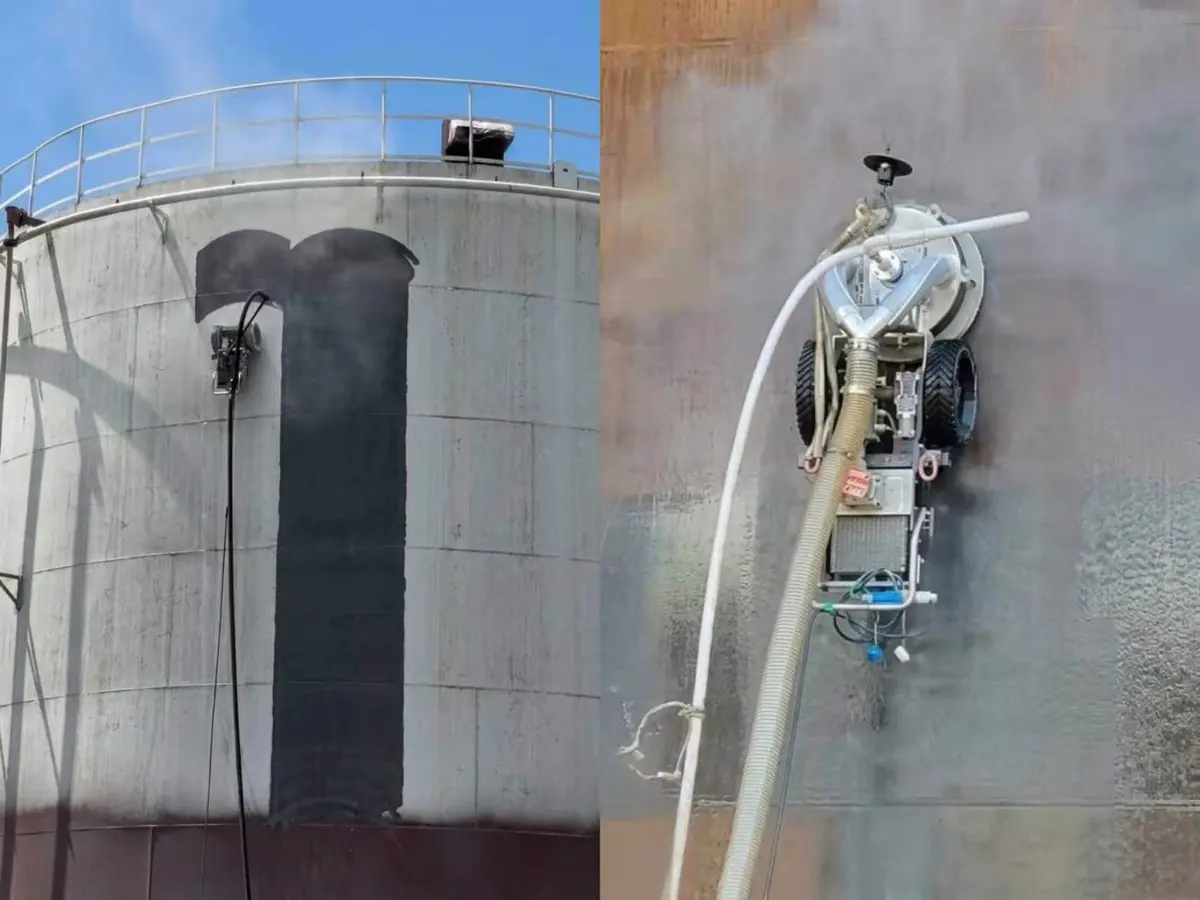
When an oil terminal operator starts planning a tank maintenance campaign, the first question is rarely “which robot.” It is “do we sandblast, or do we water-jet?” The process choice — dry abrasive blasting or ultra-high-pressure water jetting — determines the robot configuration, the compressor and pump requirements, the waste handling setup, the shift schedule, and ultimately the cost per square meter.
This guide compares the two processes head-to-head on the same magnetic chassis, covering production rates, surface quality, dust and water logistics, shift planning, and how to decide which one fits your tank campaign.
Dry Blasting vs Wet Jetting: Head-to-Head
| Parameter | Dry Abrasive Blasting (JT-1 Mini) | Wet UHP Water Jetting (JT-1-S) |
|---|---|---|
| Surface prep rate | 20–30 m²/h (new coating <200μm); 10–15 m²/h (thick coating 400–500μm) | 200–250 m²/day (8-hr shift) |
| Surface quality | SA 2.5 (near-white metal) | SA 2.5 (near-white metal) |
| Operating pressure | 0.8–1.5 MPa (compressor-dependent) | 280 MPa (40,000 psi) |
| Abrasive media | Required — grit/steel shot/slag | Zero — water only |
| Dust generation | High — requires containment + vacuum | Zero dust |
| Water consumption | None (dry process) | High — continuous supply required |
| Robot weight | 60 kg (with swing-arm module) | ~60 kg (JT-1 chassis + jetting module) |
| Manway access | 600 mm Ø — walks through standard manhole | 600 mm Ø — same chassis |
| Minimum tank diameter | 2 m | 2 m |
| IP rating | IP67 | IP67 |
| Certification | Ex db ib IIB T4 Gb (explosion-proof) | Marine-grade stainless, ISO 9227 1000+ hr salt spray |
| Continuous operation | Limited by compressor duty cycle | 18 hours continuous |
| Recoil safety | 200 kgf magnetic hold vs 8 kg recoil — 25× safety margin | Same magnetic chassis |
| Painting speed (after prep) | ~200 m²/h (swap to spray module) | N/A — jetting-only configuration |
How to Choose: A Decision Framework
Four site-level factors determine which process makes sense. There is no “better” process in absolute terms — only the process that fits your constraints.
Factor 1: Coating thickness and condition
Old tanks with heavy corrosion and thick epoxy layers (400–500 μm) slow abrasive blasting to roughly half its new-coating speed — 10–15 m²/h. UHP water jetting at 280 MPa delaminates coatings at the substrate interface, maintaining consistent speed regardless of thickness. If your tank has 15–20 years of accumulated coatings, water jetting is the faster path.
Factor 2: Dust control requirements
Refineries and terminals in dense industrial zones or near residential areas increasingly require zero fugitive dust. Dry blasting generates airborne particulate that demands containment tents, negative-pressure ventilation, and certified dust collectors — adding weeks to mobilization time and thousands of dollars in consumables. Water jetting eliminates dust at the source. If your permit says “zero visible emissions,” the decision is already made.
Factor 3: Water availability and wastewater handling
The flip side of zero dust is high water demand. A JT-1-S running a full shift consumes thousands of liters of fresh water. That water becomes process wastewater carrying stripped coating particles — it must be collected, settled, filtered, and disposed. If your site is in a desert location with no wastewater infrastructure, dry blasting may be the only practical option.
Factor 4: Production timeline and shift structure
The JT-1-S water-jetting configuration supports 18 hours of continuous operation — two back-to-back shifts with no abrasive reloading downtime. This makes it possible to finish a large-diameter crude oil tank (80 m Ø, 20 m wall height) in a single shutdown window. Dry blasting requires periodic stops to refill the blast pot and clear spent media, making it better suited to smaller tanks or campaigns where time is not the binding constraint.
The Efficiency Truth: The Bottleneck Is the Compressor, Not the Robot
Both the JT-1 Mini (dry) and JT-1-S (wet) use the same magnetic chassis rated for 15 m/min travel. The chassis can move faster than any surface-prep process can use. The real limitation is the support equipment.
For dry blasting, the limiting factor is the air compressor. A standard 0.8 MPa compressor with a 20-meter blast hose loses roughly 0.1 MPa per 20 meters of hose length. On a tall tank, the compressor at ground level may deliver 0.8 MPa at the nozzle but only 0.5 MPa at the robot 60 meters up — and blasting efficiency drops sharply below 0.6 MPa. The solution: size the compressor for the tallest tank in your fleet, or stage a secondary compressor at mid-height.
For water jetting, the 280 MPa pump unit is the capital item. JT-1-S delivers SA 2.5 at 200–250 m²/day on an 8-hour shift, but that number assumes an uninterrupted water supply and functional wastewater recovery. If your wastewater pump can’t keep up, the robot waits — and production rate becomes a wastewater logistics problem, not a robot problem.
JT-3, the closed-loop water-jetting variant with integrated recovery, runs at approximately 10 m²/h — the vacuum recovery system, not the jetting head, is the rate limiter. JT-3 makes sense when both zero dust and zero wastewater discharge are non-negotiable, and you accept a slower production rate as the trade-off.
Decision Summary: Which Process for Which Site
| If your site has… | Choose… | Because… |
|---|---|---|
| Strict dust control / near residential zone | Wet UHP Water Jetting (JT-1-S) | Zero airborne particulate. No containment tent or negative-pressure system required. |
| No wastewater infrastructure / desert location | Dry Abrasive Blasting (JT-1 Mini) | No process water required. Spent media handled as solid waste. |
| Thick multi-layer coatings (15–20 years old) | Wet UHP Water Jetting (JT-1-S) | 280 MPa jet delaminates at substrate interface — consistent speed regardless of thickness. |
| Tight shutdown window / 24-hour operation | Wet UHP Water Jetting (JT-1-S) | 18-hour continuous run, zero reloading downtime. |
| Low-flashpoint product history / spark-risk area | Wet UHP (JT-1-S) or Closed-Loop (JT-3) | No abrasive impact sparks. JT-3 adds zero wastewater discharge. |
| Need both blasting and painting with one chassis | Dry Abrasive Blasting (JT-1 Mini) | Modular: blast module → spray module swap in under 30 minutes. |
What About the Third Option: JT-3 Closed-Loop Recovery?
JT-3 combines 280 MPa water jetting with an onboard vacuum recovery system that captures spent water and stripped coating debris before it reaches the tank floor. Production rate drops to approximately 10 m²/h — the vacuum system, not the jetting head, is the bottleneck — but the advantage is a genuinely clean tank floor at the end of each shift. For operators who face both zero-dust and zero-discharge mandates, JT-3 is the only single-robot solution that satisfies both constraints simultaneously.
Frequently Asked Questions
Q: Can I switch between dry blasting and water jetting on the same robot?
Yes. The JT-1 chassis is modular. The JT-1 Mini configuration uses a swing-arm module for dry abrasive blasting, high-pressure washing, and air-assisted spray painting — three processes, one chassis. The JT-1-S replaces the swing-arm module with a dedicated UHP jetting head and stainless-steel plumbing rated for 280 MPa continuous duty. Module swap takes under 30 minutes with standard hand tools. A single robot investment covers both processes.
Q: How does a wall-climbing robot enter a storage tank?
The JT-1 chassis fits through a standard 600 mm diameter manway without disassembly. A davit crane or tripod hoist lowers the 60 kg unit into the tank. Once inside, the robot self-aligns to the wall using permanent magnets — no scaffolding, no rigging inside the tank, no confined-space entry for the operator during surface preparation. The operator controls the robot from outside the tank via a tethered console with real-time video feedback.
Q: What surface quality can I achieve with each method?
Both dry abrasive blasting and 280 MPa UHP water jetting achieve SA 2.5 (near-white metal) per ISO 8501-1 when operated within their design envelopes. Dry blasting produces the familiar angular anchor profile that coating manufacturers specify; water jetting produces a cleaner substrate with lower salt contamination because the water continuously washes soluble salts off the surface. The choice between the two profiles depends on your coating system’s requirements — some epoxy systems specify an angular blast profile, while others perform better on water-jetted surfaces with lower chloride residuals.
Q: Is the robot safe for Zone 1 hazardous areas?
The JT-1 Mini carries Ex db ib IIB T4 Gb explosion-proof certification (China GB 3836 standard). This covers Zone 1 and Zone 2 gas environments with IIB gas groups (ethylene, coke oven gas, and below) at T4 temperature class (≤135°C surface temperature). For facilities handling hydrogen, acetylene, or carbon disulfide (IIC gas group), the standard JT-1 Mini certification does not apply — consult Jingtao’s engineering team for IIC-specific configurations.
Q: What makes the 280 MPa pump different from a standard pressure washer?
A standard industrial pressure washer operates at 15–50 MPa (2,000–7,000 psi). At 280 MPa (40,000 psi), the water jet transitions from “cleaning” to “substrate preparation” — it strips coatings, mill scale, and corrosion product down to bare steel. The pump itself is a positive-displacement plunger pump with ceramic plungers, typically diesel or electric driven at 200–400 kW. It is the single largest capital item in a water-jetting setup and requires dedicated high-pressure plumbing rated for continuous 280 MPa duty.
Q: How many square meters can one robot complete in a day?
Dry blasting (JT-1 Mini): 20–30 m²/h on new coatings under 200 μm thickness, translating to 160–240 m² per 8-hour shift. On old tanks with thick coatings, this drops to 10–15 m²/h (80–120 m² per shift). Wet jetting (JT-1-S): 200–250 m² per 8-hour shift at SA 2.5, assuming uninterrupted water supply and functional wastewater recovery. JT-3 (closed-loop): approximately 80 m² per 8-hour shift — slower, but tank floor stays clean and no external wastewater handling is required.
Q: Does Jingtao supply the compressor and pump, or just the robot?
Jingtao supplies the robot, the application module (blasting arm, jetting head, or spray gun), and the control system. The air compressor (for dry blasting) and the 280 MPa UHP pump (for water jetting) are sourced separately — these are standard industrial equipment items that most tank maintenance contractors already own or prefer to source from their existing suppliers. Jingtao’s engineering team provides the interface specifications: minimum compressor output, required hose diameter and maximum length, pump flow rate and pressure envelope, and wastewater recovery pump capacity for JT-3 setups.
Get a Process Recommendation for Your Tank Campaign
Send your tank specifications — diameter, height, coating type and thickness, manway size, site location, and any environmental constraints (dust limits, wastewater restrictions, spark-risk zones). Jingtao’s engineering team will return a recommended process and robot configuration with estimated production rates for your specific tank geometry.
Request a Quote
Download Brochure
Related Resources
- Wall-Climbing Sandblasting Robot Buyer’s Guide
- JT-1 Mini Technical Specs
- JT Robot Singapore Refinery Case Study
- Tank Maintenance: How to Select a Surface Prep Robot
Email: [email protected] | JT-1 Mini Product Page
References: ISO 8501-1 — Preparation of steel substrates before application of paints and related products — Visual assessment of surface cleanliness.
Need help choosing the right equipment?
Our engineers review your application and recommend the best fit — no obligation.