
Flare Gas Power Generation vs CNG vs LPG: How to Choose the Right Route for Your Field
Three Routes, One Decision Nobody Has Made Yet
In 2025 the world flared 167 billion cubic metres of associated gas. That is the highest volume since 2019 and the third consecutive annual increase, according to the World Bank’s Global Gas Flaring Tracker. The same report puts the market value of that 2025 volume at an estimated 54 billion US dollars.
Read that number again, because it is not a disposal problem. Gas that is burned at the flare tip is gas that nobody decided what to do with. The operator either had no route to market, or had a route that looked too expensive on the day the field was designed, and the flare became the default.
There are only three ways to turn an associated gas stream into revenue without a pipeline. You can sell electrons you make on site. You can sell molecules you compress into trucks. Or you can sell the heavy end as LPG. Each route asks something different of the gas, of the site and of the operator, and the choice is usually decided by the gas analysis and a map, long before anyone discusses equipment.
This guide sets out how the three routes behave, what each one demands before it becomes available, and the five questions that settle the decision. It also shows the sizing arithmetic that converts a gas volume into an electrical capacity.
The Three Routes at a Glance
The table below compares the three monetisation routes on the factors that actually decide projects. It is written for flare gas and wellhead gas at oilfield scale: hundreds of kilowatts to a few megawatts, not a 200 MW gas plant.
| Decision factor | On-site power generation | CNG (compressed) | LPG / NGL |
|---|---|---|---|
| What leaves the site | Electricity over a cable | Molecules in pressure cylinders | Liquid propane / butane in a pressure vessel |
| Gas quality demand | CH4 content, H2S and water handled by front-end conditioning | Must be dried; H2S and CO2 stripped to protect steel cylinders | Needs a meaningful C3+ fraction in the gas — dry gas has no LPG in it |
| Front-end equipment | Filter, knock-out drum, pressure regulation, desulfurisation if H2S is high | Compressor, dehydration, sweetening, tube trailers | NGL recovery, fractionation, storage, licensed distribution |
| Transport dependency | None — the load is on the same site | Entirely a trucking business; round-trip distance drives the economics | Needs a local LPG offtake chain — bottling plant, distributor or industrial user |
| Time from decision to first revenue | Months: containerised unit, fuel connection, commissioning | Longer: compression, storage and a customer who can take a steady daily volume | Longest: process plant first, market second |
| Operating complexity | One rotating machine plus a gas train; remote monitoring is standard | Compressors and pressure equipment, plus traffic and cylinders | Process plant with the highest operating skill requirement of the three |
| Scale sweet spot | Roughly 1-5 MW, built as repeatable skid or containerised units | Small daily volumes with a nearby industrial buyer | Rich gas with liquids worth recovering at the scale of the stream |
| Where it fails first | Gas stream too small or too intermittent to hold load | Distance: freight cost per unit of gas climbs with every kilometre | Liquid content: no C3+ means no product to sell |
Route 1 – Flare Gas Power Generation: Selling Electrons Where the Gas Is
Power generation is usually the first route to examine, because it removes transport from the problem. The gas is conditioned at the well site and burned in a reciprocating gas engine coupled to an alternator; the electricity goes to the loads that already exist on that field. Every pump jack, every electric submersible pump, every compressor station, every camp and every dehydration unit is a customer standing on the same pad.
That is the structural advantage: you are not looking for a market, you are displacing one you already pay for. On remote fields where power comes from diesel gensets trucked in over bad roads, the comparison is not gas versus pipeline gas, it is gas versus diesel delivered by truck. When the field already has electricity from a weak local grid, the generator adds reliability and caps the demand charge.
What the engine needs from the fuel is a stable heat value and a clean, dry, pressure-regulated gas stream at the inlet. The gas train does the rest: filtration, knock-out, pressure regulation into the engine’s working range, and desulfurisation where the H2S load requires it. Where heat is also needed — line heaters, tank heating, dehydration reboilers, camp hot water — a combined heat and power configuration raises total fuel utilisation dramatically: electrical efficiency of a gas engine sits in the 33-35% band, while a CHP unit captures 85-90% of the fuel energy in total.
Two honest limits belong in the same paragraph as the advantages. First, if the gas stream is small or wildly intermittent, a single engine cannot hold a stable load; you need either a larger gas buffer, a multi-unit arrangement or a different route. Second, the flare stack does not disappear. Emergency relief must remain, because no operator should put a plant between a process upset and a safe relief path. On-site generation reduces routine flaring; it does not delete the flare system, and any proposal that claims otherwise has not been near a real plant.
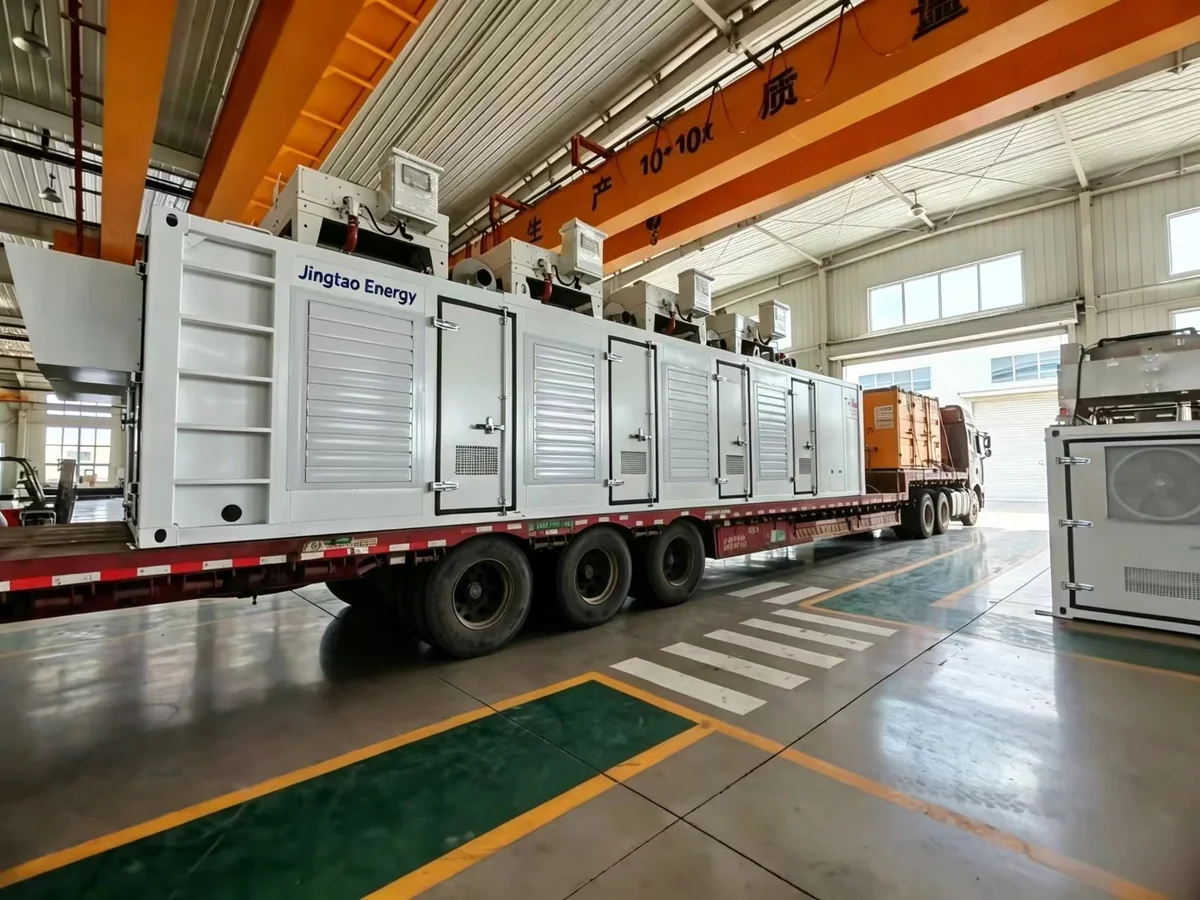
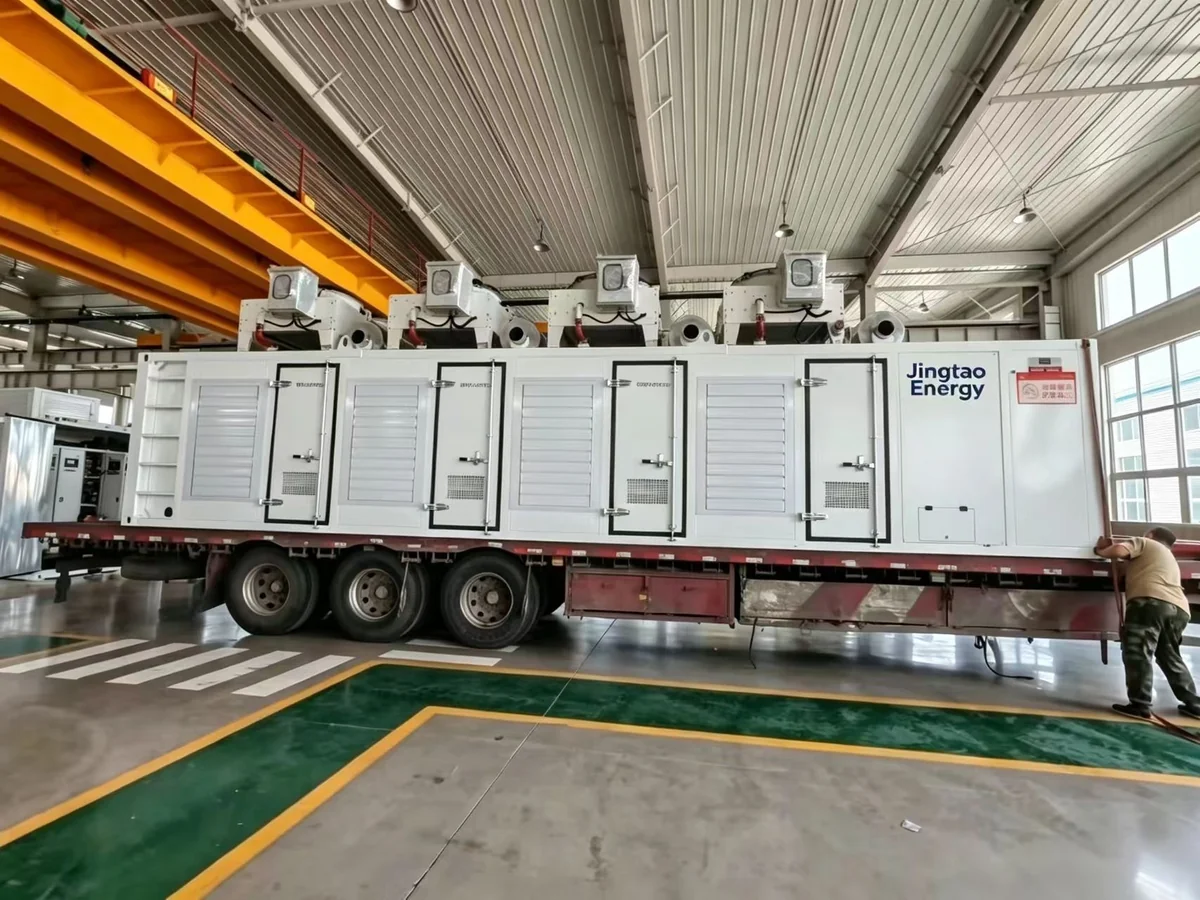
Scale is deliberately modular: a single unit covers 80-350 kW on one engine platform and 300-1,000 kW on a heavier one, and multiple units go into one container — a five-unit 1,500 kW container was delivered for a Russian project. Modularity matters for flare gas because it lets the operator start with one or two units, prove the fuel supply and the load, and add capacity without a second capital decision.
Route 2 – CNG: Turning the Gas Into a Trucking Business
Compressed natural gas takes a different view of the problem: instead of bringing a load to the gas, it brings the gas to an existing buyer. The stream is compressed into pressure cylinders — typical tube-trailer working pressure is in the 200-250 bar range — and driven to an industrial customer, a gas-fired boiler, a cement or brick kiln, or a city gas distributor.
The engineering is less forgiving than it looks. Water has to come out, because free water plus H2S plus steel under pressure is the classic recipe for sulfide stress cracking in cylinders and couplings. CO2 has to be managed for the same reason, and H2S has to be stripped well below the levels a gas engine will tolerate. Compression itself consumes a real share of the gas’s energy content, so the fuel penalty is paid before the first truck leaves the gate.
The decisive number is not the wellhead volume, it is the volume one trailer can carry relative to the round trip. A standard tube trailer holds only a few thousand standard cubic metres, so the route behaves like a freight contract: the longer the round trip and the smaller the daily gas volume, the more the per-unit cost is freight rather than fuel. CNG rewards a short haul to a steady industrial buyer and punishes long-distance ambition. Where a gas-gathering pipeline already passes near the field, CNG rarely competes; where the well is genuinely isolated and a customer sits a couple of hours away, it can be the only route that monetises gas that would otherwise be flared.
Route 3 – LPG and NGL: Selling the Heavy End
LPG is not a way to monetise gas volume. It is a way to monetise liquids, and the first question is therefore whether the gas contains liquids at all. Associated gas with a useful C3+ fraction can be processed to recover propane and butane; a dry, methane-dominated stream has no LPG in it no matter how many cubic metres per day come out of the separator.
Where the liquids are there, the route requires a small gas plant rather than a genset: recovery and fractionation, pressure storage, loading facilities, and a licensed distribution chain that can place LPG into cooking fuel, autogas or industrial burner markets. That is a chemistry-and-logistics business with the highest operating skill requirement of the three routes, and the capital is spent before the market is proven.
In practice, LPG is a route for fields with rich gas and a dense local LPG market. It is also the route that most often deserves a partner who already runs gas plants, rather than being improvised by an operator whose core competence is drilling and production. If a project review concludes that the liquid content does not justify recovery, the honest answer is to move the discussion back to power generation or CNG rather than to build a plant that produces a product nobody locally needs.
How to Choose: Five Questions That Settle the Route
Route selection is not a preference. It is the output of five questions, and any proposal that skips one of them is guessing.
| Question | What it decides | What you need in hand |
|---|---|---|
| 1. What is actually in the gas? | Which routes exist at all: H2S and CO2 decide conditioning scope, C3+ decides whether LPG is possible | A lab gas analysis: CH4, C2+, C3+, CO2, H2S, water, plus pressure, temperature and flow |
| 2. How much gas, and how steady? | The size and number of units, or whether power generation is viable at all | Daily and seasonal volume profile, not a single peak figure |
| 3. How far is the nearest load or buyer? | Power generation versus CNG versus handing the gas to a third party | Kilometres to the nearest electrical load and to the nearest gas buyer — a distance, not a region |
| 4. How much field life is left? | How much capital the route can carry and how fast it must pay back | Remaining reserve life and the production forecast for the gas stream |
| 5. Who runs it, and who is there at 2 a.m.? | Level of automation, spares strategy and remote monitoring scope | Operating staff on site, maintenance capability, communications to the unit |
Question three is where most flare-gas studies go wrong. “There is a market in the province” is not a route. Ten kilometres to a compressor station that can take the gas is a route; four hundred kilometres of trucking is a different business case that has to be priced as freight.
What the Gas Analysis Has to Show Before Any Route Is Chosen
Engine and equipment standards are written for pipeline-quality gas. Associated gas and wellhead gas are not pipeline quality, which is exactly why they need a custom evaluation instead of a catalogue answer. The thresholds below come from the manufacturer’s manual and are the starting point for that evaluation.
| Parameter | Manual standard | What happens if the gas misses it |
|---|---|---|
| CH4 content | >= 55%, heating value >= 5,500 kcal/m3 | Below this the fuel energy is too thin; combustion stability and output suffer |
| H2S | < 200 mg/Nm3 (about 200 ppm) | Above this, a desulfurisation stage is specified — a 6,000 ppm field case has run successfully with front-end treatment |
| Particulates | < 5 micrometre | Filtration required ahead of the gas train to protect valves and the engine |
| Water content | < 20 g/Nm3 | Dehydration required; water carry-over attacks both engines and pressure equipment |
| Supply pressure | 5-35 kPa at the engine inlet | Below 5 kPa needs a booster; above 100 kPa needs pressure reduction |
| Gas temperature | Above 0 degC, standard window up to 30 degC | Pre-heating or insulation where ambient conditions take the fuel below freezing |
This is the point where a supplier either says “send me the analysis and I will tell you what to burn” or says “we cannot burn that”. The difference is rarely the engine. It is whether anyone is willing to size the front end around the gas the field actually produces, including the sulphur, the water and the temperature swings, rather than quoting for the ideal gas the catalogue assumes.
The same analysis decides the other two routes. High H2S and high water make CNG expensive, because pressure equipment is far less tolerant than a gas train. Low C3+ rules out LPG. A single lab report is therefore the cheapest piece of engineering in the whole project, and it should be the first thing ordered.
Sizing the Generator to the Gas You Actually Have
A volume of gas per day is not a capacity. The conversion runs through the fuel’s energy content. Methane has a lower heating value of about 35.9 MJ per cubic metre, and a spark-ignited gas engine converts roughly 34% of that into electricity. Working that through, one megawatt of electrical output needs in the order of 7,000 cubic metres per day of methane-rich gas: 1 MJ/s divided by 0.34 is about 2.94 MJ/s of fuel, which at 35.9 MJ/m3 is about 0.082 m3/s, or roughly 7,080 m3 per day.
The arithmetic scales linearly, which makes it a useful screening tool: 5,000 m3/day is in the region of 0.7 MW, 10,000 m3/day about 1.4 MW, and 30,000 m3/day about 4.2 MW at 34% electrical efficiency. Heavier gas with a higher liquid content carries more energy per cubic metre; inert content such as CO2 or nitrogen carries less, which is the mechanical reason a gas analysis has to precede a capacity figure.
Those capacities also define the equipment architecture. Up to roughly 1 MW a single 1,000 kW-class unit is enough. Beyond that the practical answer is multiple units, either as separate skids or in a containerised arrangement up to 1.5 MW, because a modular build keeps the first capital step small and lets capacity follow the gas rather than arriving years ahead of it.
Where CHP is configured, the fuel is used twice: electricity for the field and recovered heat for the process. Total utilisation of 85-90% is the reason a CHP design can be justified on fuel savings alone in plants that need process heat, while a power-only design competes on displaced diesel or grid purchases.
The distinction is worth putting in numbers, because it decides which route a field should take.
| Power-only | CHP configuration | |
|---|---|---|
| Fuel utilisation | 33-35% (electrical output only) | 85-90% (electrical plus recovered heat) |
| Where the remaining fuel energy goes | Exhaust and jacket heat rejected to atmosphere | Recovered and delivered to process heat users |
| What the investment displaces | Diesel generation or purchased grid power | Diesel power plus boiler, heater-treater or line-heater fuel |
| What the field must have | A stable electrical load | A stable electrical load and a year-round heat demand |
The precondition is the part usually left out of CHP proposals. Recovered heat has to go somewhere useful every day of the year. In oilfield service that normally means wellhead and flowline heating, crude stabilisation, dehydration and glycol regeneration, tank heating, or facility climate control in cold climates. Where those loads exist, the second revenue stream is real, and the overall fuel utilisation of 85-90% is what pays for the equipment. Where they do not – and this is the honest answer – a power-only design is the recommendation. If the site needs cooling rather than heating, absorption chilling or an ORC unit is the alternative use for the same heat; it is not a reason to claim CHP economics that are not there.
For the route decision in this guide, CHP does not change which routes are available. It changes the economics of Route 1 in fields that already burn fuel for heat, which is most of them.
Permitting, Carbon Pricing and the Cost of Waiting
The regulatory direction is one-way. Flaring intensity — the volume of associated gas flared per barrel of oil produced — rose to 5.4 cubic metres per barrel in 2025, up 2.7% from 5.3 in 2024, and flaring volumes have now risen for three consecutive years. The World Bank’s estimate that 2024 flaring released 389 million tonnes of CO2 equivalent, with a significant share in the form of unburnt methane, is the number regulators read first.
Methane is the reason. The IEA’s Global Methane Tracker, using the IPCC’s 2021 figures, applies a 100-year global warming potential of 30 and a 20-year value of 82.5 to methane. A flare that burns incompletely is not the same as no emissions, and even a well-operated flare emits CO2 from every molecule of gas it consumes. Instrument-based methane reporting, national flaring bans and carbon-pricing mechanisms all push in the same direction: routine flaring is a cost that is becoming visible.
That reframes the investment case. Reducing routine flaring is no longer only an environmental statement in a sustainability report; it removes a future liability from the field and turns a wasted stream into capacity the site already needs. The IEA’s own list of uses for the gas currently flared is short and pragmatic — deliver it to networks or as CNG or LNG, use it to generate electricity near oil and gas sites, or reinject it to maintain reservoir pressure. Two of those three are routes an oilfield operator can build with equipment on skids.
Where the Power Route Has Already Been Proven
Route 1 is not a concept. Units supplied through our manufacturing partner are running today in conditions that cover the range an oilfield can produce. A unit commissioned in Volgograd in September 2024 has passed 10,000 running hours in a Russian winter operating profile; a second unit at another Russian site has accumulated 4,743 hours. A 1,500 kW containerised set of five units went to Mirny.
A first order of two units for a Middle Eastern operator arrived on 5 July after more than a year of technical discussion — the decision cycle on this equipment is long, because it is a permanent change in how the field is powered, not a consumable. In China the same equipment runs on wellhead gas in Shaanxi, on shale gas in Sichuan and Chongqing where summer ground temperatures reach 42 degC, in the sand and day-night temperature swings of the northwest, and in Daqing and Songyuan where ambient conditions fall to minus 30 degC.
Durability matters more than peak specification in this market. The manual figure for the fleet is 35,000 hours between major overhauls, and units that have stood outdoors for four to five years remain structurally sound. Where a service network exists, warranty follows hours run; where it does not, remote monitoring plus a spares kit carried with the unit is what keeps a distant installation alive. Certifications are in place for CE, CSA and EAC markets, and customers who visit the factory before ordering convert at a far higher rate than those who do not — which is the honest reason we always propose a factory visit and a reference call rather than a brochure exchange.
Frequently Asked Questions
What is flare gas power generation?
Flare gas power generation means capturing associated gas that would otherwise be burned at the flare tip, conditioning it to engine fuel quality, and burning it in a reciprocating gas engine to produce electricity for the field or a nearby load. It requires no pipeline and no gas market: the electricity displaces diesel generation, grid purchases or unmet demand on the same site. A generator set typically comprises the engine, the alternator, the gas train and the control system, delivered on a skid or in a container.
How much gas do I need to generate 1 MW?
As a rule of thumb, about 7,000 cubic metres per day of methane-rich gas per megawatt of electrical output, assuming a fuel lower heating value near 35.9 MJ per cubic metre and 34% electrical efficiency. If the gas carries inert CO2 or nitrogen the requirement rises, because those components add volume without adding energy. The figure is an arithmetic derivation, not a guarantee: the unit selection for a specific field follows the gas analysis and the site conditions.
Can associated gas with high H2S be used in a generator?
Yes, with front-end treatment. The manual standard for the engines is H2S below about 200 mg/Nm3, which covers pipeline-quality gas. Associated gas often sits far above that, and a field case has run successfully on gas containing 6,000 ppm H2S after desulfurisation ahead of the engine. The practical question is not whether high-sulphur gas can be burned, it is how much conditioning the sulphur and water load requires, and that is answered from the gas analysis.
Is CNG or LPG better than on-site power generation?
Neither is better in the abstract; they monetise different things. Power generation sells electricity to a load you already operate and has no transport dependency. CNG sells molecules to a buyer within trucking distance, and its economics are dominated by the round trip. LPG sells liquids recovered from the gas, so it is only available when the gas has a meaningful C3+ fraction and a local distribution market exists. Many fields have exactly one viable route once the gas analysis and the map are both on the table.
What happens when the gas composition changes over time?
Composition drifts as a field matures, and the engine control unit is designed for it: fuel pressure, temperature, top-dead-centre, speed, oil pressure, oxygen and coolant temperature are monitored continuously, and fuelling is adjusted to what the gas delivers. Where the change is large, output is de-rated rather than the unit failing, because a lower heat value simply means less energy per cubic metre. The condition to watch is not a change in composition but a collapse in volume, which is a reservoir question rather than an equipment one.
What maintenance does a remote field installation need?
Less than most operators expect, and more than brochures suggest. The design target is 35,000 hours between major overhauls, with consumables and wear parts replaced on an hours-run schedule. The realistic operating model for a remote site is remote monitoring for start/stop and data trending, a spares kit carried with the unit or held locally, and a service arrangement that does not assume an engineer on site every week. Units in this fleet have stood outdoors for four to five years with structure intact; the enemies are fuel quality and cooling, not the calendar.
Will the flare still be needed after the project is built?
Yes, for emergency relief. On-site generation reduces routine flaring, it does not remove the need for a safe relief path during upsets or maintenance. Any proposal that promises to eliminate the flare system entirely is describing a plant that does not exist. The measurable outcome of the power route is the volume of gas no longer burned continuously, plus the diesel or grid electricity it displaces.
Send Us a Gas Analysis, Not a Question About Price
The route decision lives in three documents: the lab gas analysis, the volume profile and a map with real distances on it. With those, the conversation becomes concrete — what conditioning the gas needs, which route is available, what capacity the stream supports and what the first phase of the build looks like.
We build the generation side of this business: gas engine sets from 80 kW to 1,000 kW, containerised arrangements up to 1,500 kW, and the front-end conditioning that lets them run on gas other suppliers decline to quote for.
→ Request a Quote — send the gas analysis and site conditions for a configuration proposal and lead time.
→ Download Brochure — full technical specifications, model ranges and container options.
→ Associated gas generator range — the JTF series, 100-350 kW, and the heavier platform to 1,000 kW.
Speak directly with an engineer: [email protected] | WhatsApp on request.
References
[1] World Bank, 2026 Global Gas Flaring Tracker Report — https://www.worldbank.org/en/programs/gasflaringreduction/publication/2026-global-gas-flaring-tracker-report
[2] World Bank, Global Flaring Data — https://www.worldbank.org/en/programs/gasflaringreduction/global-flaring-data
[3] IEA, Global Methane Tracker 2025, Key findings — https://www.iea.org/reports/global-methane-tracker-2025/key-findings
[4] IEA, Global Methane Tracker 2025, Regional insights — https://www.iea.org/reports/global-methane-tracker-2025/regional-insights
Need help choosing the right equipment?
Our engineers review your application and recommend the best fit — no obligation.