
How Carbon Taxes and Flaring Bans Are Reshaping Associated Gas Economics: From Liability to CHP Asset
The 2026 Policy Clock Is Already Ticking
On May 7, 2026, routine flaring of associated gas at new US oil wells became illegal under EPA’s OOOOb/c rule [1]. In Norway, flared gas already carries a carbon levy of NOK 944 per tonne of CO2 — roughly US$90 [2]. In Nigeria, the flaring penalty is US$3.50 per thousand cubic feet, up from $2.00 in 2025 [7]. None of these numbers is a proposal. All of them are in force.
Globally, more than 4% of natural gas production is still flared [4]. Flaring climbed to a five-year high in 2025, and the climate damage is now priced at up to US$82 billion per year under the EPA’s updated social cost of carbon of $248 per tonne [5]. The question for every oilfield operator is no longer whether flaring will be regulated. It is what the same cubic meter of gas is worth when the regulator prices it.
The New Regulatory Map: Three Levers, One Direction
Three different policy instruments are converging on the same target. Bans make flaring illegal. Penalties make it expensive. Carbon taxes make it a permanent line item. Together they turn the flare from an engineering convenience into a priced liability.
| Jurisdiction | Mechanism | Rate (2026) | Trajectory |
|---|---|---|---|
| United States | EPA OOOOb/c — routine flaring ban at new wells | Phase-out effective May 7, 2026 | Limited exemptions clarified Apr 2026 [1] |
| United States | IRA Waste Emissions Charge (methane fee) | $1,500 / t methane (≈$54 / tCO2e) | Start delayed to 2034 (P.L. 119-2) [6] |
| Norway | Carbon tax on petroleum combustion | NOK 944 / t CO2 (~US$90) | Raised nearly every year since 1991 [2] |
| Canada | Federal carbon price (industrial) | C$95 / t CO2e | C$115 by 2030 (May 2026 update) [3] |
| Nigeria | Flaring penalty | $3.50 / Mcf (from $2.00 in 2025) | Enforcement tightening [7] |
| Global | Zero Routine Flaring by 2030 | 30+ governments committed | 2030 deadline [7] |
The US ban matters most. It is not a tax that can be absorbed into operating cost — it is a prohibition on the act of flaring itself. New wells with associated gas and no gas infrastructure either capture the gas or stop producing.
What a 100,000 m³/day Flare Actually Costs Today
Take a single well flaring 100,000 m³ of associated gas per day — roughly the output of a well with no gas export route. Methane-dominated associated gas releases about 1.96 kg of CO2 per cubic meter when burned, so the well emits roughly 71,500 tonnes of CO2 per year. Here is what three regulators charge for that today:
| Cost line | Rate | Annual cost at 100,000 m³/day |
|---|---|---|
| Norway carbon tax | NOK 944 / t CO2 (~US$90) | ~US$6 million |
| Canada carbon price | C$95 / t CO2e | ~C$6.8 million (~US$5 million) |
| Nigeria flaring penalty | $3.50 / Mcf | ~US$4.5 million |
That is the price of doing nothing. The gas is still burned — the operator has simply paid several million dollars for the privilege. And in the United States, after May 7, 2026, the answer is simpler still: on a new well, the flare is not allowed to burn at all.
Carbon Tax vs Flaring Ban: The Ban Is the Harder Constraint
Carbon taxes and flaring bans work differently, and the difference decides the investment case.
- A carbon tax charges the combustion — but combustion for power generation pays it too. The tax alone does not forbid burning; it makes burning without output expensive.
- A flaring ban or penalty targets the flare itself. Nigeria fines the act of flaring at $3.50/Mcf. The US bans routine flaring outright. Under these regimes, continuing to flare is not a cost decision — it is a compliance failure.
This is where CHP enters the picture. It is not a cheaper way to burn gas. It is the way to keep the same cubic meter legal and productive: the gas that used to leave through the flare stack now leaves through a generator that produces electricity and heat. The ban does not tax the generator — it taxes the flare.
The CHP Alternative: Same Gas, Different Ledger
A combined heat and power (CHP) unit burns the same associated gas, at 85–90% total efficiency versus 33–35% for power generation alone — the recovered heat does real work instead of escaping up the stack. A single 1 MW unit at 94% availability delivers about 8,200 MWh per year, worth around $820,000 at a conservative $0.10/kWh — and two to three times that where power comes from trucked diesel at $0.25–0.40/kWh. Recovered heat displaces heater-treater fuel on top.
The gas itself is the hard part, and it is the part standard generators refuse. Associated gas arrives high in H2S, low in pressure, and variable in heating value. Jingtao’s approach starts with the gas composition report: CH4, H2S, C4+, water, pressure, flow. From that, the engine package is selected, derating is calculated, and any pretreatment (desulfurization, dehydration, boosting) is specified. If the gas is burnable at all, there is a pathway.
See the JTF Series associated gas generators for the engine lineup and containerized configurations.
Gas Quality Decides the Engine — Not Whether One Exists
The composition report is not paperwork. It decides derating. On the same 200 kW YDNF-200 engine, gas with 68% CH₄ and 4% C4+ delivers 150–160 kW; gas at 90%+ CH₄ can exceed nameplate by 20–30%; LPG feedstock drops output to 130–140 kW. A vendor who quotes output without the gas analysis is quoting a guess.
H₂S works the same way. The engine handbook limit is 200 mg/Nm³ — roughly 200 ppm — and anything above that is handled upstream of the engine with a desulfurization train. Jingtao has run wellhead gas with 6,000 ppm H₂S that way. The rule of thumb: if the gas is burnable at all, there is a treatment pathway — but the pathway has to be specified before the generator is sized, not after it is delivered.
Field Proof: Gas-to-Power That Runs 35,000 Hours
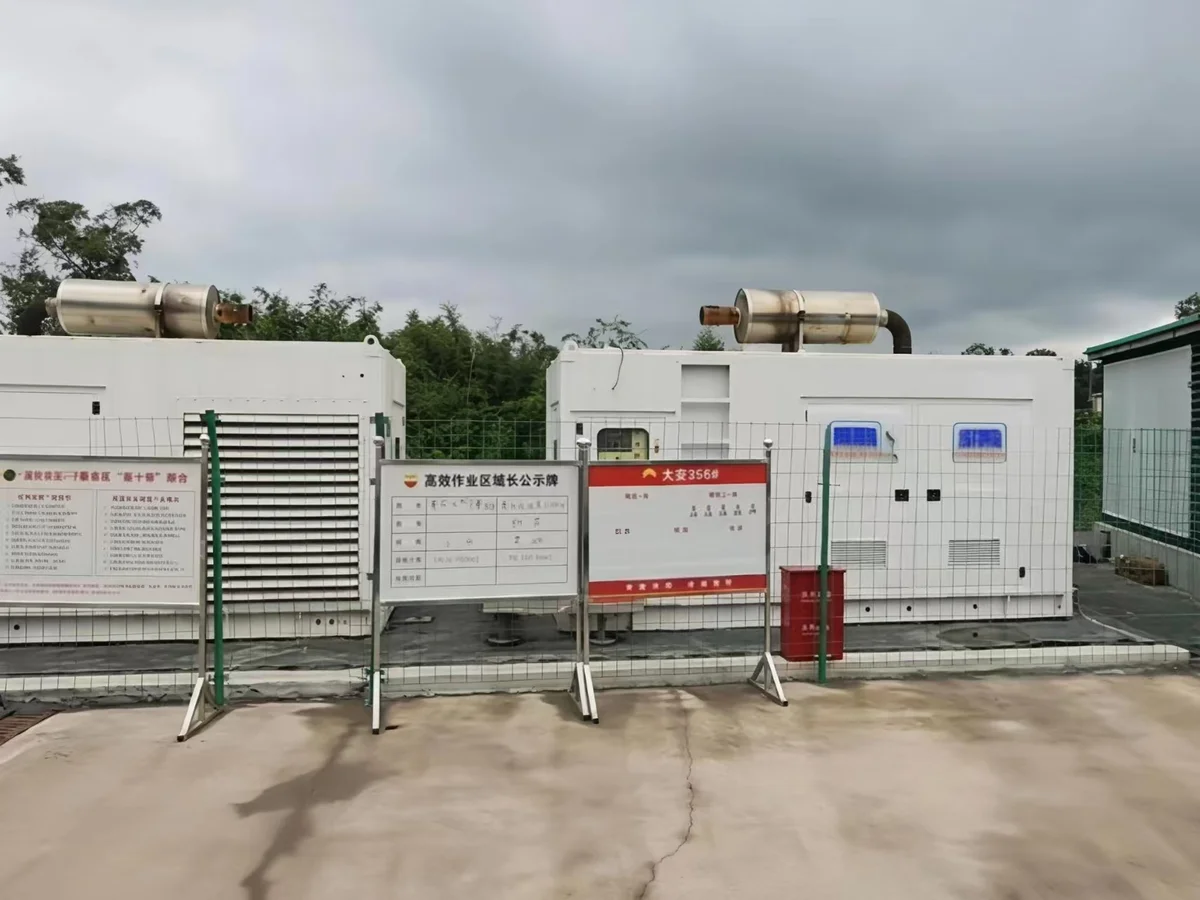
The policy case only holds if the hardware holds. Jingtao’s gas-to-power fleet has been running across the full operating envelope:
| Deployment | Condition | Evidence |
|---|---|---|
| Volgograd, Russia | Extreme cold, remote site | 10,000+ operating hours since 2024 |
| Yulin, Shaanxi (Sinopec) | 6,000 ppm H2S | Desulfurization train, stable operation |
| Sichuan / Chongqing | Shale gas, 42°C ground temperature | High-temperature cooling engineering |
| China-wide fleet | -30°C to +42°C | All-climate validation |
| Fleet record | Unattended field operation | 35,000 hours without major overhaul; structure intact after 4–5 years outdoors |
The spread matters because policy economics are only as real as uptime. A generator down for maintenance is a flare that came back. The 35,000-hour no-major-overhaul record and the 4–5-year outdoor structure life are the two figures Jingtao leads with on every proposal — they are the two numbers a field trial either confirms or kills.
Field economics from an actual Middle East deployment are documented in the associated gas power case study.
The Full Economic Model: With Policy Priced In
Stack the ledgers side by side for the same 100,000 m³/day well. Fully utilizing that volume means roughly 10 MW of generation — about 10,000 m³/day per MW at typical associated-gas BTU — deployed as a modular containerized cluster. Operators can start with a single 1 MW unit and scale modules as gas capture expands; the ledger below assumes full utilization. Containerized CHP installed CAPEX is on the order of $600K per MW — roughly one-third the cost of conventional gas power — so the math below uses conservative, publicly comparable figures.
| Line item | Keep flaring | CHP, 10 MW modular (fully utilizes the 100,000 m³/day) |
|---|---|---|
| Flaring penalty (Nigeria basis) | ~$4.5M / yr | $0 — gas fully utilized |
| Carbon levy on combustion | Payable, zero output | Payable, but produces power + heat |
| Electricity value @ $0.10/kWh | $0 | ~$8.2M / yr |
| Recovered heat value | $0 | ~$1.8M / yr (conservative) |
| Diesel replacement upside | — | Up to $2M+ / yr at remote diesel prices |
| Net annual position | Negative every year | Positive year one; payback under 12 months |
When the penalty is priced in, the payback question disappears. The decision becomes: how fast can we get a container on the pad. Orders ship in weeks, and the unit is skid-mounted — if the field depletes, the generator moves to the next pad instead of being stranded.
Methane Fees Price the Leak, Not Just the Burn
A carbon tax prices the CO₂ that leaves the stack. A methane fee prices the gas that never makes it to the stack — what vents or leaks before combustion. Methane carries roughly 28–84 times the 100-year warming potential of CO₂, so regulators treat it as a separate line item.
The US Waste Emissions Charge is the cleanest example: $1,500 per tonne of methane — about $54 per tonne of CO₂-equivalent — with implementation delayed to 2034 by P.L. 119-2 [6]. It prices methane that is vented or leaked, which is exactly the failure mode of a flare with poor combustion or an unmaintained site. Gas-to-power does not remove the meter — it removes the leak: gas that reaches a generator is combusted and metered, and compliance becomes a maintenance discipline instead of a legal argument.
Three Trends Converging in 2026
Why now, and not next year?
- Policy acceleration — the US ban is already in force, Canada repriced its trajectory in May 2026, and European lawmakers are considering a flaring tax [8]. The direction of travel is one-way.
- Contractual commitments — multilateral banks now require flare-reduction commitments for oil and gas project financing, and high-flare operators are screened out of ESG capital.
- Rising alternative costs — diesel prices and diesel carbon levies move together. Remote power gets more expensive on both axes, which shortens CHP payback every year.
Flaring is moving from an environmental footnote to a priced line item in the P&L. Operators who capture the gas first are the ones who stop paying the line item.
Four Questions for Your Operations Team
Walk into the next operations meeting with four questions:
- What do we flare per day? — 30-day average from separator gas meters, not the peak or trough.
- What does our jurisdiction charge for burning it today — and in 2030? — carbon tax, flaring penalty, or outright ban. All three are on the table somewhere.
- What does our delivered power actually cost? — diesel rental all-in: fuel, trucking, maintenance.
- Is the well new or existing? — the US ban applies to new wells; existing wells sit on phase-out paths that differ by jurisdiction. The answer decides whether you are racing a deadline or pricing a trajectory.
The World Bank’s flaring regulations database tracks rates and bans jurisdiction by jurisdiction [7] — if your team does not have the number for your operating area, it is one lookup away.
If the flared volume is meaningful and the answer to question 2 or 3 is a real number, the CHP case builds itself.
People Also Ask
Does flaring have a carbon tax?
In several jurisdictions, yes. Norway levies NOK 944 per tonne of CO2 on petroleum combustion, and Canada’s federal carbon price sits at C$95 per tonne in 2026 [2][3]. Nigeria instead fines flaring at $3.50 per thousand cubic feet, and the US EPA now bans routine flaring at new wells outright [1][7].
How much CO2 does flaring 100,000 m³/day produce?
About 71,500 tonnes per year. Methane-dominated associated gas releases roughly 1.96 kg of CO2 per cubic meter burned; at 100,000 m³/day, that is 36.5 million m³ per year.
What is the EPA flaring ban?
The EPA OOOOb/c rule phases out routine flaring of associated gas at new US oil wells effective May 7, 2026. Limited exemptions were clarified in April 2026, but the default for new wells is: capture the gas or do not produce [1].
How much is the flaring penalty in Nigeria?
US$3.50 per thousand cubic feet, raised from $2.00 in 2025. At 100,000 m³/day of flared gas, that is roughly $4.5 million per year [7].
Frequently Asked Questions
Is flared gas taxed the same as gas burned for power generation?
A carbon levy on combustion applies to both — the tax follows the CO2, not the equipment. The difference is output: a flare produces nothing while a CHP unit produces electricity and heat from the same combustion. Flaring penalties and bans, by contrast, target the flare itself and do not apply to gas utilized for power [1][7].
What is the difference between a carbon tax and a methane fee?
A carbon tax prices CO2 emissions from combustion. A methane fee prices methane that is vented or leaked before combustion — methane has roughly 28–84 times the 100-year warming potential of CO2. The US Waste Emissions Charge is set at $1,500 per tonne of methane (≈$54 per tCO2e) and is scheduled to begin in 2034 after a two-year delay [6].
Can a CHP unit burn sour associated gas with high H2S?
Yes, with pretreatment. Jingtao has operated on wellhead gas with 6,000 ppm H2S using a desulfurization train; the standard handbook limit is 200 mg/Nm³ (about 200 ppm), and anything above that is handled upstream of the engine. Send the gas composition report and the pathway is specified before any commitment.
What is the minimum gas volume for CHP to make sense?
A standalone 200 kW unit needs roughly 2,000 m³/day of gas at 85% capacity factor. As a rule of thumb, 10,000 m³/day of standard associated gas (600–1,200 BTU/scf) supports about 1 MW of electrical output. Below 2,000 m³/day, gas-to-power still works but the economics are thinner. Above 100,000 m³/day, the case is driven less by electricity value and more by the penalty or tax that disappears — at that volume the flaring penalty alone runs into millions of dollars per year.
How fast can a unit be deployed?
Containerized units ship in weeks and commission in days, not months. The container integrates gas conditioning, generation, and heat recovery, so site work is a concrete pad and a gas line connection. Units are skid-mounted and redeployable to the next pad when a field depletes.
Does gas-to-power count toward Zero Routine Flaring commitments?
Yes. The World Bank’s Zero Routine Flaring by 2030 initiative (30+ governments) counts gas utilized for power as a compliant destination, and multilateral lenders now require flare-reduction commitments for project financing. Gas that reaches a generator is not flared [7].
————————————————————————————————————————
Turn a Regulated Liability into a Power Asset
Send your gas composition report (CH4, H2S, C4+, water, pressure, flow) and we will tell you which engine package fits, how much derating is needed, and what the economics look like with your local carbon price included.
→ Request a Quote — gas analysis review and economic model within 48 hours.
→ JTF Series Associated Gas Generators — 80 kW to 1,000 kW units, containerized, CE / CSA / EAC certified.
→ Middle East Associated Gas Case Study — field results from an actual deployment.
Speak directly with an engineer: [email protected] | WhatsApp on request.
References
- US EPA — EPA Clarifies When Oil and Natural Gas Producers Can Flare After Phase-Out Deadline: https://www.epa.gov/newsreleases/epa-clarifies-when-oil-and-natural-gas-producers-can-flare-after-phase-out-deadline
- Norwegian Petroleum — Emissions to Air (carbon tax rates): https://www.norskpetroleum.no/en/environment-and-technology/emissions-to-air
- ICAP / Canada.ca — Canada publishes new carbon price trajectory (May 2026): https://icapcarbonaction.com/en/news/canada-publishes-new-carbon-price-trajectory
- Clean Air Task Force — Flaring Accountability: https://www.catf.us/resource/flaring-accountability
- EDF — The Hidden Price Tag of Flaring (2026): https://blogs.edf.org/markets/2026/03/10/the-hidden-price-tag-of-flaring-why-burning-off-natural-gas-costs-society-billions
- Congressional Research Service — Inflation Reduction Act Methane Emissions Charge: https://www.everycrsreport.com/reports/R48906.html
- World Bank — Global Gas Flaring Reduction (GGFR) regulatory summary: https://flaringventingregulations.worldbank.org/summary-report
- Columbia University Center on Global Energy Policy — A Flaring Tax Can End This Wasteful and Damaging Practice: https://www.energypolicy.columbia.edu/publications/flaring-tax-can-end-wasteful-and-damaging-practice
Need help choosing the right equipment?
Our engineers review your application and recommend the best fit — no obligation.