
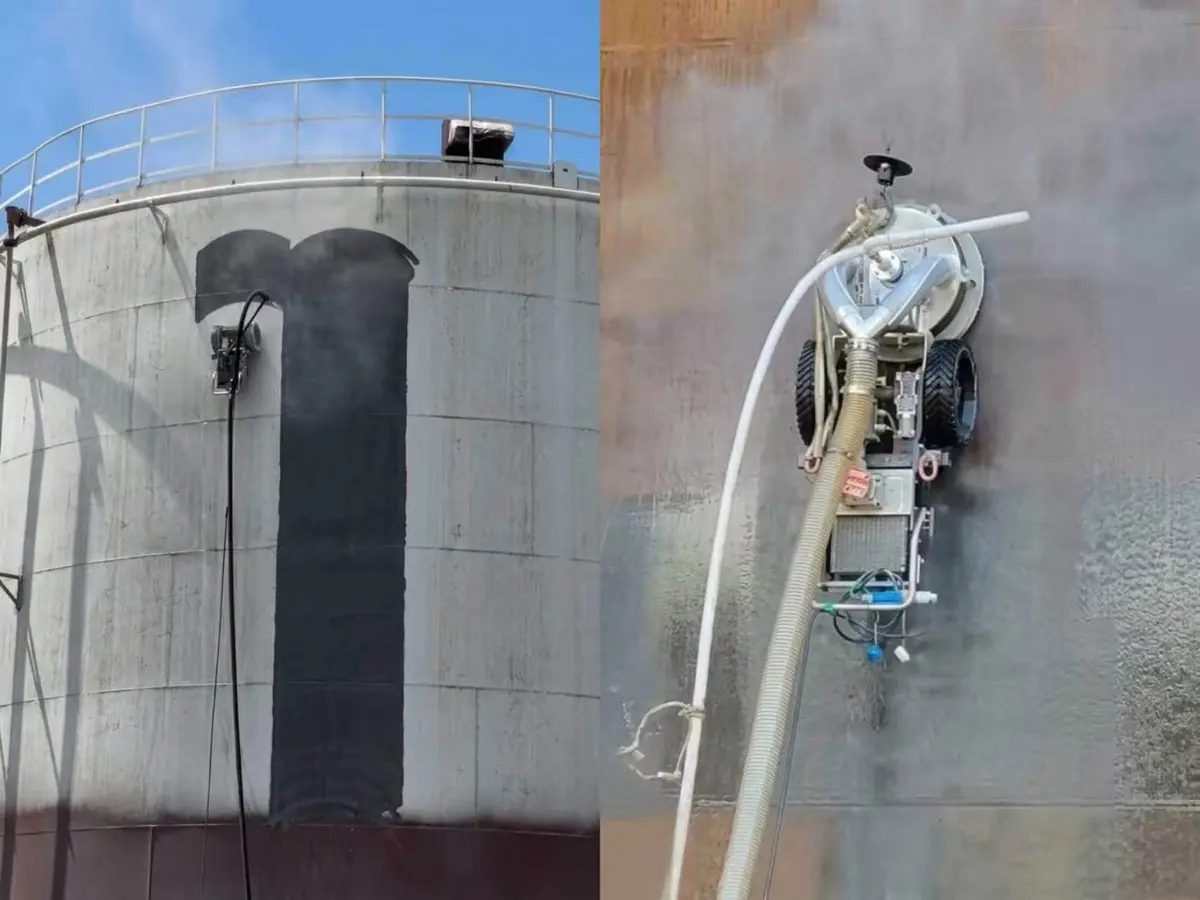
Enclosed Robotic Sandblasting for Barges: How to Get In, Blast the Hold, and Pass Inspection
Ask anyone who has blasted a barge cargo hold what went wrong, and the answer is rarely the blasting. It is the access, the air, the abrasive that had to come back up in bags, or a surveyor’s torch finding a stripe of intact paint at the far end of the tank top.
A cargo hold is a steel box with the light taken out of it. It has frames, brackets, hopper slopes, ladder rungs and a tank top that catches everything you drop. A wall-climbing robot does not change any of that. What it changes is who is standing inside while the work happens, and that is the only honest reason it belongs in the conversation.
This article is about the operating problem, not the machine. If you have decided to blast a hold and you are working out how a climbing robot fits into access, air, abrasive handling and acceptance, the four steps below are the order we would work in. If you have not decided to blast at all, read the acceptance section first — a fair share of hold work should never be blasted.
What Enclosed Actually Changes
On a tank exterior the constraints are mechanical: adhesion, wind, reach. Inside a hold they are all of that plus the atmosphere. Five things change at once, and each one adds a cost line that never appears on a blasting quote written for open steel.
| Constraint | What it does inside a hold | What it demands |
|---|---|---|
| Ventilation | Abrasive dust accumulates in a closed volume with no natural exchange | Forced ventilation sized on the hold volume, plus continuous monitoring |
| Recovery | Grit cannot be swept aside; it lands and stays where it lands | Closed blast head with vacuum recovery and bagging at deck level |
| Hose run | The compressor stays on deck while the nozzle works ten to twenty metres below | Pressure budget for the drop, and a hose that does not pull the chassis off the wall |
| Geometry | Framing, brackets and hopper slopes break every flat plane | Short passes, frequent re-orientation, and hand work on the edges |
| Acceptance | The surveyor reads the whole hold, not a sample panel | Measured coverage, profile and salt, not a visual pass from the hatch |
The hose is the detail most often missed in the office. A deck-mounted compressor feeding a nozzle fifteen metres down a hold puts twenty to thirty metres of blast hose behind the machine, and pressure loss runs at roughly 0.1 MPa for every twenty metres of hose. That is pressure you never see on the compressor gauge, and on a thick coating it is the difference between two passes and three.
The second thing that changes is the clock. On open steel a crew can spread out. Inside a box you are limited by how many people can work without getting in each other’s way, how fast the air can be exchanged, and how quickly grit can be moved out through a hatch that was never designed for it.
Step 1: Access — The Opening Decides the Machine
Start with the clear diameter of the smallest opening you intend to use. The standard chassis we supply for this work, the JT-1 Miniature, is built around a 600 mm manhole: the body measures 750 × 450 × 550 mm and weighs 60 kg, and it passes that opening in two parts — chassis first, then the one-metre arm module, with a change-over that takes about 30 minutes once a crew has done it twice.
Thirty minutes is the number to plan on, not the number to be surprised by. If reaching a corner means pulling the arm, moving the chassis and re-fitting, the access budget is really a count of how many times per shift you intend to do that. Holds with heavy internal framing turn that count quickly.
Bulk carrier cargo holds are usually the easy case. The hatch cover comes off and you have an opening measured in metres, so access is not the constraint — staging and air are. The awkward spaces are the wing tanks and ballast tanks around them, where the only way in is the manhole and the internal structure gives you no straight line to the far corner. Those are the compartments where a machine earning its place has less to do with blast rate and more to do with whether it can be carried through by two people.
| Access question | What to measure | Why it decides the machine |
|---|---|---|
| Manhole or opening | Clear diameter in millimetres | Below 600 mm the standard chassis does not go in |
| Deck footprint | Space for compressor, recovery unit and grit | No footprint means no air and no job |
| Drop to tank top | Metres from deck to the lowest steel | Sets hose length and the pressure lost in it |
| Framing spacing | Distance between frames and brackets | Passes shorter than the working width waste shift time |
| Bilge radius | Radius at the turn of the bilge | Tight radii force re-orientation or a smaller chassis |
| Lifting points | Rated capacity and reach | A 60 kg chassis and a 120 kg heavy chassis are different lifts |
Where the coating has failed across a large flat area and access is generous, the heavier chassis earns its place: the JT-2 large four-wheel-drive wall-climbing robot carries 150 kg nominal, 200 kg in our own measurements, clears a 10 cm obstacle and runs a one-metre arm. It needs curvature of about 3 m diameter to sit flat, and it must not be used for painting — the wheels run directly on the coating. In a hold that means blasting with the heavy chassis and following with the smaller one for the coat.
For the access envelope, arm geometry and module change-over on the chassis most hold jobs specify, see the JT-1 Miniature wall-climbing robot page — the dimensional drawing matters more than the specification table at this stage.
Step 2: Air — The Compressor Sets the Programme
The robot has never been the bottleneck. Our own documentation says it plainly: the machine outruns the back end. A chassis that walks at up to 15 m/min cannot help a blast pot delivering air for a nozzle two sizes smaller. On a hold job the compressor is the pacing item, and the second pacing item is the air exchange in the compartment.
A hold is a confined space under any definition used in the industry, and every jurisdiction treats entry accordingly. UK guidance from the Health and Safety Executive sets out the sequence: avoid entry where the work can be done another way, assess the space, control the hazards, and only then permit entry [3]. In practice that means a gas test before anyone goes in, continuous monitoring while anyone is inside, a rescue arrangement that can actually reach the tank top, and an attendant at the access point whose only job is that access point. None of it disappears because a machine is doing the work. What changes is who is exposed, not whether the space is hazardous.
Dust is the second half of the air problem. Abrasive blasting generates dust at the nozzle, and in a closed hold the dust has nowhere to go. Forced ventilation is the first control and extraction at the blast head is the second, but the third is the one sites forget: everyone at the hatch is breathing the same air as the people who are not inside. Where the abrasive contains crystalline silica, exposure limits apply at the access point too, not only at the nozzle.
Electrical load is the least of it. The chassis draws 1.8 kW on a 220 V supply; the compressor and the recovery unit are what the site has to find room and power for. Plan the deck layout before you plan the blast pattern, because a compressor that has to be re-sited after the first shift is a shift you paid for twice.
Step 3: Abrasive — Where It Goes, and Why That Sets the Shift
Do not plan the shift on a supplier’s consumption figure. Weigh the pot empty, blast a measured 20 m² panel, weigh it again, and you have your own kilograms per square metre for that abrasive, that pressure and that coating. It costs half a shift and it decides how many bags you carry down the deck, how many you carry back up, and how many you order.
Recovery is the price of working inside a box. With a closed blast head and vacuum recovery, throughput roughly halves: work that runs at 20 to 30 m²/h open drops to around 10 m²/h once the grit is being captured. Anyone who quotes hold productivity using open-blast rates is quoting a different job.
The waste route is a commercial question before it is an environmental one. Spent abrasive and coating residue are waste: they are bagged at deck level and landed, and nothing goes overboard. Wash water from hold preparation is governed separately by the cargo-residue rules under MARPOL Annex V, which is why the discharge port’s reading of those rules shapes the cleaning plan before the vessel arrives [1]. A yard with no licensed receiver for spent grit will stop the job faster than any technical problem.
Where the hold only needs to be washed rather than blasted, high-pressure water is far quicker: the same chassis with a cleaning head runs at 300 m²/h. That is roughly thirty times the enclosed blast rate, which is the clearest argument for deciding the process before deciding the machine.
Step 4: Surface — The Standard You Are Actually Being Asked to Hit
This is where most blasting proposals are wrong before the first tonne of grit arrives. Hold cleanliness standards are set by the charter party for the next cargo, and they are washing standards, not surface-preparation standards. Confusing the two is how a project ends up blasting a hold that only needed washing.
The three standards below are the ones marine insurers and surveyors work to, and the wording is theirs [1]. Read the middle column as the requirement and the right-hand column as the only question that matters to us.
| Hold standard | What it requires | What blasting contributes |
|---|---|---|
| Normal cleaned | Residues removed, hold swept twice, seawater wash, fresh-water rinse, then dried | Nothing. This is a wash-down job. |
| Grain clean / high cleanliness | No previous cargo residues or transferable stains, no loose rust scale, no loose paint flakes or blisters, dry, no odour and no infestation | Local touch-up where the coating has failed. Washing does the rest. |
| Hospital clean / stringent | Grain clean plus fully intact paintwork on every hold and hatch-cover surface, including the tank top, fixtures and fittings | Coating renewal: blast back to steel, re-coat, cure. This is the job a robot is built for. |
Where the steel is being re-coated, the specification normally names a preparation grade. Sa 2½ under ISO 8501-1 is the common one, and it is worth understanding what that standard actually is: a set of written descriptions and reference photographs for visual comparison, not a number a gauge can print. Two people can look at the same plate and disagree, which is why the reference photographs exist.
Two other checks travel with the grade. Soluble salt contamination is measured separately under the ISO 8502 family and is the usual reason a surface that looked perfect blistered six months later. Dry film thickness after coating, and the dew-point margin during application, decide whether the job survives its first cargo. Neither of those is a robot question, but both are reasons a hold gets rejected after the machine has gone home.
The Throughput Arithmetic, With Your Numbers
Take the hold area off the general arrangement drawing and run the arithmetic in the open. The rates below come from our own chassis documentation, and they are the conservative ones — they describe what the machine does when the back end can keep up with it.
| Operation | Rate | Machine-hours per 1,000 m² |
|---|---|---|
| Abrasive blasting, sound coating under 200 µm | 20–30 m²/h | 33–50 hours |
| Abrasive blasting, failed coating 400–500 µm | 10–15 m²/h | 67–100 hours |
| Blasting with closed-head recovery | about 10 m²/h | about 100 hours |
| High-pressure water cleaning | 300 m²/h | about 3.3 hours |
| Air-assisted paint application | 200–300 m²/h | 3.3–5 hours |
Then apply the shift factor every site knows and no brochure prints. A ten-hour shift inside a hold yields about six productive hours once dress-out, ventilation set-up, abrasive changes and the surveyor’s stops are taken out. At 20 to 30 m²/h, every 1,000 m² is six to eight shifts. With full recovery on a failed coating, the same area is closer to seventeen. That gap — six against seventeen — is the number that decides whether the work is planned as a campaign or as a patch.
Published day coverage for the same chassis sits at 150 to 300 m²/day, which is consistent with the rates above only when a crew gets eight to ten productive hours rather than six. When a supplier quotes a day figure outside that envelope, the useful question is not whether the machine is better — it is what recovery arrangement and what coating condition they assumed.
When Water Jetting Is the Better Process
Dry blasting is not always permitted, and on some holds it is not sensible. Adjacent compartments holding cargo, terminal rules on visible emissions, and coating systems that cannot take a profile all push the job toward water. The process comparison itself belongs in an earlier decision than this one — we wrote it up separately in dry blasting versus wet water jetting, and it is the right place to start if the process is still open.
Inside a closed compartment, water has its own access problem: the water has to be contained and it has to leave with its contamination accounted for. The ultra-high-pressure variant of the same platform runs at 280 MPa, reaches Sa 2.5 with no abrasive and no dust, and covers 200 to 250 m² in a working day, with 18 hours of continuous operation and a 15 m/s wind limit. The surface it leaves is cleaner in the environmental sense and different in the physical sense — roughness is lower, which affects adhesion for some coating systems. The JT-1-S high-pressure water jetting platform carries the detail, including the containment question that decides whether the process is available to you at all.
Explosion Protection: What the Certificate Covers
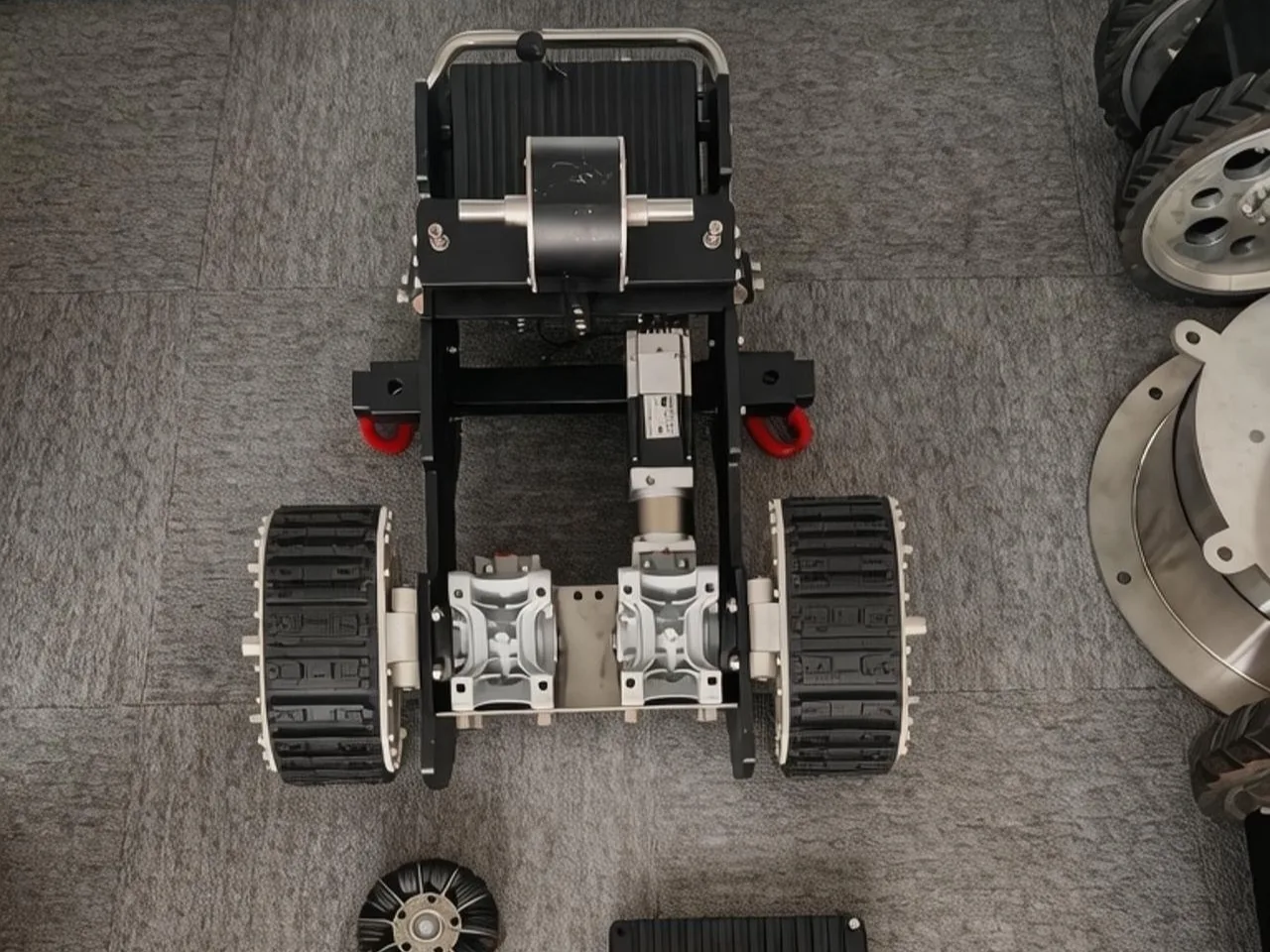
The chassis we supply on the explosion-proof build carries a Chinese national certificate: number ZJEx23.0915, marking Ex db ib IIB T4 Gb, issued against GB/T 3836.1-2021, GB/T 3836.2-2021 and GB/T 3836.4-2021, rated 220 V and 1.8 kW, valid to 10 July 2028, with a CNAS test report under accreditation L0116 and ILAC-MRA mutual recognition. It was issued in July 2023.
It is not an ATEX certificate and not an IECEx certificate. That distinction matters at the permit desk rather than in the brochure. If a terminal’s or a yard’s permit system names ATEX or IECEx as the entry condition, a national GB certificate will not satisfy it, and mutual-recognition language does not change what the permit says on the page. Ask that question at the RFQ stage, not after the compressor is on the quay. The explosion-proof certification guide sets out how the two systems differ and what to ask for.
One thing the certificate does not do is make a hold safe. Where a compartment has carried a flammable cargo, gas freeing, entry testing and the permit are the terminal’s and the vessel’s responsibility regardless of what is driving the blast nozzle.
Where a Climbing Robot Is the Wrong Tool
A framework that never says no is a sales document. These are the conditions that should end the conversation early, before anyone prices a mobilisation.
The hold only needs to be grain clean. Washing and drying does that at a fraction of the effort. Blasting is a coating-renewal tool, not a cleaning tool.
The steel is not ferrous. Magnetic adhesion needs steel; aluminium, stainless cladding and composite-lined structures are out of scope.
Nothing 600 mm wide reaches the work. If every access is smaller than that, the standard chassis does not go in, and no amount of planning changes it.
The bilge radius is tight. The base chassis turns inside roughly 2 m of diameter; the heavy blast chassis needs about 3 m of curvature to sit flat.
There is no deck space for a compressor and a recovery unit, or no crane to land them.
There is no licensed disposal route for spent abrasive. Bagging grit on a quay with nowhere to send it is how projects get stopped halfway.
The coating is sound but dirty. A fresh-water wash and a solvent wipe beat a blast on time, cost and coating life.
What to Put in the RFQ
Most hold budgets go wrong at the RFQ, not at the machine. These eight items decide the answer, and each one changes either the chassis, the crew or the programme.
| Item | Why it changes the answer | Format |
|---|---|---|
| Hold general arrangement drawing | Sets area, framing pattern and bilge radius | |
| Opening dimensions | Applies the 600 mm access rule before anything else | Millimetres, with tolerance |
| Coating system and condition | Decides blast rate, profile and number of passes | Microns, plus the system sheet |
| Acceptance standard | Separates a wash job from a coating renewal | Charter party clause |
| Deck power and air | Sizes the compressor, which sets the programme | kVA, MPa, m³/min |
| Disposal route | Chooses recovery type and the waste plan | Local licensing requirement |
| Certification requirement | GB or ATEX or IECEx, per the permit condition | Permit entry condition |
| Required completion date | Sets crew count and shift pattern | Date, with the survey window |
If the budget question is the live one, the honest framing is already published: seven factors that decide what a wall-climbing robot costs breaks the number into adhesion, process module, geometry, certification, module count, support kit and daily coverage, and explains why two quotes for the same hold can differ by a factor. If the equipment selection is still open across blasting, water jetting and coating, the tank maintenance equipment selection guide is the better starting point.
Field Evidence, and What It Does Not Prove
Our published field data comes from tank interiors, not from barge holds. The access problem is the same and the dust problem is the same, but we are not going to present a tank as a hold. Two references are worth reading if you want to see the same machine class in a closed compartment: the dual-function sandblasting and painting project in Hainan ran blast and coat on one platform, and the Singapore refinery confined-space work is the closest thing we have published to the access conditions inside a hold. Neither is a barge. If a barge hold reference is a requirement of your tender, say so early and we will tell you honestly what exists.
Technical Data Sheet
| Parameter | Value |
|---|---|
| Chassis (standard hold build) | 750 × 450 × 550 mm, 60 kg |
| Access opening | 600 mm manhole, body and arm pass separately |
| Magnetic adhesion, rated | 2,500 N |
| Blast reaction vs adhesion | Peak reaction about 8 kgf at 8 kg/cm², margin above 25:1 |
| Blast rate, sound coating under 200 µm | 20–30 m²/h |
| Blast rate, failed coating 400–500 µm | 10–15 m²/h |
| Blast rate with closed-head recovery | about 10 m²/h |
| High-pressure cleaning rate | 300 m²/h |
| Paint application rate | 200–300 m²/h |
| Daily coverage, combined operations | 150–300 m²/day |
| Remote control / cable | 200 m remote, about 50 m cable |
| Explosion protection | GB Ex db ib IIB T4 Gb, certificate ZJEx23.0915, valid to 2028-07-10 |
Figures come from the documentation supplied with our wall-climbing chassis range and from running hours accumulated in the field since 2020. Blast rate is a function of the air supply behind the machine, not of the machine alone; treat every rate above as a ceiling set by the compressor and the recovery arrangement.
People Also Ask
Can a robot blast the inside of a barge cargo hold?
Yes, with two conditions. The opening has to be at least 600 mm for the standard chassis, and the steel has to be ferrous so the magnets can hold. A chassis with a one-metre arm passes a 600 mm manhole in two parts, which is how most ballast and wing tanks are reached.
How long does it take to blast one hold?
Work from area, not from a headline rate. At 20 to 30 m²/h, every 1,000 m² of hold surface is 33 to 50 machine-hours; on a failed coating at 10 to 15 m²/h it is 67 to 100, and with full recovery closer to 100. With six productive hours in a ten-hour shift, that is six to eight shifts at best and about seventeen at worst.
Does the hold have to be gas-free before the robot goes in?
Yes. The presence of a machine does not change the classification of the space. Gas freeing, testing and the entry permit remain with the vessel and the terminal, and an attendant stays at the access point for the duration.
Can the machine reach Sa 2½?
Abrasive blasting on this class of chassis is specified for Sa 2½ under ISO 8501-1, which is a visual comparison against reference photographs rather than a measured value. The grade you can hold depends on air pressure at the nozzle, abrasive choice and how many passes the nozzle makes over the same strip — which is why hose length matters on a deep hold.
Frequently Asked Questions
Can a wall-climbing robot work inside a cargo hold?
It can, and the constraint is access rather than the machine. The standard chassis measures 750 × 450 × 550 mm at 60 kg and passes a 600 mm manhole in two parts — body first, then the one-metre arm module, with a change-over of about 30 minutes. Bulk carrier holds opened at the hatch are easier than tanks; the hard cases are the wing and ballast tanks where the manhole is the only way in.
What size opening does the robot need?
600 mm clear diameter for the standard chassis. That is the number the design was built around, and it applies to the smallest dimension of the path, not just the manhole itself — internal framing and pipe runs can narrow a route that starts at 600 mm. If every access is smaller than that, this class of machine does not go in.
How long does it take to blast a barge hold?
Run the arithmetic on your own area. At 20 to 30 m²/h a 1,000 m² hold is 33 to 50 machine-hours; at 10 to 15 m²/h on a failed 400 to 500 µm coating it is 67 to 100 hours; with closed-head recovery it is about 100 hours. A ten-hour shift yields roughly six productive hours inside a hold, so plan six to eight shifts for the easy case and about seventeen for the hard one.
Why does recovery cut the blast rate in half?
Because the grit has to be captured, separated and moved out at the same time as blasting. With a closed head and vacuum recovery, throughput that runs at 20 to 30 m²/h open drops to around 10 m²/h. That is the cost of not filling a closed compartment with dust, and it should be in the plan from the beginning rather than discovered in week two.
Do I need a permit to work in the hold while the robot is running?
Yes. A cargo hold is a confined space and the entry rules do not relax because the work is mechanised. Expect a gas test before entry, continuous monitoring, a rescue arrangement that reaches the tank top, and an attendant at the access point. UK HSE guidance sets out the same sequence of avoid, assess, control, permit; other jurisdictions phrase it differently but rarely disagree on substance.
Is the robot ATEX or IECEx certified?
Neither. The explosion-proof build carries a Chinese national certificate, ZJEx23.0915, marking Ex db ib IIB T4 Gb under GB/T 3836.1-2021, GB/T 3836.2-2021 and GB/T 3836.4-2021, rated 220 V and 1.8 kW, valid to 10 July 2028, with a CNAS report under L0116 and ILAC-MRA recognition. If your permit system requires ATEX or IECEx, that needs to be raised at RFQ stage because the certificate itself will not satisfy the condition.
What happens to the spent abrasive and the dust?
They are recovered, bagged at deck level and landed. Nothing goes overboard. Wash water from hold preparation is a separate matter governed by cargo-residue rules under MARPOL Annex V, which is why the discharge port’s interpretation shapes the plan. Before award, confirm that a licensed receiver will take the spent grit — a yard with no disposal route stops the job faster than any technical fault.
Can the robot be used on aluminium or stainless holds?
No. Adhesion is magnetic, so the structure has to be ferrous. Aluminium, stainless cladding and composite-lined compartments are outside the working envelope, and so are any surfaces where the magnets would mark a finish that has to stay intact.
Should a hold be blasted to reach grain clean?
Usually not. Grain clean is a washing standard: no residues, no transferable stains, no loose rust scale or paint flakes, dry and free of odour. Blasting belongs at the next level up, hospital clean, which requires fully intact paintwork on every surface including the tank top. That is a coating renewal job, and it is the only hold standard where a robotic blast is the cheaper route rather than the more expensive one.
Next Step: Send the Hold Drawing, Not the Brochure
A hold general arrangement drawing with the opening dimensions tells us more in one page than a specification sheet tells us in ten. Send that and the charter party cleanliness clause, and we will come back with the chassis, the recovery arrangement and a shift count for the compartment.
→ Request a Quote — send the hold drawing, the coating system and the acceptance standard for a scoped assessment.
→ Download Brochure — dimensional drawings, module list and the rate table behind the figures used here.
→ Talk to an engineer — if the access is unusual or the coating system is unknown, that conversation is shorter than the quotation.
References
[1] West of England P&I Club. Cargo Hold Cleaning — loss prevention bulletin, including hold cleanliness standards and MARPOL Annex V cargo residue context. https://www.westpandi.com/news-and-resources/loss-prevention-bulletins/cargo-hold-cleaning
[2] Skuld. Guidance on Preparing Cargo Holds and Loading of Solid Bulk Cargoes. https://www.skuld.com/contentassets/e2d486e683a84d7582fa1b867d18f8ac/preparing-cargo-holds_-loading-solid-bulk-cargoes.pdf
[3] Health and Safety Executive (UK). Confined spaces — guidance on assessment, control and permit to work. https://www.hse.gov.uk/confinedspace/
Need help choosing the right equipment?
Our engineers review your application and recommend the best fit — no obligation.