What Does a Power Catwalk Cost? 5 Key Factors
You are a drilling superintendent handed a budget decision: the rig’s catwalk is 20 years old, the hydraulic hoses leak in winter, and the crew manually racks pipe every trip. Your procurement manager asks the obvious question — “how much does a power catwalk cost?” — and hits the same wall everyone hits. No manufacturer publishes a price list. Not because they are hiding something, but because a catwalk is engineered around your rig, not off a shelf.
This guide breaks down the five factors that actually set catwalk pricing, so you can compare quotes on engineering grounds instead of guessing. It is the same framework we use when we quote a rig — no numbers game, just the specs that move the number.
Why Catwalk Pricing Looks Opaque
Walk any drilling equipment exhibition and you will find power catwalks from a dozen manufacturers — and zero price tags. The reason is structural, not secretive. A catwalk is a custom-engineering product: the deck height of your rig, the tubulars you run, the automation level your operator wants, and the certification your contract demands all change the machine. Two catwalks that look alike in a brochure can differ in build cost by a wide margin because one carries a bigger structure, a VFD drive train, and an explosion-proof control package.
The wrong question is “what does a power catwalk cost?”. The right question is “what configuration does my rig actually need?” — and that is what the five factors below answer. Each factor maps to a spec you can verify, not a marketing claim.
The 5 Factors That Set the Price
1. Rig Height and Drill Floor Configuration
Rig height is the single biggest cost driver, because it decides the size of the structure, the hoist winch, and the transport package. Catwalks are built in five tiers matched to drill floor heights — from small land rigs around 7.5–8 m up to extra-large installations at 13.76–14 m. A taller deck means a longer incline, a bigger winch drum, and more steel in the base and skid.
Payload capacity is common across the tiers — 45 kN maximum conveying load — with pipe handling for Φ73–139.7 mm (2⅞–5⅞ in) drill pipe, three joints per cycle, and clearance for 24 in casing and 11 in drill collars. If your rig is at 12 m and someone quotes you a 7.5 m machine, the cycle-time and safety margins will not hold. Measure the deck height first; it filters half the market instantly.
The engineering chain behind that spread is straightforward. A taller deck means a longer incline structure, a bigger winch drum and cable, and heavier base steel — and it moves the machine into a different transport class. The incline top connects to the rig’s setback area through a pin joint sized to match the original ramp, and the base carries four hydraulic outrigger legs, a folding transport configuration, and a reserved mounting position for a 5-tonne pneumatic winch. In other words: the height tier sets the whole bill of materials, not just one dimension. When you compare quotes, confirm the tier first and everything else second — a quote that does not state its tier is not a quote, it is a placeholder.
2. Drive Technology: Electric vs Hydraulic
The drive train is the second cost driver, and it is where the industry is moving. Hydraulic catwalks — the traditional design — use a pump skid and cylinders to raise and feed pipe. Electric catwalks use VFD-controlled winches driven by explosion-proof motors, with encoder-based positioning for precise stops. The two differ in purchase structure and, more importantly, in lifetime cost.
An electric drive eliminates the hydraulic power unit entirely: no oil, no filters, no hose wear, no cold-weather viscosity problems. VFD control matches motor torque to the load, which cuts energy consumption versus a pump that idles all shift. In cold basins, a hydraulic machine needs warm-up time before it moves pipe; an electric machine does not. For a rig that runs year-round in freezing winters, that difference shows up on the fuel bill and the maintenance log — the deep comparison is in our electric vs hydraulic guide.
The control system is where electric earns its keep operationally. A VFD catwalk’s control cabinet runs a Siemens PLC with a touchscreen that shows live current, voltage, hydraulic pressure, oil temperature, speed and position on one display; the machine is commanded three ways — wireless remote, local panel, or integration into the driller’s cabin — over shielded control cables with explosion-proof quick connectors. That single-screen visibility is what a maintenance superintendent actually lives with for ten years. The drive train itself is a matched set: twin 37 kW VFD winch motors plus an 11 kW traverse motor on ABB drives, each with its own short-circuit, overload and phase-loss protection. When a supplier quotes “electric”, ask for the drive architecture — the difference between a matched VFD package and a bolted-on motor is the difference between ten years of smooth operation and ten years of fault codes.
See how the two drives compare on energy, maintenance and cold-weather operation: VFD vs Hydraulic Catwalk — Electric Drive Guide
3. Automation and Control Level
Automation is where price rises with capability — and where you buy back crew hours. A basic machine moves pipe on manual command. A fully automated catwalk does one-key tripping: push a button and it picks up, conveys, and racks three stands without a person on the incline. Control options typically run three ways: wireless remote (about 50 m range), a local panel, and integration into the driller’s cabin.
For contractors running the numbers on drill-floor headcount, automated pipe handling is not a convenience — it is the documented direction of the industry. IADC’s Drilling Contractor has reported on rigs designed around a “hands-off” philosophy where automated pipe handling removes people from the drill floor during tripping [¹]. The pipe-handling chain is one of the most accident-dense sequences on a rig: manual tongs, slips and pipe racking put crew directly in the load path on every trip, and a deep well repeats that exposure hundreds of times. Automation does not just speed the cycle — it takes the crew out of the load path entirely, which is why rig owners pay for the control package rather than treat it as an option. Every automation step you add changes the control package, the sensors and the commissioning scope — and it changes the quote.
4. Certification and Safety Configuration
The safety and certification package is non-negotiable cost — and the fastest way to disqualify a cheap quote. On a drilling rig, the catwalk’s electrical and control enclosures sit in a classified area, so explosion-proof ratings matter. A field-grade machine carries Ex d IIB T4-rated power, PLC and terminal cabinets, plus a wireless remote certified for the same zone.
Safety functions add engineering, not just stickers: dual electrical protection plus mechanical limit stops, automatic shutoff if the winch sees over-torque (protecting the wire rope), and an emergency powered descent that returns the catwalk to its horizontal rest position on power loss. Auto-latching stops prevent pipe from rolling off the incline. When a supplier’s quote skips these, the price gap is usually the safety gap.
The certification thread runs the whole way through the electrical system: the frequency converters, the PLC cabinet, the terminal boxes and the remote all carry the same explosion-proof class, and the interconnects use multi-core shielded cables with explosion-proof quick connectors so the drill-floor section can be broken out safely. Ask for the certificate numbers, not the word “certified”. A machine built for a non-classified environment can look identical in a brochure and be entirely different in a tender review.
5. Logistics, Installation and Commissioning
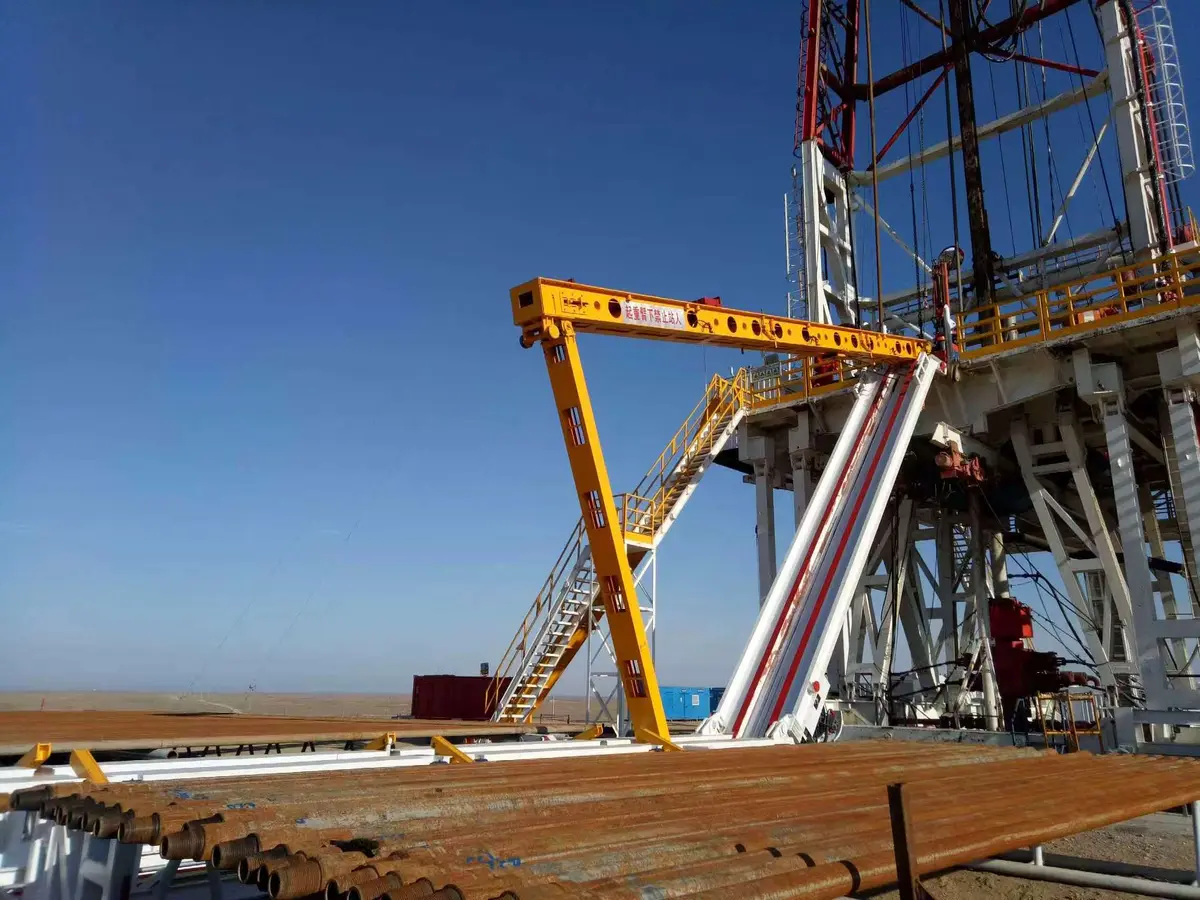
A catwalk is a 30-tonne machine that has to reach your rig site. Transport configuration splits into two families: one-piece transport (16.8–17.5 m overall length) for rigs with road access, and split-body transport (under 12.5 m per section) for mountain, desert, or logistics-constrained locations. The control house ships as a separate unit with explosion-proof quick connectors.
Installation and commissioning scope is part of the price conversation too: craneage, alignment to the rig’s setback area, driller-cabin integration, and operator training all carry cost that shows up in the quote or shows up later as change orders. Ask for the commissioning scope in writing — it is the factor buyers most often discover after signing.
| Tier | Rig Height | Max Pipe Length | Cycle Time | Transport Length |
|---|---|---|---|---|
| Small | 7.5–8 m | 13.5 m | <80 s | 16.8 m |
| Mid-small | 9.5–10 m | 13.5 m | <90 s | 16.8 m |
| Medium | 10.5–11 m | 13.5 m | <100 s | 17.5 m |
| Large | 12–12.5 m | 13.5 m | <115 s | 17.5 m |
| Extra-large | 13.76–14 m | 13.5 m | <130 s | 17.5 m |
How the Factors Stack Up: Electric vs Hydraulic
| Dimension | Electric (VFD) | Hydraulic |
|---|---|---|
| Energy use | Lower — VFD matches motor torque to load | Higher — pump idles across the shift |
| Cold-weather operation | Unaffected by ambient temperature | Fluid viscosity requires warm-up |
| Noise on location | Lower (motor + gearbox) | Higher (pump skid) |
| Control precision | Encoder-based positioning | Displacement-sensor speed control |
| Maintenance burden | Fewer fluid components | Oil, seals, filters, hose wear |
| Crew footprint | One-key tripping, no incline personnel | Manual oversight of hydraulic functions |
For a first-pass comparison, here is how the two drive families behave across the dimensions that matter over a machine’s working life. Qualitative, because the right answer depends on your basin and your crew:
Neither is universally “cheaper” — but the two cost curves cross over time. The electric machine typically carries a different purchase structure (no hydraulic power unit) and a lower operating curve; the hydraulic machine is the traditional, well-understood baseline. Our selection guide walks through the decision on engineering terms.
On the record deployment — Team 90008’s 8,882 m well, the deepest onshore well in Asia — the catwalk ran in electric configuration for the full operation. The choice was not aesthetic: at that depth every trip is hours long, and a drive that behaves the same in freezing winters and desert summers removes one variable from the critical path. That is the field argument for electric that no brochure photo can make. The crew’s operational record from that well — the joint counts, the incident-free runs — is documented in the 8,882m ultra-deep pipe handling case study.
What Field Data Says
Pricing frameworks are only credible when the machine behind them has run real wells. The catwalk family behind this guide has been in service since 2014, when the first unit went to work on Shengli Oilfield’s 70108SL drilling team. The milestone that matters for buyers: in 2022, West Drilling took delivery of its first electric catwalk — and electric has been the default request since.
The reference case is Team 90008’s record well: 8,882 m, the deepest onshore well in Asia, with the catwalk handling pipe for the full run. Behind that single record sit 40+ catwalks deployed since 1999, 42 supply contracts logged between 2021 and 2025, and more than 60 units delivered to a single customer — Shengli Drilling Research Institute — between 2021 and 2025. Recent output runs about 30 units per year. When a manufacturer gives you field numbers like these, you can weigh their quote against something real:
8,882 m — Asia’s deepest onshore well, Team 90008, catwalk in continuous service
40+ catwalks deployed since 1999; ~30 units/year recent output
42 contracts (2021–2025); 60+ units to one drilling institute in five years
First unit 2014; first electric unit in West Drilling’s fleet 2022
The full field record behind that well is documented in the 8,882m ultra-deep pipe handling case study — 50,000+ joints, zero incidents.
The contract book shows the pattern behind those totals: electric units to Bohai Drilling’s Tarim and Bayan teams, hydraulic direct-drive units and racking arms to the Shengli Drilling Research Institute, and international-bound electric units through West Drilling’s export arm. The customer base is not one flagship account — it is a spread of drilling contractors who standardized on the machine after the first unit proved itself. When a manufacturer’s sales pitch leans on a single showcase project, ask what the repeat rate looks like. Repeat customers are the pricing signal that marketing cannot fake.
How to Read a Catwalk Quote
A catwalk quotation should read like an engineering proposal, not a one-line price. Five line items should be explicit — and they map exactly to the five factors above:
Structure: deck-height tier, incline length, base and outrigger configuration, transport mode (one-piece vs split-body)
Drive: electric VFD (motor ratings, drive brand, control architecture) or hydraulic (pump skid, cylinder sizes)
Control: remote / local panel / driller-cabin integration, and what the HMI shows
Safety & certification: explosion-proof class of every enclosure, protection functions, certificate numbers
Scope: delivery terms, installation and commissioning, operator training, spares policy
If a line item is missing, ask why before you ask the price. The difference between a complete quote and a skeleton quote is where change orders are born — and change orders are where budgets die. A supplier that cannot state its own tier, its own drive architecture and its own certificate numbers is quoting you a picture, not a machine.
A Buyer’s Framework: Five Questions to Ask
Skip the “what’s your best price” opening. Ask these five questions instead — the answers are what actually separate a fair quote from a cheap one:
1. Which deck-height tier does this quote match — and what is the rated cycle time at my rig height?
2. Electric or hydraulic — and what is the drive train’s energy draw at full load vs idle?
3. What is included in automation: manual, one-key tripping, or driller-cabin integration?
4. Are the electrical enclosures and remote Ex-rated for my zone (Ex d IIB T4 or equivalent)?
5. What exactly is in the logistics and commissioning scope — split-body transport, craneage, training?
A supplier that answers all five with specs and drawings is pricing engineering. A supplier that answers with a single round number is pricing hope.
Price vs Cost: The ROI Angle
The purchase price is one line in a ledger that runs 8–10 years. The operating cost is the other lines: energy, maintenance, crew time, and non-productive time when pipe handling slows a trip. On the record well at 8,882 m, the catwalk’s job was not to be the cheapest machine on location — it was to keep tripping safe and consistent through the deepest run in Asia. That is the ROI that matters: fewer people on the incline, fewer weather delays in winter, fewer hydraulic failures in the maintenance log.
On the maintenance side, the electric machine removes an entire consumable category: hydraulic oil, filters, seals and hose assemblies simply do not exist in the bill. VFD-matched power means the drive draws only what the load requires instead of keeping a pump at full pressure all shift. For a rig running multiple trips a week, those two lines alone shift the annual operating comparison between the drive families — which is why the decision framework in our electric vs hydraulic guide starts with energy and maintenance, not sticker price. The purchase number is negotiated once; the operating number is negotiated every month.
If you are weighing a retrofit against a new build, start with your deck height and your tubulars, then compare drive and automation on the five questions above. Send the resulting rig profile to us and we will quote against it — same-week, with a lead-time estimate. You will get a spec sheet, not a slogan.
Frequently Asked Questions
Q: How much does a power catwalk cost?
A catwalk is quoted to the rig, not off a price list. Five specs move the number: deck-height tier (7.5–8 m up to 13.76–14 m), drive type (electric VFD vs hydraulic), automation level (manual, one-key tripping, driller-cabin integration), certification (Ex d IIB T4 enclosures), and logistics/commissioning scope (one-piece vs split-body transport). Send your rig height and tubulars for a same-week quotation.
Q: What five factors determine catwalk price?
Rig height and drill floor configuration; drive technology (electric vs hydraulic); automation and control level; certification and safety configuration; and logistics, installation and commissioning. The first factor alone — deck height — filters most of the market, because a 13.76–14 m machine is a different structure from a 7.5–8 m one.
Q: Is an electric catwalk more expensive than a hydraulic one?
Electric and hydraulic machines differ in cost structure rather than a simple “cheaper” answer. Electric removes the hydraulic power unit (no oil, filters, hose wear), uses VFD-matched power, and works unchanged in cold weather — lower lifetime operating cost. Hydraulic is the traditional baseline with a deeper service history. The comparison table above shows where each wins.
Q: Will a power catwalk fit my existing rig?
Catwalks are built in five deck-height tiers from 7.5–8 m to 13.76–14 m, and the incline top connects to your rig’s setback area with a pin joint sized to match the original ramp. The machine conveys pipe up to 13.5 m and 45 kN. If your rig is an unusual height, the tier table tells you which family fits; a site survey settles the rest.
Q: What safety certifications should a pipe handling catwalk carry?
At minimum, explosion-proof rated electrical and control enclosures (Ex d IIB T4 class), dual electrical protection plus mechanical limit stops, over-torque shutdown on the winch, emergency powered descent on power loss, and auto-latching stops to prevent pipe roll-off. Certification scope should be in the quote, not discovered at commissioning.
Q: How fast can a power catwalk move pipe?
Cycle time depends on the deck-height tier: under 80 seconds for a small (7.5–8 m) machine up to under 130 seconds for an extra-large (13.76–14 m) unit, per three-joint stand of Φ73–139.7 mm pipe. Conveying capacity is 45 kN, clearing 24 in casing and 11 in drill collars.
Get the Specs for Your Rig
→ Request a Quote — send your rig specifications for a same-week quotation and lead time estimate.
→ Download Brochure — full technical specs, dimensional drawings, and cycle-time charts.
Speak directly with an engineer: [email protected] | WhatsApp on request.
Related: Power Catwalk Selection Guide · Powered Catwalk product page · 8,882m case study
[¹] Drilling Contractor (IADC), “Automated rig built to enable operator’s ‘hands off’ philosophy” — https://drillingcontractor.org/automated-rig-built-to-enable-operators-hands-off-philosophy-18366
Need help choosing the right equipment?
Our engineers review your application and recommend the best fit — no obligation.