
Hull Cleaning at the Quay vs Dry Docking: The Rules, the Costs, and How to Decide
By Jingtao Energy | Technical guide | 2026
A hull cleaning decision usually arrives disguised as a price question. One quotation is for cleaning the ship where she lies, alongside the quay. The other is a shipyard estimate for docking her. The two numbers land on the same desk and get compared, although they were never measuring the same thing. One buys a day or two of a service spread. The other buys a week of the ship's service life, a coating system, and a class survey window. Until three facts are settled — the fouling rating on the hull today, whether the local authority accepts cleaning in that area, and how much anti-fouling coating life is left — neither number means anything.
This article is about the decision, not the equipment. It sets out what cleaning at the quay actually is, when a port will refuse it, what each route really costs, and how to run the arithmetic on your own ship. It is written from the perspective of a supplier of the cleaning equipment, so read the section on what we have and have not done as carefully as the rest.
What "at berth" actually means
Cleaning at the quay means the ship stays where she is: alongside, moored, stationary, with cargo operations or port business proceeding around the work. The hull is worked by a remotely operated unit driven from the quay or from a small support boat, using rotating brush discs or water jets against the flat and curved areas it can reach. Nothing is lifted out of the water. No dock is booked. No coating is renewed.
Three conditions define the envelope, and all three are practical rather than technical.
The vessel must be stationary. Brush and jet tools are positioned against a hull that is not moving relative to the tool. A ship proceeding under her own power, or drifting at speed, is not a berth-cleaning job and should not be sold as one. Any provider who offers to clean while the ship is underway is describing a different machine, a different risk profile and a different regulatory conversation — and in most ports, a conversation that ends with "no".
The berth has to tolerate the work. Cleaning generates a plume. Ports increasingly require that the material removed is contained and collected rather than allowed to drift, and that the work happens inside an accepted area. That is a permission question, not an equipment question, and it is answered before mobilisation or not at all.
There has to be a working window. Alongside time is cargo time. A cleaning spread needs enough continuous hours at the same berth, or a berth the ship will return to, to finish a defined area rather than nibble at it. Turnaround pressure is the most common reason a planned clean becomes a partial clean.
The rule that decides most arguments: fouling rating
The 2023 IMO biofouling guidelines, adopted as resolution MEPC.378(80), introduced a fouling rating scale that ports and providers now use as the common vocabulary. It is a visual assessment of macrofouling coverage. It is not a coating-thickness measurement, and it does not tell you whether the anti-fouling system is still working — two things owners routinely assume it does.
| Rating | What the hull looks like | What the guidelines allow |
|---|---|---|
| 0 | No visible biofouling; clean hull | Proactive cleaning permitted |
| 1 | Microfouling only; painted surface visible | Proactive cleaning permitted |
| 2 | Light macrofouling patches | Conditional — depends on local acceptance and capture capability |
| 3 | Moderate macrofouling coverage | Conditional; capture normally required |
| 4 | Heavy macrofouling | Generally refused at berth; plan for docking |
| 5 | Very heavy fouling, slime and weed over large areas | Not a berth job |
The distinction the guidelines draw between proactive and reactive cleaning matters commercially. Proactive cleaning removes microfouling before hard growth establishes, and may be done with or without capture depending on local rules. Reactive cleaning removes established growth, and the guidelines expect capture, because the material being removed is exactly the material ports do not want released into the water column.
Where cleaning at the quay gets refused
Five situations turn a berth plan into a docking. Four of the five are decided by someone other than the shipowner.
No accepted area. The guidelines require cleaning to happen in an area accepted by the relevant authority, and they point operators to local rules on discharge and to sensitive areas such as marine protected areas. Some ports accept capture-capable cleaning under an approved provider scheme. Others accept proactive cleaning only at the lowest ratings. Others accept nothing without a specific permit. The written acceptance decides the job — not what worked in the last port.
Fouling too advanced. Once hard growth is established across the hull, the cleaning effort, the waste volume and the coating damage all rise together. At that point the honest answer is to bring the docking forward rather than spend money on a clean that changes nothing.
Coating at the end of its life. Cleaning a depleted anti-fouling system accelerates its failure. The guidelines state directly that cleaning may physically damage the coating and shorten its service life, which is why a reactive clean should use a method compatible with the coating installed. A coating already at the end of its life should not be cleaned; it should be replaced.
No waste route. If the port requires capture and the provider cannot contain and dispose of what comes off, the job does not exist, whatever the fouling rating says.
No time. A berth window too short to finish a defined area produces a partial clean, which is worse than none: it removes the evidence of fouling without removing the drag.
What cleaning at the quay actually costs
A berth clean is not a robot rental. It is a permitted service with a waste stream and a paper trail. The cost drivers that appear on real quotations look like this:
| Cost driver | What moves it |
|---|---|
| Permission and paperwork | Approved-provider scheme, permit application, port authority correspondence |
| Service spread | Unit, brush or jet tools, pump or power pack, hoses, control console, launch and recovery |
| Crew and supervision | Operators, supervisor, and a port-approved observer where required |
| Capture and disposal | Containment, filtration, waste handling and disposal receipts |
| Support boat and berth time | Boat hire, port dues, and the berth hours consumed by the work |
| Weather and visibility window | Days lost to current, visibility and wind; a real line item, not a contingency |
| Reporting | Pre- and post-clean records, area coverage, fouling rating, disposal documentation |
Two things are usually missing from a berth quotation and should be asked for explicitly: what area, in square metres, is being cleaned at that figure, and what happens to the material removed. A quotation without a measured area cannot be compared with anything.
What docking actually costs
The dock side has its own seven drivers, and they are the ones that make a "cheap" clean look expensive when the docking arrives early.
| Cost driver | Why it dominates |
|---|---|
| Yard and dock charges | Fixed cost of occupying a dock, independent of how much work is done |
| Off-hire days | The vessel earns nothing; on a chartered ship this is the largest single number |
| Coating system | Grit blasting, primer, intermediate and topcoat, with cure time between coats |
| Survey window | Class surveyor attendance, thickness measurement, and the surveys tied to the docking |
| Tugs, pilots, repositioning | Movement to and from the yard, and the fuel burned doing it |
| Work scope growth | Steel renewal and repairs found once the hull is accessible |
| Schedule risk | Yard delays that push the return-to-service date |
The eighth cost never appears on either quotation: the docking you brought forward, or the one you pushed back. A cleaning programme that costs money every quarter and does not change the docking date has bought nothing but a clean hull. A programme that moves a docking by months has bought the interval itself, and that is where the money is.
The arithmetic that decides it
Put both routes on one line and the decision stops being rhetorical:
Net advantage of cleaning at the quay = (dock days avoided × vessel day value) + (fuel and speed penalty avoided over the interval) − (cleaning spend across the interval + permission and compliance cost)
Three of those four terms are yours alone to fill in. Vessel day value is a charter rate or an internal opportunity cost. The fuel and speed penalty is a function of fouling severity and service speed, and it is the term most often estimated by feel rather than measured. Cleaning spend is what a provider quotes against a measured area. The only figure that cannot be estimated is the first one, and it is the largest.
A practical note on the fuel term: it is not linear in time. Fouling penalty grows with the interval, then jumps when hard growth establishes. That is why the same annual cleaning budget produces different results depending on whether the cleans are placed early in the fouling cycle or after the growth has set.
Where the Q180 fits, and where it does not
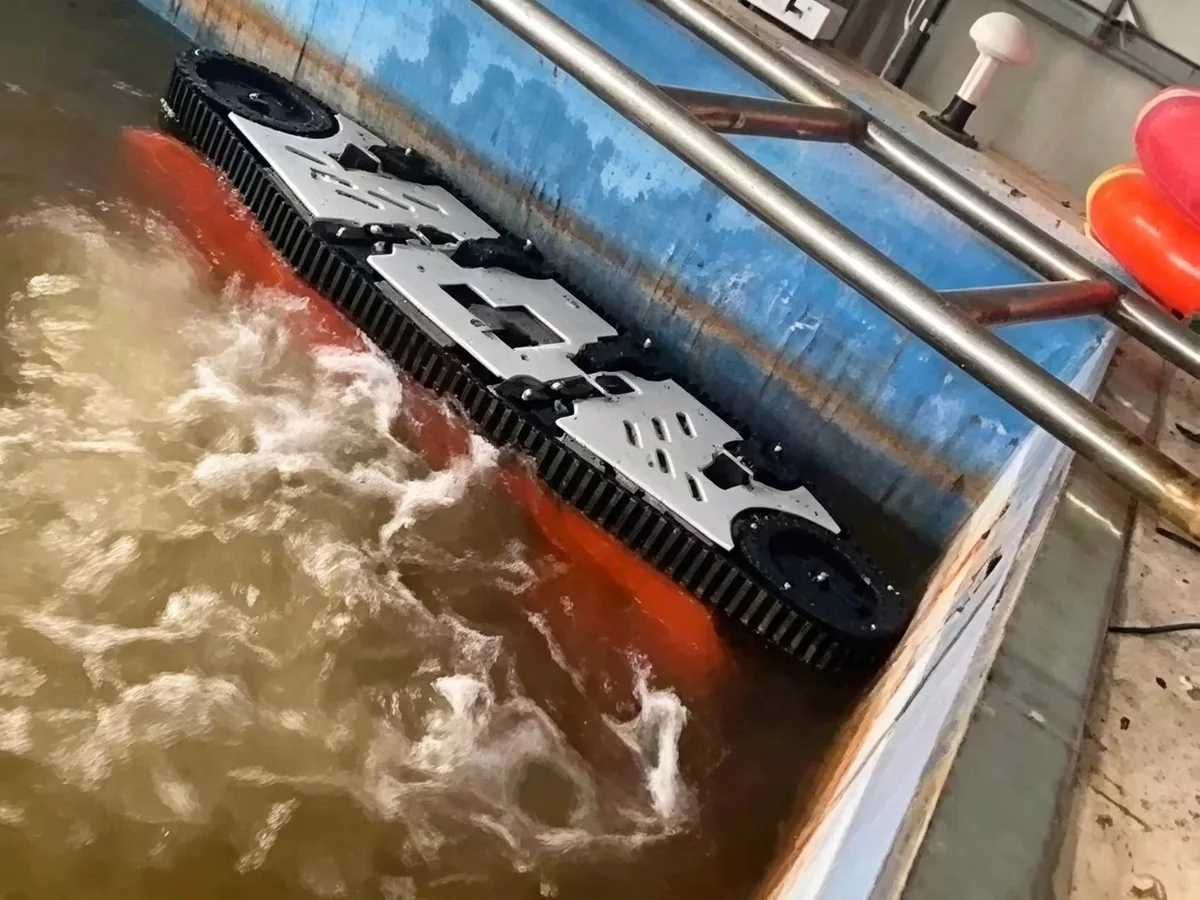
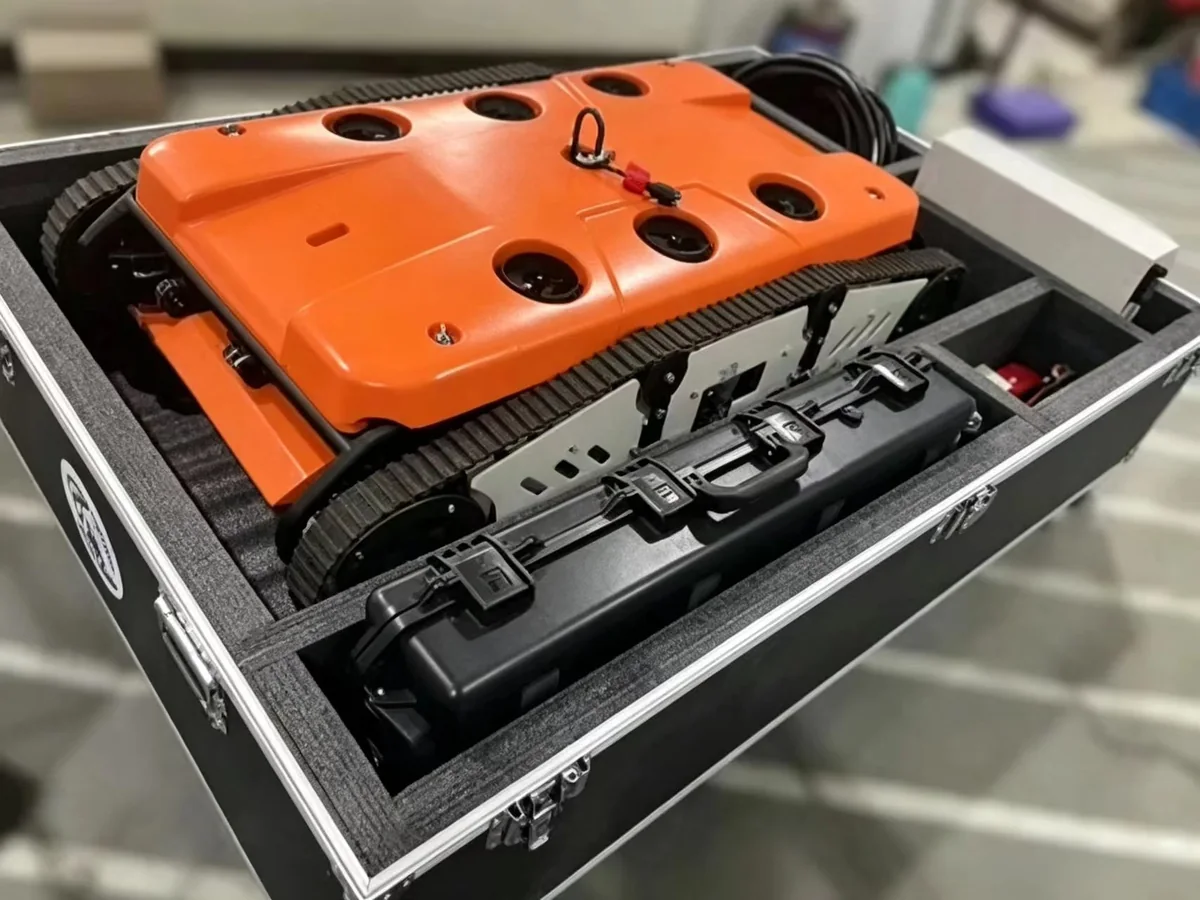
Our Q180 is a remotely operated unit carrying brush-disc tools, rated to 100 m and drawing about 9 kW. It is held against the working surface by its own thrusters, not by magnets. That one design choice decides where the machine can go: the surface does not have to be ferrous. Steel, aluminium, concrete, timber and coated plate all hold the same way, so the limits are flatness, access and fouling — not the material of the wall. It works on a hull that is alongside and stationary, and it is specified at 400–500 m²/h on a cleanable surface depending on fouling. Do the arithmetic honestly: at that rate a 2,000 m² wetted area is roughly four to five hours of contact time, and once launch, recovery, hose handling and repositioning are added it is a working day rather than a shift. Any quotation that implies a large hull is a single easy job has not planned the job.
The envelope is where it is. Flat and gently curved areas are straightforward. Heavy hard growth, deep pitting, sea chests, gratings, thruster tunnels and niche areas are not brush-disc work, and a berth clean that ignores niches has cleaned the part that photographs well and left the part that costs fuel.
We do not clean while a vessel is underway. Anyone who needs that has a different problem and needs a different machine.
If the decision is between methods rather than between cleaning and docking, our comparison of robot, manual and diver-based removal covers the trade-offs. If the question is what hull cleaning equipment itself should cost and why quotations differ, that is a separate framework.
What we have and have not done
We supply the equipment and support the service providers who operate it. We have not run a fleet-wide cleaning programme for a shipowner, and we will not describe one as if we had. If your decision needs a fleet reference, ask a provider who has one — and then ask them what area they measured, what capture arrangement the port accepted, and what the fouling rating was before and after.
Eight questions to put to any provider
- What area, in square metres, does this quotation cover — and how will it be verified?
- Which port acceptance do you hold for this berth, in writing?
- How is the removed material captured, and where does it go?
- What fouling rating did you record before the clean, and who recorded it?
- Which coating system is on this hull, and is your method compatible with it?
- What happens if the window closes halfway through?
- What documentation do we receive, and does it match the reporting the guidelines expect?
- What do you refuse to do? A provider with no refusals has not thought about this.
Frequently asked questions
Is hull cleaning at the berth allowed in every port?
No. Cleaning must happen in an area accepted by the relevant authority, and local rules govern discharge and sensitive areas. Some ports accept capture-capable cleaning under an approved provider scheme, some accept proactive cleaning only at low fouling ratings, and some accept nothing without a specific permit. Written acceptance, not a provider's record elsewhere, decides the job.
Can cleaning at the quay replace dry docking entirely?
No. Statutory and class rules require two bottom surveys in each five-year period, and an in-water survey may stand in for the docking associated with one of them, subject to conditions set by the class society — visibility, video record, surveyor attendance and often thickness measurement. That is a survey credit, not a coating renewal.
What fouling rating is too high for cleaning at the berth?
Rating 4 and above is generally refused. From rating 2 upward, acceptance depends on local rules and on whether the operation can capture what it removes. The rating is a visual assessment of coverage, not a coating assessment, so a hull at rating 1 on a failed coating is still a docking decision.
Does the vessel have to be stationary?
Yes. Brush and jet tools work against a hull that is not moving relative to the tool. Cleaning alongside at the quay, with the ship moored, is the standard case. Cleaning while the vessel is underway is a different machine, a different risk profile and, in most ports, a different answer.
How long does a clean take?
Work from contact time on a measured area. The Q180 is specified at 400–500 m²/h on a cleanable surface; a 2,000 m² wetted area is therefore four to five hours of contact time, plus launch, recovery, hose handling and repositioning. Weather, visibility and current can cost a day.
Does cleaning damage the anti-fouling coating?
It can. The guidelines state that cleaning may physically damage the coating and shorten its service life, which is why reactive cleaning should use a method compatible with the coating installed. The practical protections are a method matched to the coating, cleaning before macrofouling hardens, and a coating supplier asked in advance what cleaning frequency their warranty assumes.
What depth can the unit work at?
The Q180 is rated to 100 m, which covers alongside work on most commercial tonnage. That rating is a working envelope, not a survivability figure: rate, visibility and current all degrade with depth, and a deep job in poor visibility is a different proposition from a shallow one in clear water.
What documentation should we receive?
At minimum: the area cleaned, the pre- and post-clean fouling rating, coverage records, and the disposal documentation for the material removed. If the clean supports a survey credit, add the video record and the surveyor's attendance record. If a provider cannot produce these, the clean happened but the evidence did not.
Need help choosing the right equipment?
Our engineers review your application and recommend the best fit — no obligation.