Robotic Tank Cleaning in Nigeria: How the JT-1 Backed a Seplat Storage Bid
At a Glance
| Item | Detail |
|---|---|
| Buyer | Habrams Energy Services, Lagos — Nigerian oil & gas service/EPC contractor |
| End-user project | Seplat storage tank maintenance bid (Tank 1001 scope) |
| Equipment | JT-1 explosion-proof wall-climbing robot with cleaning module |
| Contract date | July 7, 2026 (MOU, conditional on Seplat award) |
| Route | EXW Dongying, China (Quotation JT-Q-2026-0706-HBS) |
| Status | Full bid submittal delivered; equipment purchase conditional on Seplat award |
This is a case about a bid — and about the equipment packet that made the bid credible. It is written from the manufacturer’s side, honestly: what is confirmed, and what is still pending.
The Challenge: Cleaning Tanks Without Letting People In
Storage tank maintenance is one of the most dangerous routine jobs in the oil and gas industry. Tanks are confined spaces: a worker entering a crude or fuel tank for cleaning faces toxic vapors, oxygen deficiency, and the physical awkwardness of working inside a steel shell with no natural light. In Nigeria, where storage capacity is expanding with midstream development, operators and their contractors are under pressure to find methods that keep people out of the tank — without losing the surface quality a coating job demands.
For a Nigerian EPC contractor bidding tank work, the challenge is double: win the technical argument with the operator, then prove the equipment behind the bid is real — certified, inspected, and deliverable. That second half is where most bids die.
The Real Problem: A Bid Packet, Not a Machine
The conventional story is “we sold a robot to a contractor.” The real story is that an EPC contractor bidding storage-tank work in Nigeria does not need a machine — it needs a submission packet that survives an operator’s technical review. When Habrams Energy Services prepared its bid around Seplat’s Tank 1001 storage scope, the questions from the operator side were not “is robotics a good idea?” but:
What is the robot’s explosion-proof rating, and under what standard was it certified?
What independent inspection evidence exists (not a brochure)?
Who trains the crew, and what does the training cover?
What is the manufacturer’s delivery record?
A manufacturer that answers those questions with documents — certificates, inspection reports, training plans, and a signed cooperation agreement — gives the contractor a bid packet that reads as engineering, not as a sales pitch. That was the actual deliverable in this project.
The Solution: JT-1 Plus a Complete Manufacturer Submittal
| JT-1 Key Specifications | Value |
|---|---|
| Manway entry | Ø60 cm |
| Robot weight | 60 kg |
| Adhesion | Permanent magnet, ~8 mm air gap, rubber wheels |
| Climbing surface | Steel tank walls (magnetic) |
| Remote control range | 200 m |
| Protection rating | IP67 |
| Explosion-proof | Ex db ib IIB T4 Gb (GB/T 3836.1/2/4-2021) |
| Cleaning rate | up to 300 m²/h with external high-pressure pump |
| Blasting rate | 20–30 m²/h (fresh coating <200 µm) |
| Module changeover | ~30 minutes |
| Platform first released | 2020 |
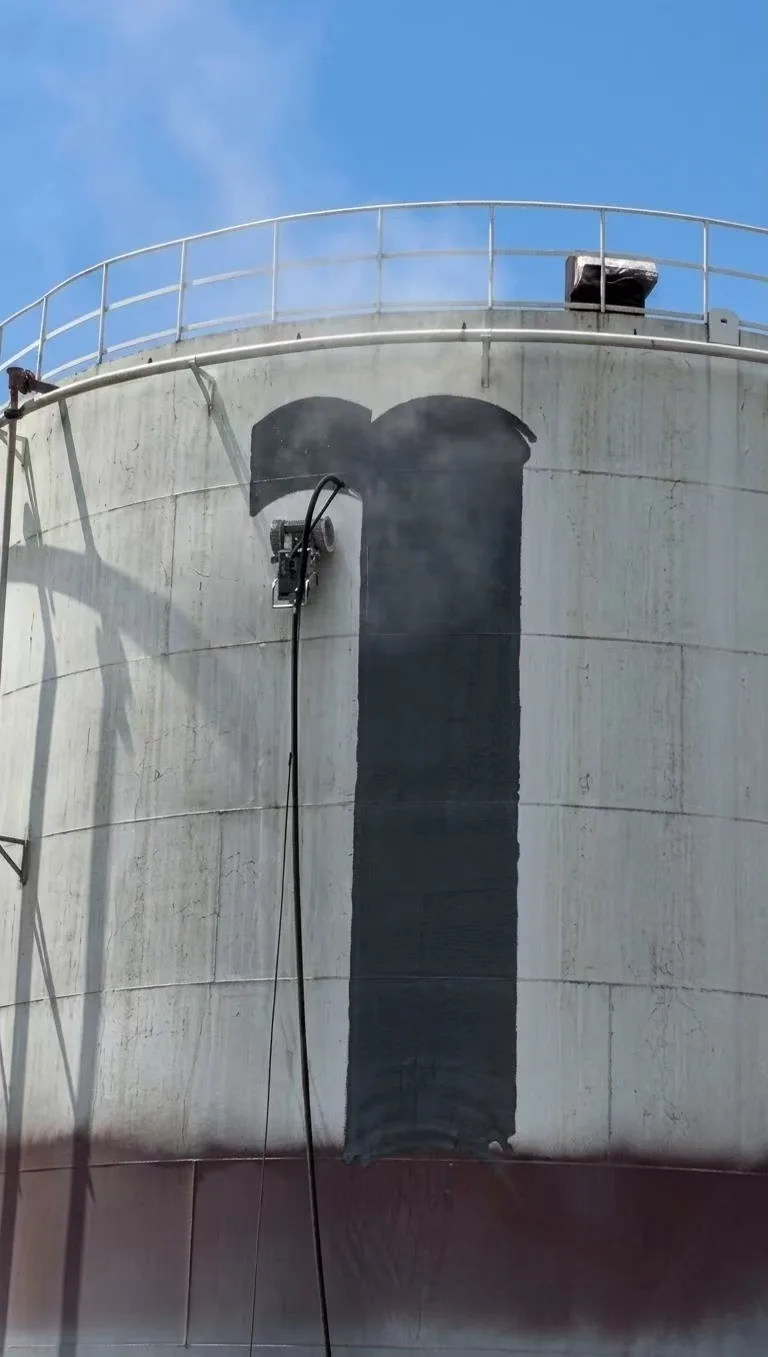
The JT-1 is a magnetic-adhesion wall-climbing robot built on a platform first released in 2020, with field iterations since. It climbs steel tank walls on permanent magnets held ~8 mm off the surface, so it moves on rubber wheels without grinding the coating. The robot enters tanks through a standard Ø60 cm manway, works on vertical and curved surfaces, and swaps between blasting and coating modules in about 30 minutes. On the cleaning side it runs with an external high-pressure pump at up to 300 m²/h; on the blasting side it does 20–30 m²/h on fresh coatings (under 200 µm) and 10–15 m²/h on heavy old coatings (400–500 µm); coating runs at up to 100 m²/h (air-assisted, as quoted for this scope).
The adhesion margin is worth stating in numbers: the magnet system holds roughly 200 kgf against the wall, while the maximum reaction force from the blasting nozzle is about 8 kg — a 25:1 safety factor, which is why the robot does not lift off or drift on vertical surfaces.
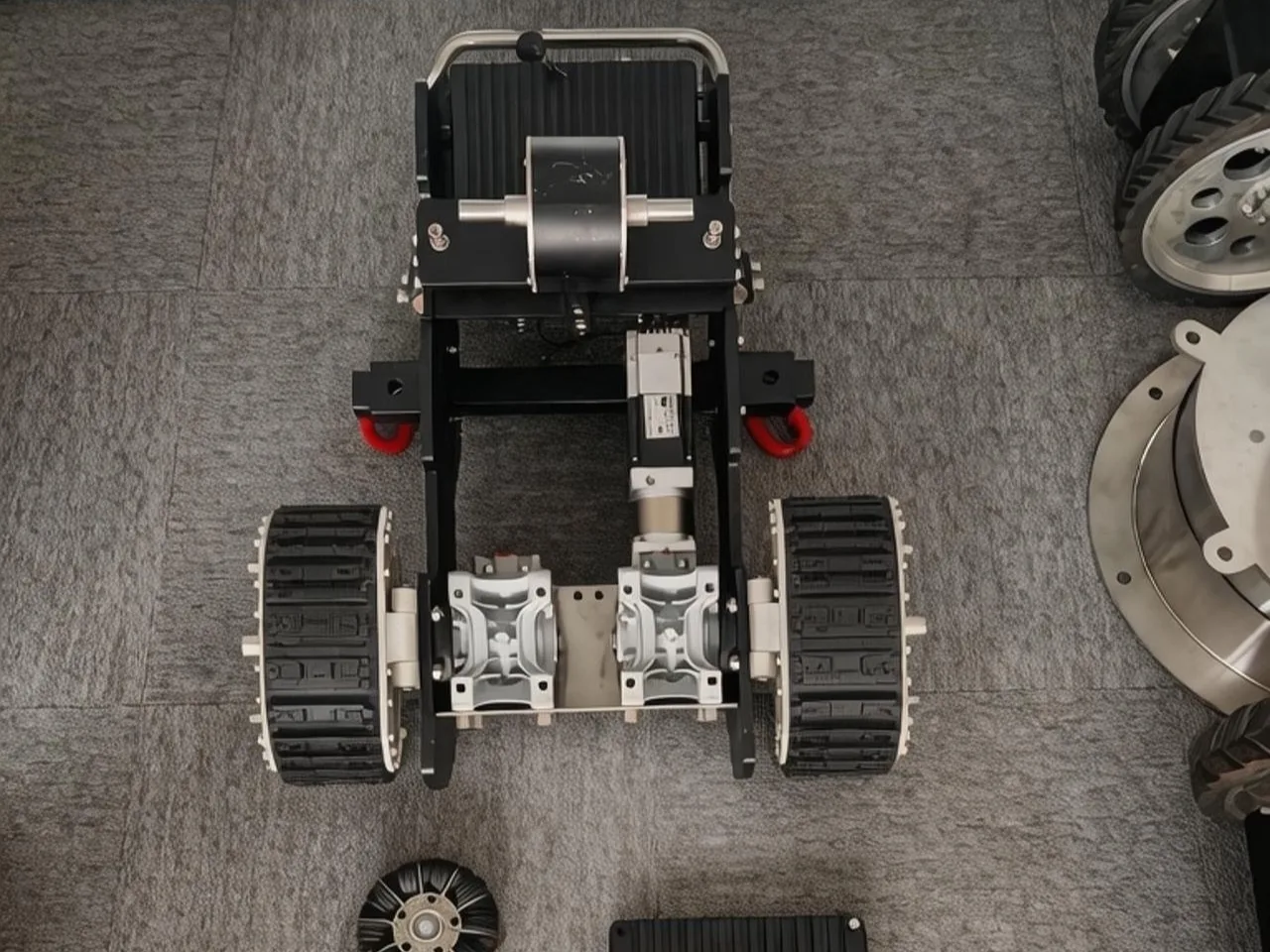
The explosion-proof rating covers the electrical system: Ex db ib IIB T4 Gb, certified to GB/T 3836.1/2/4-2021 under certificate ZJEx23.0915, with the inspection report backed by CNAS-accredited laboratory L0116 (ILAC-MRA recognized).
What went into the bid packet:
Equipment specification sheet and certificate of conformity
Explosion-proof certificate (English edition) and CNAS inspection report
Training plan for the contractor’s crew and a signed MOU covering the cooperation
Two factory demonstration videos of the robot in operation
One boundary was set deliberately: Jingtao supplied as equipment manufacturer. Site method statements, JSA and HSE plans are the EPC contractor’s scope — the manufacturer documents the machine, not the work at height. That line keeps the packet honest for the operator’s review.
Who Should Not Use This Robot
Not every tank is a candidate, and saying so is part of the engineering. The JT-1 is excluded or needs evaluation in these cases:
Manways smaller than Ø60 cm — the robot cannot be rigged through the opening
Non-steel tanks — magnetic adhesion requires a steel wall (concrete, FRP or lined tanks are out)
Ball tanks and complex geometries — curved shells need an on-site evaluation of the robot’s turning radius (diameter >2 m turns are fine; tighter geometry must be checked)
Coating-critical work with the blasting module on heavy multi-millimeter rust — blasting on very thick old coatings drops to 10–15 m²/h, which may not meet schedule economics
The screening questions — manway size, wall material, tank geometry, coating condition — should be answered before anyone writes a bid, not after the equipment lands on site.
What Is Confirmed, What Is Still Pending
| Confirmed | Pending |
|---|---|
| Signed MOU (July 7, 2026): one JT-1 with blasting and coating modules, purchase conditional on Seplat award; EXW Dongying per Quotation JT-Q-2026-0706-HBS | Seplat bid outcome — awaiting operator decision on the storage tank scope |
| Full manufacturer submittal delivered (specs, certificates, CNAS report, training plan, MOU, demo videos) | Field cleaning results at the tank site — not yet available for publication |
| Technical handover to Habrams’ engineering team and commercial follow-up on a separate tank-cleaning scope | Follow-on quotes — JT-2 blasting configuration and ZDSA dredging robot remain open, pending bid result |
Honesty clause. Here is exactly where this project stands:
We are not going to dress this up as a completed field campaign. The equipment is real, the certification is real, the commercial framework is signed — and the tank-site results will be published when the operator’s process allows. What this case demonstrates today is the part of the chain that is fully proven: a Chinese explosion-proof climbing robot, documented to the standard an African operator’s technical review expects, positioned with a local contractor through a signed cooperation agreement.
Why This Matters for Africa’s Storage Sector
Nigeria’s oil and gas industry operates under a local-content regime: the NOGICD Act 2010 and the Nigerian Content Development and Monitoring Board (NCDMB) push operators to build in-country capability [¹]. For tank maintenance, that creates a practical pipeline: the operator awards to a Nigerian contractor, the contractor brings equipment and method, and the equipment manufacturer documents the machine to international inspection standards. Robotics fits this structure cleanly — it is exportable capability that lands as local service capacity, with people kept out of confined spaces as a bonus.
For operators weighing confined-space entry against robotic methods, the economics line up the same way they did in the Singapore refinery application: the cost structure shifts from labor and scaffolding toward equipment and setup, and the headcount exposure in the tank drops toward zero. The Singapore refinery case shows the same robot family eliminating confined-space entry in a refinery context; the JT-2 Nigeria case shows the heavy-blasting variant already at work on the continent.
People Also Ask
How do you clean an oil storage tank without entry?
Magnetic wall-climbing robots clean from inside the tank without personnel entry: the robot enters through the manway, climbs the steel wall on permanent magnets, and runs cleaning or blasting modules under remote control from outside the tank.
Can explosion-proof robots work inside crude oil tanks?
Yes, where the robot carries a certified explosion-proof rating for the zone. The JT-1 is rated Ex db ib IIB T4 Gb to GB/T 3836.1/2/4-2021; operators should verify the specific zone classification of their tank against the certificate.
Does robotic tank cleaning cost more than manual cleaning?
The cost structure differs rather than simply being higher or lower: robotic cleaning shifts spend from scaffolding, personal protective equipment and confined-space standby crews toward the robot and high-pressure equipment — while removing the confined-space headcount. Quote against your tank’s specific scope.
Frequently Asked Questions
Q: Can wall-climbing robots clean storage tanks in Nigeria?
Yes. In July 2026 Jingtao signed an MOU with Lagos-based contractor Habrams Energy Services covering a JT-1 explosion-proof climbing robot for a Seplat storage tank scope. The robot enters through a Ø60 cm manway and works steel walls under magnetic adhesion with 200 m remote control.
Q: What explosion-proof certification does the JT-1 carry?
Ex db ib IIB T4 Gb, certified to GB/T 3836.1/2/4-2021 under certificate ZJEx23.0915, with the inspection report from CNAS-accredited laboratory L0116 (ILAC-MRA recognized). Note: this is a China national standard certification — operators requiring ATEX or IECEx equivalents should confirm in the tender stage, which is exactly what the submittal packet is for.
Q: What is the smallest manway the JT-1 can enter?
Ø60 cm. Tank manway sizing is the first screening question: below 60 cm the robot cannot be rigged through the opening, and the contractor should look at smaller equipment or a different method.
Q: Is the Seplat project completed?
No — and we will not pretend otherwise. The equipment, certification and export are complete; the Seplat bid outcome and tank-site results are pending the operator’s process and will be published when confirmed.
Q: How fast does the JT-1 clean and blast?
Cleaning runs up to 300 m²/h with an external high-pressure pump; blasting runs 20–30 m²/h on fresh coatings under 200 µm and 10–15 m²/h on heavy old coatings of 400–500 µm. Module changeover takes about 30 minutes.
Get the Specs for Your Rig
→ Request a Quote — send your rig specifications for a same-week quotation and lead time estimate.
→ Download Brochure — full technical specs, dimensional drawings, and cycle-time charts.
Speak directly with an engineer: [email protected] | WhatsApp on request.
Related: JT-1-Mini product page · Tank maintenance equipment selection guide · Dry blasting vs water jetting
[¹] Nigerian Content Development and Monitoring Board (NCDMB), established under the NOGICD Act 2010 — https://ncdmb.gov.ng