The Silent Killer of Horizontal Wells: Water Coning — How AICD Technology Keeps Every Meter of Lateral Producing Oil
- Horizontal wells lose 40-60% of their productive lateral length to premature water breakthrough within 12 months
- Jingtao’s AICD screen dropped water cut from 85% to <15% in a Bohai Bay 1,200m horizontal heavy oil well — zero electronics, zero moving parts
- Water handling costs fell 85% ($12,000 → $1,800/month), oil production rose 41% in 90 days
- Pure fluid-dynamic control: no intervention required, no downhole electronics to fail
The Horizontal Well Paradox
You drill 1,200 meters of lateral through the pay zone. Every meter should be producing oil. But within 6-12 months, half that lateral is flowing mostly water.
That’s the horizontal well paradox. The same geometry that maximizes reservoir contact also creates the perfect conditions for early water coning — especially in heavy oil, thin oil columns, or reservoirs with strong aquifer drive.
The physics is straightforward: the heel of the lateral sees lower drawdown than the toe. Water finds the path of least resistance, breaks through at the heel, and once it does, the pressure differential pulls more water into that zone while starving the rest of the lateral. The well doesn’t “water out” — it channels out, leaving 60% of the pay zone untouched.
Conventional fixes — cement squeezes, mechanical packers, chemical shutoffs — are expensive, temporary, and require intervention. Each workover means lost production days, rig costs, and the near-certainty that water will find another path within months.
The AICD Difference: Physics, Not Electronics
An Autonomous Inflow Control Device (AICD) uses fluid dynamics — not sensors, not motors, not batteries — to selectively choke water and gas while maintaining full oil flow.
Inside each AICD screen joint, a precisely machined flow path creates a pressure differential based on fluid properties:
- Oil (higher viscosity, lower Reynolds number): flows through with minimal restriction
- Water (lower viscosity, higher Reynolds number): hits a flow restriction that chokes production from that zone
- Gas (lowest viscosity): choked even more aggressively
The mechanism is purely mechanical. There are no downhole electronics to fail at 120°C. No control lines to the surface. No intervention to adjust settings. The device responds autonomously to the fluid arriving at its inlet — and it does this continuously, for years.
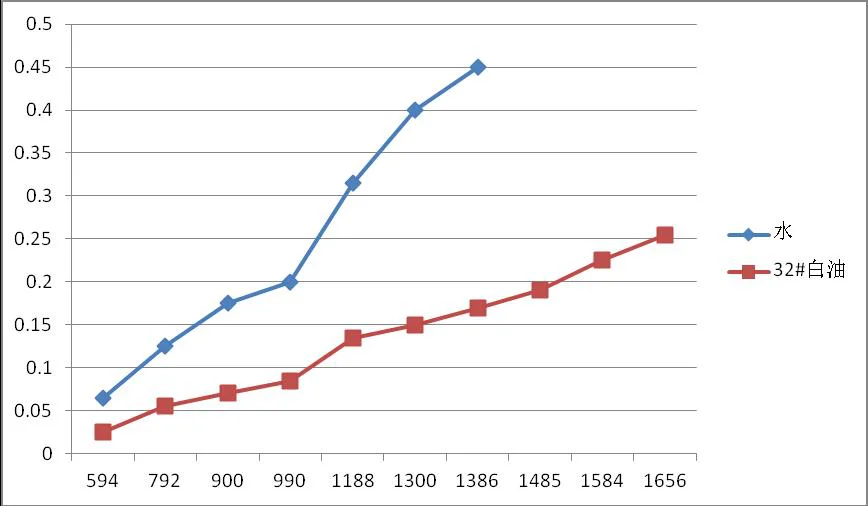
Laboratory flow test: Water (blue) generates sharply increasing pressure drop as flow rate rises — the autonomous choke mechanism in action. 32# white oil (red) maintains low resistance across the full flow range. This viscosity-driven differential response is the foundation of autonomous inflow control.
This fundamentally changes the completion philosophy. Instead of accepting that the heel will water out and drag the whole well down, you segment the lateral into 3-5 compartments with packer-delimited AICD screens. Each compartment produces independently. If the heel sees water, it chokes itself — while the middle and toe compartments keep flowing oil at full rate.
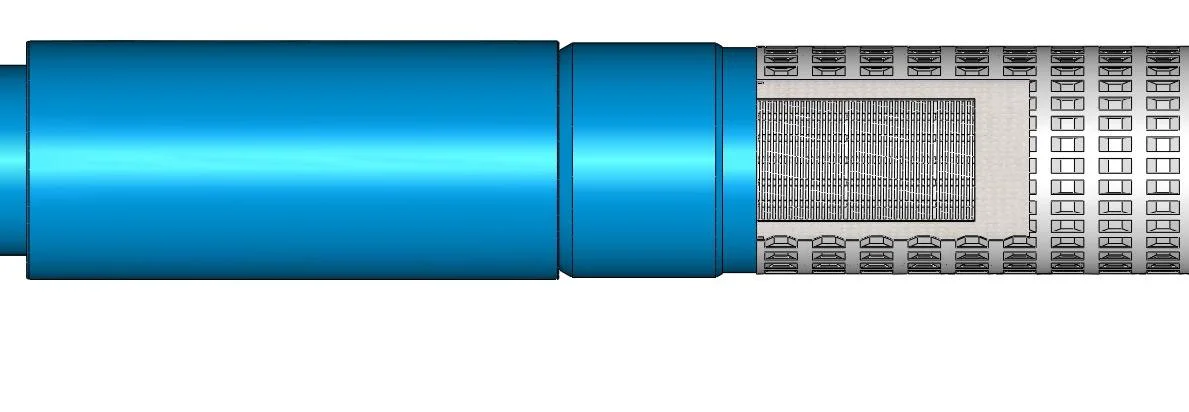
Cutaway view of the AICD screen assembly. The outer protective shroud (left) with precision-machined inflow slots feeds reservoir fluids into internal distribution channels. A ceramic-coated precision sand screen (10-20μm filtration) prevents formation sand ingress while the autonomous flow restrictor — a passive, orifice-plate mechanism — selectively chokes water and gas based on fluid viscosity.
Bohai Bay: 85% → <15% Water Cut
A 1,200m horizontal well in Bohai Bay, producing 14° API heavy oil with strong bottom-water drive, was completed with 4-compartment AICD zonal isolation in 2025.
| Metric | Before (Open Hole) | After (AICD Completion) |
|---|---|---|
| Water cut | 85% (rising monthly) | <15% (stable 12+ months) |
| Oil production | Declining 8%/month | +41% within 90 days |
| Water handling cost | $12,000/month | $1,800/month (85% reduction) |
| Well interventions | 3-4 per year (water shutoff) | Zero |
| Installation time | — | 7 days |
The operator went from planning quarterly water-shutoff workovers to running 12+ months with zero interventions. The water handling cost savings alone — $122,400/year — paid for the AICD completion hardware within the first year.
Critically, the production profile didn’t just improve — it stabilized. Instead of the familiar decline curve of a channeling horizontal well, the AICD-completed well held a plateau. The toe compartments, previously starved by heel breakthrough, began contributing for the first time.
Why This Matters Now
Three forces are making AICD completions the default choice rather than a niche option:
- Water handling economics. Treating and disposing of produced water costs $2-8/bbl depending on the field — the single largest operating expense for many mature fields (U.S. Department of Energy, 2024). A well making 85% water cut at 500 bbl/day sends 425 barrels of water to the surface every day — that’s $850-3,400/day in handling alone. Cutting that by 85% is a direct margin improvement.
- Horizontal well density. More fields are going to extended-reach horizontals to maximize recovery. The longer the lateral, the more severe the heel-toe imbalance — and the higher the payoff from zonal control.
- Workover avoidance. In offshore and remote fields, a workover can cost $500K-2M and take 2-4 weeks of lost production. Passive, intervention-free inflow control isn’t a nice-to-have — it’s the difference between a profitable well and a marginal one.
When AICD Makes Sense — and When It Doesn’t
AICD is not a universal solution. The sweet spot:
- Horizontal or highly deviated wells with ≥500m laterals
- Reservoirs with strong water drive or gas cap
- Heavy oil (10-22° API) where viscosity contrast with water is large
- Wells where workover cost is high (offshore, remote, deep)
Where AICD adds less value:
- Vertical wells (natural coning geometry is different)
- Dry gas wells with no liquid hydrocarbon
- Extremely light oil (>35° API) where oil-water viscosity contrast is small — the device has less “signal” to work with
Frequently Asked Questions
How does an AICD physically distinguish oil from water?
It doesn’t “detect” anything. The flow path inside the device creates a pressure drop that depends on the fluid’s Reynolds number. Oil, being more viscous, has a lower Reynolds number and flows through with minimal loss. Water and gas, with lower viscosity and higher Reynolds numbers, hit a flow restriction that chokes them back. Physics does the work — no sensors required.
What is the minimum oil-water viscosity contrast needed for AICD to work effectively?
A minimum viscosity contrast of roughly 5:1 between oil and water is recommended for strong autonomous performance. This covers most heavy and medium crude oils (10-22° API). For lighter crudes (25-35° API), AICD still provides some control but with less selectivity, and in these cases the device is often paired with ICDs (Inflow Control Devices) for a hybrid completion.
How long does an AICD completion last without intervention?
The device itself has no moving parts, no electronics, and no consumable components — there is nothing to wear out. The primary limitation is screen plugging over time, which is why Jingtao pairs AICD flow control with ceramic-coated filtration (10-20μm). In the Bohai Bay deployment, after 12+ months of continuous production there has been no degradation in performance and zero interventions.
Can AICD screens be installed in an existing wellbore, or only new completions?
AICD screens are deployed as part of the lower completion — placed across the reservoir section during initial well construction. Retrofitting into an existing open-hole or cased-hole well is technically challenging and generally not recommended. For existing wells with water breakthrough, mechanical isolation (packers, cement) or chemical shutoff are more practical options.
What’s the difference between AICD and ICD?
An ICD (Inflow Control Device) imposes a fixed flow restriction — the same for oil, water, or gas. It helps balance flow along the lateral by adding backpressure, but it cannot selectively choke water. When water arrives at an ICD, it flows through the same restriction as oil. An AICD is autonomous — it chokes water and gas more aggressively than oil, responding to the fluid actually arriving at the inlet. Think of an ICD as a passive equalizer and an AICD as an active valve that swings shut when water arrives.
What installation requirements does AICD have for zonal isolation?
Effective AICD deployment requires zonal isolation — typically open-hole packers between each AICD compartment — to prevent cross-flow behind the liner. A typical configuration is 3-5 compartments across the lateral, each with AICD screens and a packer at each boundary. The Bohai Bay well used 4 compartments across 1,200m. Swellable packers are the most common option; mechanical packers are used in cased-hole applications.
Related Resources
→ AICD Screen — Full Product Specifications — datasheets, deployment case studies, technical drawings
→ Self-Cleaning Sand Control Screen — Dutch twill weave, 92% flow retention at 12 months
→ Contact Jingtao Energy — get a completion design proposal for your specific reservoir conditions
Technical Data Sheet
| Parameter | Specification |
|---|---|
| Gas/Oil Resistance Ratio | ≥3.0 |
| Water/Oil Resistance Ratio | ≥3.0 |
| Flow Control Stages | 6-stage autonomous flow control |
| Nozzle Sizes | 2.5 / 3.0 / 4.0 / 4.9 mm |
| Material Compliance | NACE MR0175 (H₂S service) |
| Acid Compatibility | 20% HCl resistant |
| Test Fluid | 32# white oil (bench-validated) |
| Typical Configuration | 3-5 compartments with swellable packers |
| Reference Deployment | Bohai Bay: 4 compartments across 1,200 m |
Data sourced from manufacturer bench tests and field deployment records. Performance varies by well conditions.
Need help choosing the right equipment?
Our engineers review your application and recommend the best fit — no obligation.