
Modular Associated Gas Power Generation: How to Deploy It at a Remote, Off-Grid Site
Why an Off-Grid Site Is a Different Engineering Problem
On a field with a grid connection, a gas engine is an optimisation. It displaces diesel, caps demand charges, and the grid absorbs every starting transient. Off grid, the same machine has to behave like a power system. It must start the field from dead, carry the inrush of the largest motor on site, hold frequency while a compressor comes online, and keep running in the months when the diesel road is impassable.
The comparison at a remote site is almost never gas against cheap grid power. It is gas against diesel that arrives by truck, plus the storage, the handling and the logistics that go with it. That comparison is favourable far more often than the headline efficiency numbers suggest, because the diesel case carries a tail of cost that nobody puts on the project sheet: the deliveries that are cancelled, the tanks that have to be inspected, the generator sets that need their own maintenance. That tail of cost is what makes associated gas power generation viable at a remote, off-grid site — and it is the number most project sheets leave out.
Four numbers decide whether a site can carry its own generation. Collect them before any equipment conversation:
- Peak demand in kW, and how long the peak lasts.
- Minimum sustained demand in kW — the load that never switches off.
- The largest motor start on site: its rating, and whether it starts direct-on-line or through a soft starter or drive.
- Load factor: the annual hours at each load level, not just the peak.
A mine that draws a flat load around the clock and a well pad that needs a few hundred kilowatts for a shift are not the same project, even when they burn the same gas. The first one is close to ideal for a reciprocating gas engine. The second one has to be designed around the fact that the machine will spend most of its life lightly loaded.
What “Modular” Actually Means on an Oilfield Skid
A modular unit is an engine, an alternator, a control panel, a cooling system and a gas train mounted on one transportable base, works-tested before it leaves the workshop. The commercial consequence is not only that site works shrink to a pad, a gas connection, a cable and an exhaust path. It is that the second unit, when the field grows or a second pad is tied in, becomes an order rather than a project.
The range covers three practical levels of modularity:
- Single skid, 80–350 kW on one engine platform — one pad-level load, the fastest route to first power.
- Heavier single unit, 300–1,000 kW on a larger platform — a field load that has outgrown a single small machine.
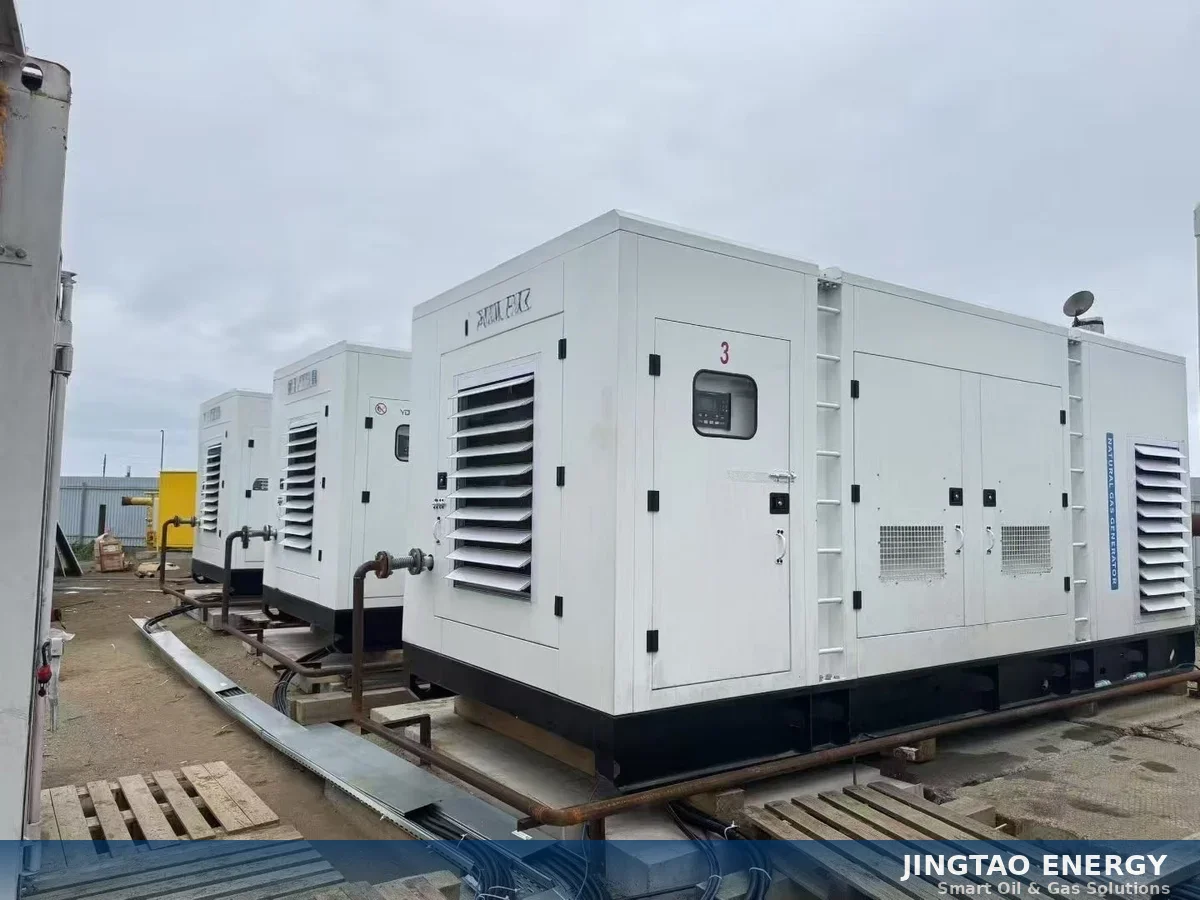
- Containerised bank — several units in one enclosure. A five-unit container at 300 kW each, about 1,500 kW in total, shipped as a single piece of freight for a project in Russia.
Modular does not mean small; it means repeatable. It also does not remove anything difficult. The front-end gas treatment, the civil works, the earthing, the exhaust routing, the tie-in to the relief system and the person who has to understand all of it on site are still there. Modularity removes the second capital decision, not the engineering.
Step 1 — Survey the Load Before You Survey the Gas
Projects that disappoint after commissioning usually disappoint on the load side, not the gas side. The gas was specified; the load was assumed. The table below is the survey we ask for at the start of a remote-site enquiry.
| Load on a remote field | Behaviour | What it demands from the plant |
|---|---|---|
| ESP banks and pump jacks | Continuous, moderate steps, high starting current | A steady base load; staged or soft starting |
| Compressor station | Large motors, inrush at start | Sizing for the start transient, not just the running load |
| Dehydration reboilers, tank heating, camp hot water | Steady thermal load, seasonal peaks | Heat recovery turns the same fuel into a better return |
| Mine, processing plant or data-centre style load | Flat, high utilisation, runs around the clock | The best match for a gas engine, and the easiest to finance |
| Workover rigs, frac spreads, batch operations | Intermittent, high peak, low annual hours | Poorly matched to a single engine; keep diesel for the peaks |
Where the site also needs heat — reboilers, tank heating, camp hot water — a combined heat and power configuration changes the arithmetic, because the same fuel then serves two loads, and the CHP economics are worth reading before the units are sized rather than after they are installed.
One constraint repeats on every project. A reciprocating gas engine is happiest under steady load, and standard practice keeps the sustained minimum above roughly 40% of nameplate. Below that, fuel efficiency falls and maintenance hours climb, because the machine keeps burning fuel to stay turning. That single constraint decides whether the site needs one unit, two units, or a gas buffer ahead of the engine to smooth a fluctuating supply.
Step 2 — The Gas Analysis That Gates Everything Else
We will not quote an associated gas power generation configuration before a gas analysis, and it is not a formality. Two of the numbers on that sheet — hydrogen sulphide and water — decide whether the scope contains a desulfurisation package and a dehydration skid. Those two packages can cost more than the generator, and they are the reason a catalogue quote for this application is meaningless.
| Parameter | What the engine package needs | If the gas is outside the window |
|---|---|---|
| Methane content and heating value | CH4 of 55% or more; lower heating value of at least 5,500 kcal/m³ | The energy per cubic metre is thin, so combustion stability and output fall. A larger gas volume does not repair a low heating value |
| Hydrogen sulphide | Below 200 mg/Nm³ at the engine inlet | Front-end desulfurisation. A documented field case has run at roughly 6,000 ppm after treatment |
| Particulates | Below 5 μm | Filtration ahead of the engine |
| Water | Below 20 g/Nm³ | Dehydration. Water plus sulphur plus pressure is what attacks steel in the gas train |
| Supply pressure at the engine inlet | 5–35 kPa | Below 5 kPa a booster is needed; above 100 kPa a regulator is needed |
| Gas temperature | Above 0 degC, with a standard window up to about 30 degC | Trace heating and insulation in cold service |
Sampling discipline decides whether the analysis is worth the money. Take two samples: one downstream of the treatment train at the engine inlet, which is the gas the engine will actually burn, and one upstream, which captures the boundary condition and catches a bypass or a process upset. Sample each source separately rather than commingling, because the mixture describes a stream that does not exist. Use stainless steel or aluminium high-pressure cylinders — no glass, no plastic — and passivated cylinders or a dedicated method for hydrogen sulphide. Take two or three parallel samples at each point, and record the pressure, temperature and flow at the sampling point, because an analysis without those three numbers cannot be scaled to the unit.
The laboratory methods are worth naming when you brief the lab: composition by ASTM D1945 or ISO 6974; sulphur by ASTM D5504 or ISO 6326, with hydrogen sulphide by ASTM D4084; heating value by ASTM D3588 or ISO 6976; water dew point by ISO 6327; potential hydrocarbon liquid by ISO 6570; particulates by gravimetric method.
A difficult gas stream is not a dead end. High hydrogen sulphide, heavy ends and a composition that moves with the weather are exactly why some suppliers decline the enquiry and why the treatment step is the difference between a fuel and a liability — the treatment sequence itself is covered here. The commercial reading is simpler than the chemistry: this class of machine does not need a clean gas, it needs a specified gas, and the specification is negotiated from the analysis rather than from a brochure.
Step 3 — Size the Associated Gas Power Generation Units to the Gas You Actually Have
The arithmetic that converts a gas volume into electrical capacity is short enough to show, which is the point — an operator should be able to check it on one line of paper before signing anything.
- One cubic metre of methane carries about 35.9 MJ of lower heating value.
- A reciprocating gas engine turns 33–35% of that into electricity, so one megawatt of output needs roughly 2.94 MJ per second of fuel energy.
- 2.94 divided by 35.9 is about 0.082 cubic metres per second, which is about 7,000 m³ per day.
In round terms: roughly 7,000 m³ per day of methane-rich gas is one megawatt. Scaling is close to linear in that band.
| Gas available | Approximate electrical capacity at 34% efficiency |
|---|---|
| 5,000 m³/day | About 0.7 MW |
| 10,000 m³/day | About 1.4 MW |
| 30,000 m³/day | About 4.2 MW |
Treat those as planning figures on gas that is mostly methane. Heavier gas, high hydrogen sulphide and a cold feed all derate the output, which is why the sizing conversation belongs after the analysis and not before it. Where the gas volume swings three to one between seasons, the answer is usually a gas buffer or staged units rather than one larger engine, because a machine sized for the wet season runs starved for the rest of the year.
Unit count is a decision in its own right. Two units of 150 kW are not the same project as one unit of 300 kW: the pair survives a single-unit outage, tolerates a gas swing better, and shares one set of spares. The screening arithmetic on the revenue side — what the gas is worth against what the equipment has to deliver — sits in our guide to evaluating associated gas power ROI. The step described here is the fuel-to-power conversion that comes first, because a project that fails that arithmetic fails on the physics before it fails on the financing.
Step 4 — Choose the Package: Skid, Container or Multi-Unit Bank
| Package | Typical capacity | Site works | Choose it when |
|---|---|---|---|
| Single open skid | 80–350 kW | Compacted or concrete pad, exhaust path, cable route | One pad-level load and the fastest possible route to first power |
| Heavy single unit | 300–1,000 kW | Heavier foundation, larger cooling air path | Field load above roughly 500 kW on a single shaft |
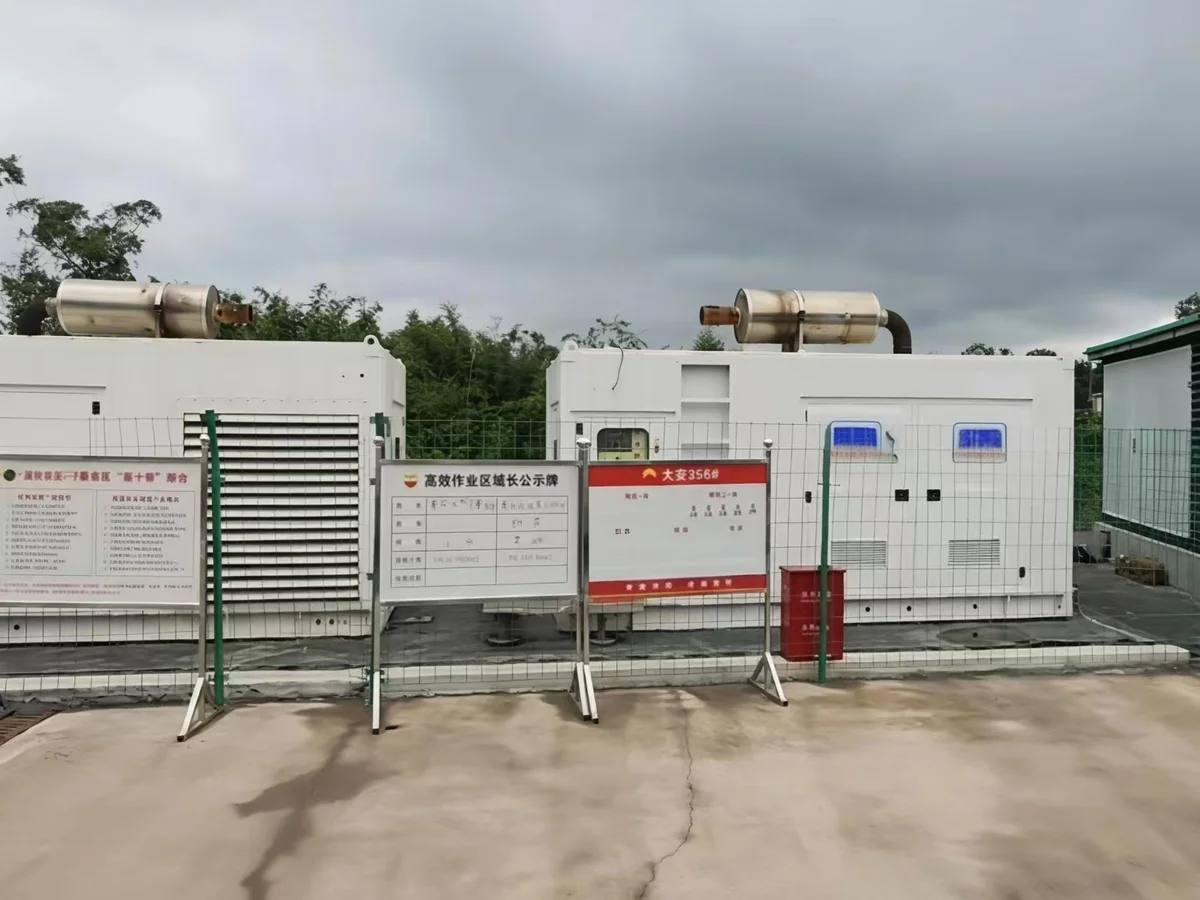
| Containerised multi-unit | Up to about 1,500 kW in one container (for example five units of 300 kW) | Pad, cable trench, enclosure included | Desert, arctic, noise-sensitive or unattended sites |
| Multi-container island | Above 1,500 kW | Switchgear, control room, staged commissioning | Field-wide generation, mine power, island grid |
On a remote site the container is doing more work than shelter. It carries the cooling arrangement, the noise attenuation, the sand and snow protection and a walk-in aisle for service. Sites like this rarely have a workshop within a day’s drive, so the enclosure becomes the workshop, and that is the argument for it rather than the weather. The enclosure also fixes the logistics: a container has to be liftable and road-legal on the route to your field, which is a question for the first meeting, not the last one.
Choose the package on the operating model, not on the purchase order. An attended field with a workshop can justify an open skid. An unmanned field with a monthly visit needs the enclosure, the remote monitoring and the spares kit as part of the same scope, because retrofitting them later costs more than specifying them now.
Step 5 — The Gas Train, the Pad and the Interfaces That Decide the Schedule
The gas train runs in a fixed order: knock-out drum to take liquids out of the stream, filtration below 5 μm, pressure regulation into the 5–35 kPa window the engine wants, desulfurisation where the hydrogen sulphide load demands it, and then into the engine — with a leak detector watching the enclosure and a shut-off solenoid valve that closes the gas on alarm. Everything upstream of the engine exists to deliver one thing: a clean, dry, pressure-stable stream at the inlet.
| Interface | What has to be built | Where the schedule actually slips |
|---|---|---|
| Civil | Pad, drainage, cable trench, crane and road access | Pad level and soil bearing, and the crane that has to reach the container position |
| Gas | Flowline to the pad, knock-out, regulation, tie-in to the relief system | Any tie-in to a live process needs a shutdown window |
| Electrical | Cable to the load or to switchgear, earthing, protection relays, metering | Earthing and protection settings are left to the last week |
| Mechanical | Exhaust routed away from air intakes, unobstructed cooling air path | Exhaust recirculating into the radiator and quietly derating the unit |
| Safety | Gas detection, audible and visual alarm, shut-off valve, flame arrestor and relief valve | Permits, hot-work procedures and the alarm logic sign-off |
One interface gets argued about on almost every project, and it is worth putting in writing early: the flare. A power plant does not retire the flare system. Emergency relief has to have a safe path, so the stack stays, and the relief capacity is designed for the worst case rather than the average one. What changes with generation is the routine flaring — the twenty-four-hour burn that exists because there is nowhere else for the gas to go. A proposal that claims the flare will disappear has not been near an operating plant, and an operator who has been told otherwise will find out at the first process upset.
Step 6 — Commissioning, First Start and the Safety System
Commissioning a remote unit is a sequence, and the order matters more than the speed:
- Workshop test before shipment. Run the unit on gas in the workshop. A fault found there costs a day; the same fault found on site costs a month and a flight.
- Mechanical completion. Pad and alignment, gas train pressure test and purge, cable termination, earthing and protection checks.
- Safety function test. Gas detection, alarm, shut-off valve closure time, flame arrestor and relief valve, and every ECU sensor channel verified against the drawing.
- No-load and staged load runs. Accept load in steps, watch exhaust temperature spread across cylinders, and watch frequency recovery after the largest motor on site starts.
- Trial run at site load — 72 hours continuous is a common standard — with the existing diesel or the flare still available as a fallback.
- Handover with the first service kit, the alarm list and the maintenance calendar in the local language if the operator needs it.
The safety package is not an optional extra and should be listed in the quotation by name: a gas leak detector, an audible and visual alarm, and a shut-off solenoid valve that isolates the gas supply; an explosion relief valve protecting the intake manifold and intercooler against backfire; a gas filter ahead of the engine; and an engine control unit reading pressure, temperature, top dead centre, speed, oil pressure, oxygen and coolant temperature channels on a continuous basis. On a remote site this is the difference between a machine that protects itself and a machine that needs a person watching it.
Remote monitoring belongs in the same paragraph, not in the accessories list. Start and stop commands, live readings, data logging and maintenance records are what make an unmanned site workable, because running hours come off the portal and running hours are what drive the maintenance calendar. Without it, every trip becomes a road trip, and a road trip to a remote field is measured in days.
Cold-weather commissioning has its own shipping realities, and they are easier to plan than to discover. Cooling systems are drained before shipment and antifreeze is sourced locally at the destination. Batteries travel as dangerous goods, so most sites buy them locally against a specification. Lubricant is best supplied with the first service kit so that the second fill matches the first one. Gas temperature has to be held above 0 degC ahead of the engine, which means trace heating and insulation rather than hope.
Warranty terms are worth stating plainly at this point in the project. Where a service network exists — as it does in Russia and Canada — cover runs for one year or 2,000 running hours, whichever comes first. Where no network exists, the model is remote technical support plus shipped parts, with the customer’s own team doing the work. We do not pretend to station engineers in every country, and a buyer who plans around that honestly will have fewer surprises than one who plans around a promise.
Step 7 — Who Runs It at Two in the Morning
The engine is rarely what fails a remote project. The gap between the site and the nearest person who can diagnose it is what fails a remote project. Three operating models are normally on the table, and the choice should be made before the units are ordered:
- A trained site operator with remote diagnostics support — the usual answer at a producing field where people are already on site.
- A service network within reach, with scheduled maintenance and warranty cover — viable where the region has other installations.
- Remote support with a stocked spares kit and customer-performed maintenance — for unmanned or very remote sites, where the trade is less support for more spares and more instrumentation.
Whichever model is chosen, the first order should include a consumables kit: seals, couplings, filters, lubricant and the sensors that fail first. On a remote field, the airfreight for one sensor can exceed the cost of the sensor by a wide margin, and a week of lost production exceeds both by a wider one. The maintenance calendar itself is built on a running-hour record rather than on a visit schedule: the engine family used in this service has run 35,000 hours without a major overhaul, which is the number that sets the interval between planned interventions rather than a workshop’s convenience.
Installation at Temperature Extremes: What Changes
Two decisions repeat on almost every remote project, and both follow from one principle: the cooling arrangement is the first thing that has to be adapted, and it is decided by the site, not by the engine.
In hot service the radiator goes outside the enclosure and the fans are arranged to exhaust upward, with the doors opened for auxiliary air on the hottest days. In one project area, the ground surface temperature reaches about 42 degC in summer; at that point the enclosure design, not the engine rating, decides whether the unit holds full output at three in the afternoon. In cold service the logic reverses: the radiator sits inside the enclosure for warmth, insulation and pre-heating are added, gas temperature is held above 0 degC, and the site runs through conditions below minus 30 degC.
Dust is the third climate and it is underestimated. Desert and gobi sites close the enclosure and rely on sealed cooling paths, because a cooling pack packed with fine sand stops being a cooling pack. In that service the filter schedule matters more than the cooling margin, and the enclosure doors stay shut except for service.
The durability evidence for this class of equipment is worth reading against those conditions. Units have run 35,000 hours without a major overhaul. One unit supplied in 2021 has stood outdoors for close to five years with the structure intact and only light corrosion at the corners. A unit in the Volgograd region has passed 10,000 running hours since it was shipped in 2024, through two winters. The first two units for a Middle Eastern field arrived in July after a decision cycle that ran for more than a year — and that contrast is the honest shape of this business: the decision takes years, the deployment takes weeks. The delivery record behind the Middle Eastern order is documented as an associated gas power case study.
Where a Modular Skid Deployment Is the Wrong Answer
A framework that never says no is a sales document, so here are the conditions that should stop a project or send it in a different direction.
| Condition | Why it stops the project | What to do instead |
|---|---|---|
| A gas line or a usable grid is already within reach | Connecting and treating the gas properly is a better use of it than generating on site | Connect. Generation is for the sites that have no line to connect to [3] |
| Gas volume too small, or too intermittent to hold load | A single engine cannot hold frequency on a flickering supply, and cycling costs maintenance hours | Buffer the gas, stage the units, or route the gas to a different use |
| The gas is dry and you need liquid revenue now | Dry gas contains no LPG, no matter how large the volume | Take the power route and stop promising liquids |
| Hydrogen sulphide beyond an economical treatment scope | The front end becomes the project, and the engine becomes a detail | Revisit the treatment scope before the engine selection |
| Nobody within reach can maintain it, and remote monitoring is not acceptable | Outage duration is set by logistics rather than by the machine | Service network, stocked spares and a trained operator — or keep diesel |
| Batch loads with low annual hours | Peak demand with low utilisation does not pay for a generation plant | Keep diesel for the peaks and use gas for the base load |
Every one of those conditions has ended a project somewhere. Screening them out takes one meeting. Discovering them three months after commissioning takes a year and a reputation. We would rather decline an enquiry at the screening stage than explain the mismatch after the equipment has been installed.
Technical Data Sheet
| Parameter | Value |
|---|---|
| Engine platforms | 80–350 kW and 300–1,000 kW classes |
| Containerised integration | Up to about 1,500 kW in one container (five units of 300 kW) |
| Electrical efficiency, generation only | 33–35% |
| Total fuel utilisation with heat recovery | 85–90% |
| Gas specification window | CH4 55% or more and LHV at least 5,500 kcal/m³; hydrogen sulphide below 200 mg/Nm³ at the engine inlet with front-end desulfurisation where needed; particulates below 5 μm; water below 20 g/Nm³ |
| Inlet pressure and gas temperature | 5–35 kPa at the engine inlet; gas above 0 degC, standard window up to about 30 degC |
| Fuel-to-power planning figure | About 7,000 m³/day of methane-rich gas per MW at 34% electrical efficiency |
| Running-hour record | 35,000 hours without major overhaul |
| Climate adaptation | Radiator outside the enclosure in hot service, inside in cold service; sealed cooling paths in dusty service |
| Certification | CE, CSA, EAC |
| Monitoring | Engine control unit with multi-sensor monitoring; remote start and stop, data logging, maintenance records |
| Warranty where a service network exists | One year or 2,000 running hours, whichever comes first |
Figures above come from the documentation supplied with our gas generator range, from running-hour records on delivered units, and from the physical derivation shown in Step 3 — 35.9 MJ per cubic metre of methane at 33–35% electrical efficiency — which any engineer can check. Where a gas stream sits outside the specification window, the configuration is quoted after a gas analysis and a treatment review, not from a catalogue.
Frequently Asked Questions
Q: How much associated gas do I need to generate 1 MW?
Roughly 7,000 m³ per day of methane-rich gas at 34% electrical efficiency. The derivation is short: a cubic metre of methane carries about 35.9 MJ, a gas engine converts 33–35% of that to electricity, so a megawatt needs about 2.94 MJ per second, which is about 0.082 m³ per second, or 7,000 m³ per day. Scale linearly from there — 10,000 m³ per day is about 1.4 MW. Treat it as a planning figure rather than a guarantee, because heavy gas and a cold feed derate the output.
Q: How long does a modular deployment take from decision to first power?
The equipment side is measured in weeks, not months. A single skid arriving at a prepared pad is typically running within two to three weeks, including commissioning and first start. What sets the date is almost always upstream of the generator: the pad, the gas train and the electrical interface. The pattern we see most often is a decision cycle that runs for over a year, followed by a deployment of weeks — which is why the pad and the gas piping belong in the first conversation, not the last one.
Longer on the decision than on the equipment, in our experience. The first two units for a Middle Eastern field arrived in July after a decision cycle that ran for more than a year. Once the order exists, a containerised unit is works-tested before shipment and the site works — pad, gas train, cable, commissioning — are measured in weeks rather than months. The variable that eats weeks is not the machine; it is the tie-in to a live process, which needs a shutdown window.
Q: Can a remote field run entirely on associated gas with no grid at all?
Yes, provided the gas is stable and the load profile suits a reciprocating engine. That combination is an island grid, and it changes the specification: the plant has to black-start the field, carry the largest motor start on site, and hold frequency through load steps. Two units are usually better than one at that scale, because a single engine has to be shut down for its own maintenance and the field still needs power. Where the load is intermittent and the gas is steady, the pairing is the other way round: keep diesel for peaks and use gas for the base.
Q: What happens if the gas composition changes after commissioning?
The engine control unit derates output rather than failing, and that derate is visible in the monitoring data. Composition moves for ordinary reasons — a new well tied in, a change in separator pressure, a wet season — so the front end is sized for the worst case you expect rather than the sample you happened to take. If the change is permanent, a re-analysis tells you what the new configuration should be: sometimes a different gas train setting, sometimes a larger treatment step, sometimes simply an accepted reduction in output.
Q: Do I still need the flare stack if I generate power from the gas?
Yes, for emergency relief. No operator should put a plant between a process upset and a safe relief path, so the stack and its relief capacity stay. What changes is routine flaring: the twenty-four-hour burn that exists because there is nowhere else for the gas to go. On a producing field, that is the larger volume by a wide margin, which is why generation reduces flaring substantially without eliminating the flare system.
Q: What maintenance does a unit need where there is no workshop?
Maintenance is scheduled by running hours rather than by site visits. The first order should include a consumables kit — seals, couplings, filters, lubricant and the sensors that fail first — because on a remote field the airfreight on one sensor can exceed the cost of the sensor, and a week of lost production exceeds both. The engine family used in this service has run 35,000 hours without a major overhaul, and that figure sets the interval between planned interventions rather than a workshop’s convenience.
A consumables kit, a running-hour calendar and remote diagnostics. The kit carries seals, couplings, filters, lubricant and the sensors that fail first; the calendar is driven by running hours rather than by visits, which is why remote monitoring matters more on a remote site than on a connected one. Where a service network exists, warranty cover runs for one year or 2,000 running hours, whichever comes first. Where it does not, the model is remote support plus shipped parts and a customer team trained at commissioning.
Q: How much space does a containerised unit need?
A single skid has the smallest footprint. Containerised units use standard 20-foot and 40-foot enclosures, which keeps them liftable and road-legal on the route to the field. A multi-unit bank — for example five 300 kW units, about 1,500 kW — is built into one enclosure rather than five separate containers. The enclosure carries the cooling arrangement, the noise attenuation, the sand and snow protection and a walk-in aisle for service, so it is sized for maintenance access as much as for the machine.
Less than the equivalent diesel plant, but the pad has to be planned properly. A containerised bank needs a level pad with adequate soil bearing, cable trenching to the load or switchgear, exhaust routing away from air intakes, and crane access at the position it will occupy. The container itself carries the cooling, the noise attenuation and the weather protection, and it provides a service aisle — which on a site without a workshop is the main reason to specify it.
Q: Is there gas this equipment cannot handle at all?
Yes. Below a methane content of 55% and a heating value of 5,500 kcal/m³ the fuel is too thin for stable combustion in this class of engine, and those enquiries are declined. Above that line, a difficult stream is a treatment scope rather than a dead end: hydrogen sulphide far above the 200 mg/Nm³ inlet limit is handled with a desulfurisation train, particulates with filtration below 5 μm, and water with dehydration below 20 g/Nm³. The rule is simple — this class of machine does not need a clean gas, it needs a specified gas.
There is gas that should not be accepted without a treatment scope, and there is gas that should be declined. Below a methane content of 55% and a heating value of 5,500 kcal/m³ the fuel is too thin for stable combustion in this class of engine. Hydrogen sulphide far above the inlet limit needs desulfurisation first — a documented field case has run at roughly 6,000 ppm after treatment — and water above 20 g/Nm³ has to be removed rather than tolerated. A volume too small or too intermittent to hold load is a screening failure rather than a gas problem. Everything on that list is a specification conversation, not a refusal.
Next Step: Send the Gas Analysis and the Load Profile
Two documents unlock a configuration: a gas analysis taken at the engine inlet, and the load profile — peak demand, minimum sustained demand, the largest motor start, and the annual hours. With those we can come back with a unit selection, an outline scope for the front end, and a commissioning sequence, instead of a catalogue page that may or may not apply to your field. Send both and the reply is a sized associated gas power generation design for your gas, not a generic datasheet.
→ Request a Quote — send the gas analysis and the load data for a scoped configuration.
→ Download Brochure — platform specifications, container layouts and the commissioning checklist.
→ See the modular gas generator range — the units described in this guide, with the gas specification window.
Speak directly with an engineer through our contact page if the gas stream is unusual — high hydrogen sulphide, heavy ends, or a composition that moves. That conversation is usually shorter than the quotation it saves.
References
[1] World Bank. 2026 Global Gas Flaring Tracker Report. World Bank Group, 2026. https://www.worldbank.org/en/programs/gasflaringreduction/publication/2026-global-gas-flaring-tracker-report
[2] World Bank. Global Flaring Data — annual flared volumes and country-level estimates. https://www.worldbank.org/en/programs/gasflaringreduction/global-flaring-data
[3] International Energy Agency. Global Methane Tracker 2025 — Key Findings. https://www.iea.org/reports/global-methane-tracker-2025/key-findings
Need help choosing the right equipment?
Our engineers review your application and recommend the best fit — no obligation.