Explosion-Proof Tank Robot Guide: ATEX, IECEx & Ex Markings
Opening Hook
A storage tank that has held crude oil is not a clean vessel — it is a confined space with a hydrocarbon atmosphere, waiting for a spark. Before any robot is allowed through the manway, the site HSE team asks one question that no sales video can answer: is this equipment certified for explosive atmospheres? The certificate, not the payload or the coverage rate, decides whether the machine may legally enter the tank at all.
This guide explains the three certification schemes you will meet when buying a tank maintenance robot — ATEX, IECEx and China’s GB/T 3836 — how to read an Ex marking such as Ex db ib IIB T4 Gb, and the five checks that separate a verifiable explosion-proof machine from a painted one.
Why the Certificate Decides Whether the Robot May Enter the Tank
Explosive atmospheres are classified into zones by how often a hazardous concentration of gas appears: Zone 0 (continuous), Zone 1 (likely in normal operation) and Zone 2 (unlikely, brief if it occurs). A tank that has held crude, once gas-freed and tested, is typically treated as Zone 1 or Zone 2 while maintenance work is in progress — and the equipment brought inside must carry an equipment protection level (EPL) that matches.
That matching is not paperwork for its own sake. Ignition sources in a climbing robot are easy to list: the drive motors, the power electronics, cable glands, brushed contacts, and static charge from abrasive blasting. A certification body has examined each of these against the IEC 60079 series of standards and verified that the design cannot ignite a surrounding gas atmosphere of the stated group and temperature class.
The second half of the safety story is the operator. A certified climbing robot is operated by remote control — in the case of the JT-1 platform, from up to 200 m away — which means nobody stands inside the tank or on the roof while the hazardous work happens. People plan, robots execute, and the interface between them is a radio link, not a body in a breathing apparatus.
Three Certification Schemes You Will Meet: ATEX, IECEx and China GB/T 3836
Buyers meet three certification languages in tenders. They are built on the same technical foundation — the IEC 60079 standards family — but they are issued under different legal frameworks, and a tender will usually name one of them explicitly.
| Scheme | Jurisdiction / recognition | Standards base | What tenders say |
|---|---|---|---|
| ATEX | EU — mandatory for equipment sold into the European market | EN 60079 series (EU version of IEC 60079), Directive 2014/34/EU | “ATEX certified equipment only” |
| IECEx | International — accepted across most of the Middle East, Asia-Pacific and the Americas | IEC 60079 series | “IECEx certified” |
| China GB/T 3836 | China — national mandatory certification, structurally identical to IEC 60079 | GB/T 3836.1 / 3836.2 / 3836.4-2021 | “防爆合格证” / Ex certificate with CNAS report |
The three schemes are close enough that markings look alike — the same Ex db ib IIB T4 Gb string can appear on an ATEX plate, an IECEx certificate or a Chinese GB certificate. The differences are jurisdictional: where the certificate is legally required, whether the issuing body is recognized there, and which inspection bodies accept it. China’s GB/T 3836 series is a direct adoption of the IEC 60079 structure, and Chinese test reports issued under CNAS accreditation carry ILAC-MRA mutual recognition — the JT-1’s explosion-proof certificate (No. ZJEx23.0915) is backed by a CNAS L0116 report. But mutual recognition is not the same as a local certificate: if your project jurisdiction explicitly demands ATEX or IECEx, that must be raised at the RFQ stage, not discovered at the tank.
How to Read an Ex Marking: Ex db ib IIB T4 Gb
An Ex marking is a compressed engineering statement. Take the marking on the JT-1 Mini wall-climbing robot certificate — Ex db ib IIB T4 Gb — and decode it element by element:
| Element | Meaning | What it tells the buyer |
|---|---|---|
| Ex | Explosion-protected equipment | The device is certified under an explosion-protection standard family |
| db | Flameproof enclosure, level b (IEC 60079-1) | Enclosures contain an internal explosion and cool the escaping gases so they cannot ignite the outside atmosphere |
| ib | Intrinsic safety, level b (IEC 60079-11) | Internal circuits are energy-limited so they cannot produce an ignition-capable spark |
| IIB | Gas group | Suitable for group IIA and IIB atmospheres (ethylene-class gases); NOT certified for IIC (hydrogen, acetylene) |
| T4 | Temperature class | Maximum surface temperature 135 °C — safe where the atmosphere’s auto-ignition temperature is above 135 °C |
| Gb | Equipment protection level | Suitable for Zone 1 and Zone 2 explosive gas atmospheres (Ga would be required for Zone 0) |
Every element is checkable against the certificate: the number (ZJEx23.0915), the issuing body (国家电器安全质量检验检测中心 — Zhejiang, China), the standards invoked (GB/T 3836.1-2021, GB/T 3836.2-2021, GB/T 3836.4-2021), the rated supply (AC 220 V / 1.8 kW), and the validity period (issued 2023-07-11, valid to 2028-07-10). If any of these is missing from the documentation a supplier sends you, treat the claim as unverified.
Gas Groups and Temperature Classes: Does the Marking Match Your Tank?
Certification is not a single checkbox — it is a bounded envelope. The envelope has two dimensions you must match against your own atmosphere.
Gas group. IIA covers propane-class gases, IIB covers ethylene-class gases, and IIC covers hydrogen and acetylene — the hardest to protect against. Crude-oil vapour in a storage tank is usually IIA; refinery intermediate streams can reach IIB. A robot marked IIB covers both IIA and IIB, but a site with a hydrogen-rich stream needs IIC-rated equipment, which is a different and rarer certification class.
Temperature class. T-classes run from T1 (max surface temperature 450 °C) down to T6 (85 °C). The rule is simple: the equipment’s maximum surface temperature must stay below the atmosphere’s auto-ignition temperature with margin. T4 means a 135 °C ceiling — comfortably below the auto-ignition temperature of most hydrocarbon vapours, which is why T4 is the workhorse class for oilfield and tank work. When you see ‘T4’ quoted in a datasheet, ask which gas group it is paired with — a T4 rating without a gas-group statement is an incomplete claim.
What “Explosion-Proof” Actually Protects Inside a Robot
A climbing robot is a harder certification subject than a junction box, because it moves, it carries power, and it swaps tools. Three protection concepts do most of the work in a robot like the JT-1:
Flameproof enclosure (db): the motor housings and electronics enclosures are built to contain an internal explosion and quench the flame before it reaches the outside atmosphere. That is why certified robots are heavier than their non-certified cousins.
Intrinsic safety (ib): control and instrumentation circuits are limited in energy so that even a fault cannot produce a spark with enough energy to ignite the atmosphere.
Component-level temperature control (T4): every surface that could get hot — motors, drives, lights — is verified to stay below the stated temperature class during continuous operation.
The part most buyers underestimate is the interface between the robot and the job. Changing a module or adding a tool can break the certified configuration — the certificate covers the machine as built and as tested, not the machine plus a workshop modification. If you plan to run dry abrasive blasting, high-pressure water jetting and inspection from one chassis, the certificate scope should cover the configurations you actually intend to use, and your site controls must handle the dust cloud and static that blasting generates regardless of the robot’s rating. The JT-1 platform addresses this with modular end-effectors on a certified base chassis — sandblasting, water jetting (JT-1-S), underwater cleaning (JT-1-H) and inspection modules — so the certified core stays intact while the tool changes.
Certified Robot vs. Non-Certified Robot vs. Manual Crews: What You Are Comparing
When a tender says ‘tank cleaning robot’, the market actually offers three different products that are only superficially similar. Comparing them on coverage rate alone is how buyers end up with a beautiful machine that is legally barred from the only tank that matters.
| Explosion-proof certified climbing robot | Non-certified industrial robot | Manual crews | |
|---|---|---|---|
| Explosive-atmosphere tank entry | Yes — Zone 1/2 with matching gas group & T-class | No — non-hazardous locations only | Yes, with gas freeing, testing & permits |
| Operator position | Outside the tank, remote (up to 200 m) | Outside, but machine itself is the hazard | Inside the tank (confined-space entry) |
| Typical fit | Refinery & terminal tanks, gas-oil separators, jet fuel storage | Water towers, exterior hulls, benign tanks | Any tank — at the cost of people-hours inside |
| Certification paperwork | Full Ex certificate + test report, traceable | None (CE/RoHS only, not Ex) | Permit-to-work, gas tests, rescue plan |
The classification matters more than any individual spec line. A non-certified robot may clean a water tank all day, but the moment the vessel held hydrocarbons, its certificate — or lack of one — overrides every performance advantage it has. This is also why ‘explosion-proof’ claims deserve scepticism until you have seen the certificate: in this product class, the certificate is the product.
The Economics Few Buyers Model: Confined-Space Entry Costs
Most cost comparisons stop at the machine price and miss the real line item: the cost of preparing and supervising people inside a permit-required confined space. Every tank entry means gas freeing, LEL and oxygen monitoring, a standby and rescue crew, ventilation, lighting, communications, and the administrative load of the permit itself — repeated for every shift, every day, for the duration of the job.
A certified climbing robot moves the work from inside to outside: the machine enters through a standard Ø60 cm manway, the operator works from a remote position up to 200 m away, and the confined-space headcount drops to the people who plan and supervise rather than the people who breathe. Field experience on the JT-1 platform — first released in 2020, with roughly 120 units deployed and an 8–10 year design life — puts dry abrasive blasting at 20–30 m²/h on new tank linings under 200 µm and 10–15 m²/h on old heavy coatings of 400–500 µm. The honest framing is not ‘the robot is cheap’; it is that the alternative spends days of confined-space preparation and people-hours inside the vessel for every square metre it treats.
Five Checks Before You Buy an Explosion-Proof Tank Robot
Use this checklist at the quotation stage. Any supplier that cannot produce all five items is asking you to take the explosion-proof claim on faith.
1. Certificate number and issuing body. Ask for the certificate number and look up the issuing body. A verifiable example format: No. ZJEx23.0915, issued by a national electrical-safety quality inspection centre, covering the robot by model name and number.
2. Zone and EPL match. The marking must state an EPL — Gb for Zone 1 and 2 work. If the certificate says only ‘explosion-proof’ with no EPL or zone statement, it is not a usable certificate.
3. Gas group and temperature class. Confirm the atmosphere class you are working in: IIB equipment covers IIA and IIB gas groups; hydrogen or acetylene service needs IIC. Confirm the T-class ceiling against your stream’s auto-ignition temperature.
4. Scope covers the actual configuration. Verify that the certificate covers the robot with the modules and tools you will use — swapping in an unlisted tool can void the certified configuration.
5. Validity and international recognition. Check the issue and expiry dates (a typical validity window is five years — the JT-1 certificate runs 2023-07-11 to 2028-07-10) and confirm whether the test report carries mutual recognition such as CNAS L0116 with ILAC-MRA — and whether your project’s jurisdiction additionally demands ATEX or IECEx certificates, which must be raised before commitment.
Where a Certified Robot Still Cannot Help
A certified robot is a tool with an envelope, not a universal key. Being straight about the limits is part of what makes the capability claims credible:
Zone 0 continuous atmospheres require Ga-rated equipment; a Gb (Zone 1/2) robot is not certified for continuous presence in Zone 0.
Hydrogen or acetylene atmospheres (gas group IIC) need IIC-rated equipment — most tank robots, including IIB-rated machines, cannot legally enter that service.
Jurisdictions that mandate local ATEX or IECEx certificates will not accept a foreign national certificate as a substitute, regardless of mutual-recognition schemes — the requirement must be identified in the RFQ.
Abrasive blasting generates heat, static and dust. Even with a certified machine, the tank still needs gas freeing, LEL monitoring and ventilation; robot certification does not replace the site’s own hazardous-work controls.
Geometry limits remain: a robot needs a manway it fits through (the JT-1 Mini enters a Ø60 cm manway) and a surface it can climb — tanks under roughly 2 m diameter or with no magnetic surface fall outside the climbing envelope.
How a Certified Platform Is Put Together: One Chassis, Certified, Modular
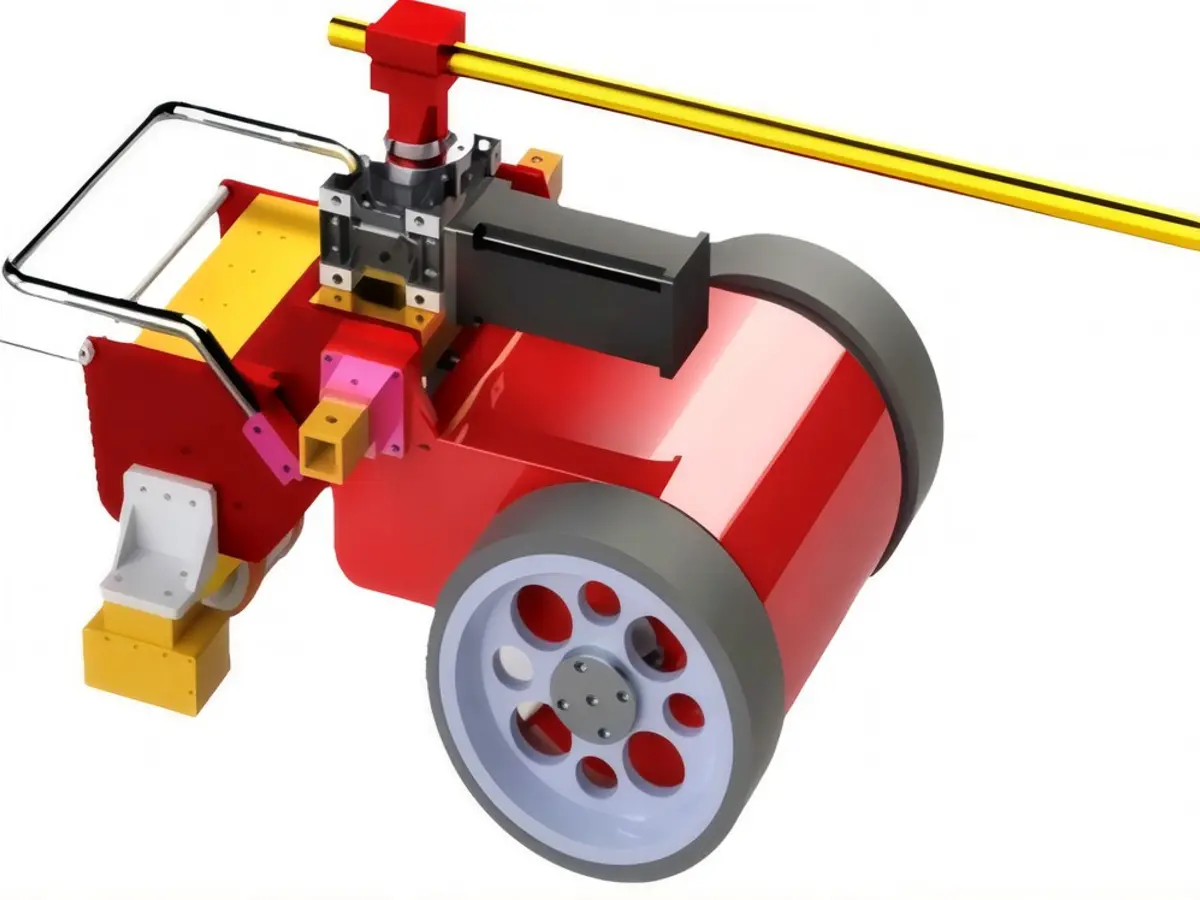
The JT-1 Mini wall-climbing robot (factory model XBR-1) carries explosion-proof certificate No. ZJEx23.0915, rated Ex db ib IIB T4 Gb to GB/T 3836.1 / 3836.2 / 3836.4-2021 at AC 220 V / 1.8 kW, with a CNAS L0116 test report under ILAC-MRA. It is a modular platform: the same certified base chassis supports dry sandblasting, high-pressure water jetting (JT-1-S), underwater cleaning (JT-1-H) and inspection tools, with an IP67 aluminium body at 60 kg and a remote range of 200 m that keeps the operator out of the classified area.
Jingtao Energy is straightforward about its certification position: the explosion-proof certificate held is the Chinese national certification under GB/T 3836, structurally identical to the IEC 60079 series and covered by ILAC-MRA mutual recognition for test reports. Buyers whose projects explicitly require ATEX or IECEx certificates should state that in the RFQ so the path can be confirmed before any commitment — that is a commercial conversation, and it should happen before the tank is opened, not after.
For the wider decision framework — how to select tank maintenance equipment, dry blasting vs. wet water jetting, and field adoption data for wall-climbing robots — the site’s maintenance guides cover the process side. The Nigeria storage-tank project case study shows how an operator prepared a certified-robot bid for tank work.
Frequently Asked Questions
What does ‘explosion-proof’ actually mean on a tank robot certificate?
It means a certification body has verified the machine against the IEC 60079 standards family (in China, the identical GB/T 3836 series): enclosures contain internal explosions (db), circuits are energy-limited (ib), and surface temperatures stay within a stated class such as T4 (135 °C). The certificate states the gas group and equipment protection level, which define the atmospheres the robot may enter — Gb equipment covers Zone 1 and Zone 2.
Is ATEX the same as IECEx — can one certificate cover both?
They certify to the same technical standards but under different legal frameworks. ATEX is the EU’s mandatory regime under Directive 2014/34/EU; IECEx is the international scheme accepted across most of the Middle East and Asia-Pacific. A single design can be certified under both, but they are separate certificates from separate bodies. Chinese GB/T 3836 certification is a third variant — structurally aligned with IEC 60079 and covered by CNAS/ILAC-MRA mutual recognition for test reports, but not a substitute where a jurisdiction legally demands ATEX or IECEx.
What does Ex db ib IIB T4 Gb mean on the JT-1’s certificate?
Element by element: Ex = explosion-protected; db = flameproof enclosure (IEC 60079-1); ib = intrinsic safety level b (IEC 60079-11); IIB = gas group covering IIA and IIB (ethylene-class) atmospheres but not IIC (hydrogen/acetylene); T4 = maximum surface temperature 135 °C; Gb = equipment protection level for Zone 1 and Zone 2. The full certificate is No. ZJEx23.0915, valid 2023-07-11 to 2028-07-10.
Can I use a non-certified robot if the tank has been gas-freed and cleaned?
Gas freeing and testing make the atmosphere safe at the moment of measurement, but maintenance work — especially abrasive blasting — can reintroduce hazards through dust, static and the work itself. Most sites therefore still classify the vessel as a hazardous area for the duration of hot or abrasive work and require certified equipment. If your vessel is a benign water tank, a non-certified machine is fine; if it ever held hydrocarbons, treat the certificate as mandatory and confirm the classification with your HSE team.
What is a temperature class, and why does T4 matter for tank work?
The temperature class sets the maximum surface temperature of the equipment: T4 means 135 °C, T3 means 200 °C, down to T6 at 85 °C. The class must stay below the atmosphere’s auto-ignition temperature with margin. Most hydrocarbon vapours auto-ignite well above 135 °C, which makes T4 the standard class for oilfield and storage-tank service — but check your specific stream, because light fractions and hydrogen-rich gas change the answer.
How do I verify that a supplier’s explosion-proof certificate is genuine?
Four checks: confirm the certificate number is traceable to the named issuing body; confirm the model number and rated supply match the machine you are buying; confirm the marking (gas group, T-class, EPL) covers your actual atmosphere; and confirm validity dates are current. Chinese certificates can be cross-checked through the issuing inspection centre, and test reports under CNAS accreditation (such as CNAS L0116) carry ILAC-MRA mutual recognition.
Do I need a certified robot if the tank only ever held water?
No — a water tank is a non-hazardous location, and a non-certified climbing robot is appropriate and cheaper. Explosion-proof certification matters when the vessel held hydrocarbons, solvents or other flammable products, or when it sits inside a classified plant area. Buy the certification envelope to match the worst atmosphere the machine will ever face, not the easiest job in your schedule.
References
[1] IECEx — International Electrotechnical Commission System for Certification to Standards Relating to Equipment for Use in Explosive Atmospheres — https://www.iecex.com/
[2] European Commission — ATEX equipment directive 2014/34/EU — https://single-market-economy.ec.europa.eu/sectors/mechanical-engineering/atex_en
[3] GB/T 3836.1-2021 / GB/T 3836.2-2021 / GB/T 3836.4-2021 — Explosive atmospheres (China, aligned with IEC 60079)
Get the Specs for Your Tank
JT-1 Mini Explosion-Proof Wall-Climbing Robot — certified base platform and module matrix (sandblasting / water jetting / underwater / inspection).
Request a Quote — send tank dimensions, product history and your site’s zone classification for a configuration review.
Speak directly with an engineer: [email protected] | WhatsApp on request.
Need help choosing the right equipment?
Our engineers review your application and recommend the best fit — no obligation.