Diving Without Divers: How the JT-1-H Underwater Robot Makes Dry-Docking Optional
Every ship owner knows the drill. Marine growth builds up on the hull. Speed drops. Fuel burns faster. Then comes the inevitable: schedule a dry-dock slot, swallow the six-figure bill, lose weeks of revenue. Or hire commercial divers, and accept the safety risk, the inconsistent results, and the fact that half the biofouling grows back before the next scheduled cleaning.
The JT-1-H underwater hull cleaning robot changes that equation. It cleans hulls in water, while the vessel stays in service. No dry-docking. No divers in the water. One operator with a remote control.
The Real Cost of Hull Biofouling
Biofouling isn’t a cosmetic problem. The International Maritime Organization (IMO) estimates that even light slime layers increase hull friction enough to raise fuel consumption by 9–12%. Heavy calcareous fouling, barnacles, tubeworms, mussels, can push that past 40%.
For a Panamax bulk carrier burning 30 tonnes of fuel per day at sea, a 15% biofouling penalty costs roughly $270,000 in extra fuel per year, at 2025 bunker prices. That’s before factoring in the speed loss, the missed charter windows, and the carbon compliance headaches.
Dry-docking to clean and repaint the hull typically costs $150,000–$500,000 and takes 7–14 days out of service. For a vessel earning $25,000/day on charter, the total hit, dock fees plus lost revenue, runs $325,000–$850,000 per docking.
The Old Options: Dry-Docking vs. Diver Cleaning
| Method | Cost per Cleaning | Vessel Downtime | Safety Risk | Cleaning Consistency |
|---|---|---|---|---|
| Dry-docking | $150K–$500K | 7–14 days | Low | High (full access) |
| Commercial divers | $8K–$25K | 1–3 days | High (drowning, entrapment) | Variable (fatigue, visibility) |
| JT-1-H underwater robot | Fraction of dry-dock cost | Zero | None | Consistent, programmable |
Diver cleaning looks cheaper on paper, until you factor in the insurance premiums, the regulatory paperwork, the weather windows, and the reality that divers tire after 2–3 hours underwater. A robot doesn’t get tired. It doesn’t need decompression stops. It works in currents and low visibility that would ground a dive team.
How the JT-1-H Works
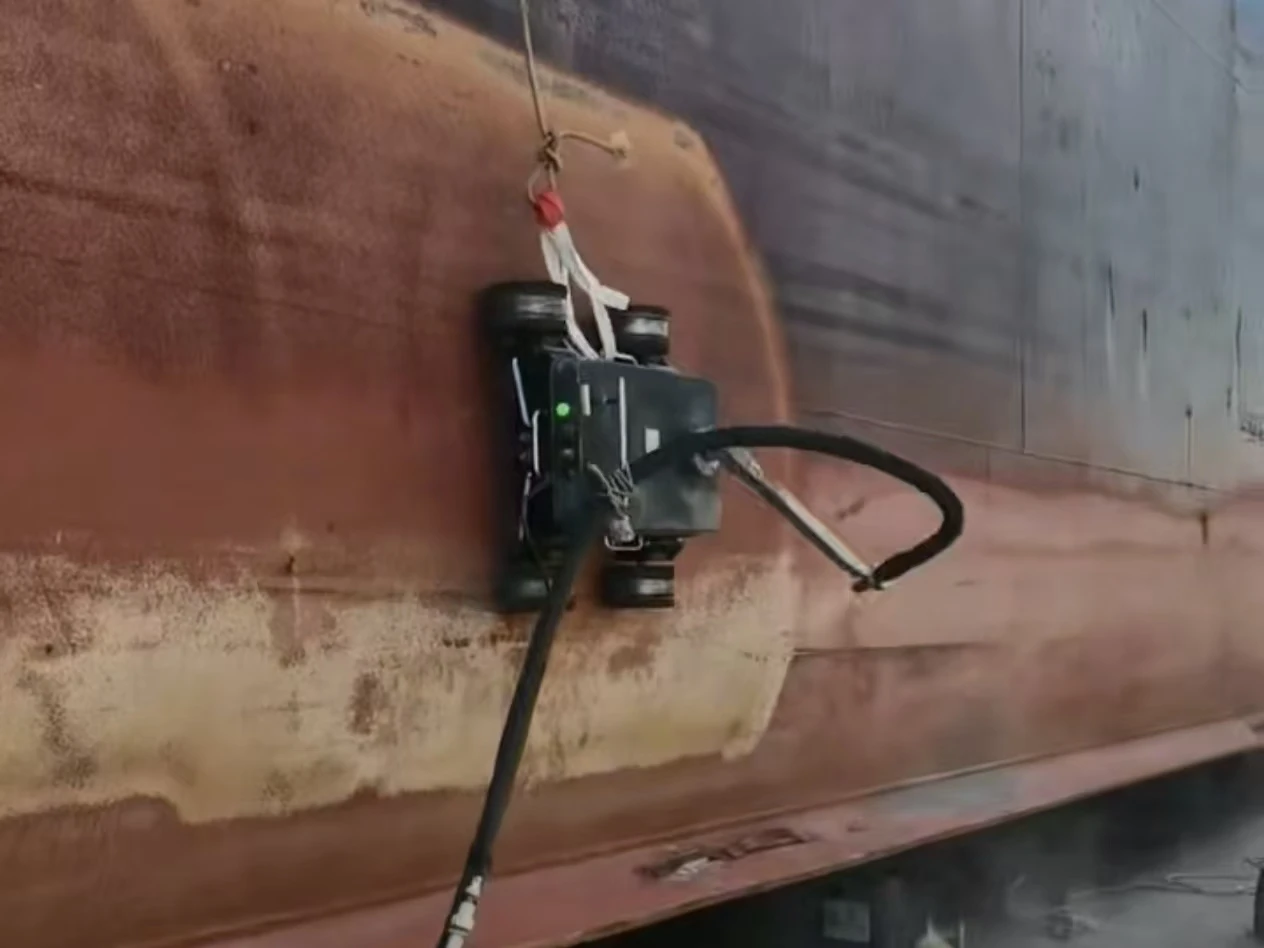
The JT-1-H uses permanent magnetic wheel adhesion to lock onto steel hull surfaces, the same magnetic technology that powers Jingtao Energy’s JT-2 wall-climbing robot for above-water tank maintenance. Unlike vacuum-based systems that lose grip on curved or rough surfaces, magnetic wheels hold firm on ship hulls, platform legs, and FPSO sides.
Key specifications:
- Operating depth: Up to 50 meters
- Adhesion: Permanent magnetic wheels, no external power needed to stay attached
- Control: Remote operated, single operator
- Cleaning mechanism: Rotating disc with interchangeable brushes/pads
- Surface compatibility: Steel hulls, platform legs, monopile foundations
- Coating-safe: Adjustable pressure preserves antifouling coatings, no accidental stripping
The rotating cleaning disc adapts to hull curvature automatically. The operator watches a live camera feed and adjusts speed and pressure, the same way our JT-1-S marine robot handles above-waterline high-pressure water jetting.
The Economics: One Robot, Zero Downtime
A vessel that docks twice every five years for hull cleaning spends 14–28 days in dry-dock for biofouling alone. With the JT-1-H, hull cleaning becomes a between-voyage maintenance item, done at anchor, at berth, during cargo operations. No schedule disruption.
Conservative estimate for a medium-sized tanker operating 300 sea days/year:
| Cost Category | Traditional (Dry-Dock 2×/5yr) | JT-1-H (In-Water 6×/year) |
|---|---|---|
| Direct cleaning cost (5yr) | $300K–$1M | ~$150K–$300K |
| Lost charter revenue (5yr) | $350K–$1.7M | $0 |
| Fuel penalty from fouling | ~$540K extra (avg. 10% drag) | ~$108K extra (avg. 2% drag with frequent cleaning) |
| 5-year total | $1.19M–$3.24M | $258K–$408K |
The spread is wide because it depends on vessel type, trade route, and water temperature, but the direction is consistent. Frequent in-water cleaning with the JT-1-H costs 60–80% less over a 5-year cycle than the dry-docking alternative.
Environmental Angle: Invasive Species and the IMO
The IMO’s Biofouling Guidelines (2023 revision) are tightening. Port states, starting with Australia, New Zealand, and California, now inspect hulls and can deny entry to vessels with visible heavy fouling. The risk isn’t just fuel cost anymore; it’s port access.
Biofouling is the primary vector for invasive aquatic species transfer. A single vessel can carry dozens of non-native species on its hull from one port to another. The IMO classifies this as a major threat to marine biodiversity, ranking alongside ballast water discharge.
The JT-1-H addresses this directly. Frequent, gentle cleaning prevents heavy fouling from establishing in the first place, the most effective form of biofouling management, according to the IMO’s own hierarchy of controls.
Where the JT-1-H Fits in Your Fleet
The JT-1-H isn’t just for ship hulls. Common deployment scenarios:
- Offshore platform legs and braces, combined with JT-1-F for above-water corrosion removal
- FPSO hulls, continuous on-site cleaning without dry-tow to a repair yard
- Monopile wind turbine foundations, growing fleet of 12,000+ offshore turbines globally needs routine maintenance
- Lock gates and dock infrastructure, stationary steel structures that accumulate growth
- Naval vessels, where dry-docking frequency is dictated by operational tempo, not hull condition
For a deeper dive on the economics of robotic vs. manual maintenance, read our earlier analysis: Robots vs. Workers: The Economic Ledger of Wall-Climbing Equipment.
The Bigger Picture: Jingtao Energy’s Robotics Portfolio
The JT-1-H is one member of a growing family of magnetic-adhesion robots. Each is purpose-built for a specific environment:
- JT-2, four-wheel-drive tank crawler for large-diameter storage tanks and ship hulls above water
- JT-1-F, grinding and rust removal robot for wind turbine towers and steel structures
- JT-1-S, high-pressure water jetting for marine corrosion removal above the waterline
- JT-1 Mini, explosion-proof compact crawler for confined spaces and ATEX zones
- JT-1-H, the underwater specialist
If you’re running a fleet, an offshore platform, or a port facility, adding add an underwater robot to your maintenance toolkit makes financial sense for most operators.
Contact Jingtao Energy for JT-1-H specifications and pricing
Related reading: Confined Space, Zero Risk: Automating Tank and Hull Maintenance · Robotic vs. Manual Anti-Corrosion: Breaking the Scaffolding Deadlock · Real Reviews from Frontline Operators on Wall-Climbing Robots
Technical Data Sheet
| Parameter | Specification |
|---|---|
| Operating Depth | Up to 50 m |
| Adhesion Method | Permanent magnetic wheels, zero external power required |
| Control | Remote operated, single operator |
| Cleaning Mechanism | Rotating disc with interchangeable brushes/pads |
| Coating Protection | Adjustable pressure — preserves antifouling coatings, no stripping |
| Surface Compatibility | Steel hulls, platform legs, monopile foundations |
| Minimum Curvature Radius | 5 m |
| Operation Environment | In-water at anchor, berth, or during cargo operations |
| 5-Year Cost vs. Dry-Docking | 60–80% reduction |
Data sourced from Jingtao Energy JT-1-H product specifications and IMO Biofouling Guidelines (2023 revision) cost models. Fuel penalty figures based on IMO MEPC standard hull friction coefficients.
Frequently Asked Questions
What surface types can Jingtao wall-climbing robots operate on?
The magnetic adhesion system works on carbon steel, stainless steel, and coated surfaces with curvature radii down to 5 meters. The robots maintain grip on vertical, overhead, and curved surfaces.
How does robotic maintenance reduce confined space entry risk?
By performing surface preparation, coating, and inspection tasks remotely, the robots eliminate the need for workers to enter confined tanks and vessels, reducing permit-to-work requirements by over 90%.
Technical Data Sheet
| Parameter | Specification |
|---|---|
| Operating Depth | Up to 50 m |
| Adhesion Method | Permanent magnetic wheels, zero external power required |
| Control | Remote operated, single operator |
| Cleaning Mechanism | Rotating disc with interchangeable brushes/pads |
| Coating Protection | Adjustable pressure — preserves antifouling coatings, no stripping |
| Surface Compatibility | Steel hulls, platform legs, monopile foundations |
| Minimum Curvature Radius | 5 m |
| Operation Environment | In-water at anchor, berth, or during cargo operations |
| 5-Year Cost vs. Dry-Docking | 60–80% reduction |
Data sourced from Jingtao Energy JT-1-H product specifications and IMO Biofouling Guidelines (2023 revision) cost models. Fuel penalty figures based on IMO MEPC standard hull friction coefficients.
Need help choosing the right equipment?
Our engineers review your application and recommend the best fit — no obligation.