How to Select Tank Maintenance Equipment: Abrasive Blasting, Water Jetting, and Coating Guide
Key Takeaways
- Manual tank maintenance costs $8–15 per square foot when scaffolding, labor, and downtime are factored in — robotic systems cut this by 40–60%.
- Abrasive blasting delivers Sa 2.5 surface cleanliness at ~30 m²/h with a single robot — matching the output of a 3-person manual crew without the confined-space risk.
- Permanent-magnet adhesion robots tolerate surface irregularities up to 5 mm and operate on vertical, overhead, and curved tank walls without rigging.
- Equipment choice depends on three variables: tank geometry (diameter, height, roof type), coating failure mode (corrosion, delamination, chemical attack), and access constraints (manhole size, internal structures).
- Explosion-proof certification (Ex db ib IIB T4 Gb) is non-negotiable for hydrocarbon storage tanks — verify before procurement.
The Real Cost of Manual Tank Maintenance
Storage tank maintenance is not a cleaning job — it is a production shutdown. Every day a crude oil or refined product tank sits empty for inspection and recoating, revenue stops flowing. Yet most operators still default to what they have always done: erect scaffolding, send crews into confined spaces with handheld blasting guns, and accept the 2–3 week timeline as inevitable.
The numbers tell a different story. A standard 40-meter floating-roof crude tank has roughly 2,800 m² of internal surface area. At manual blasting rates of 6–8 m²/h per nozzle, surface preparation alone consumes 8–12 shifts with a 3-person crew — before a single liter of coating is applied. Add scaffold erection (3–5 days), coating application, cure time, and inspection, and a full tank turnaround easily stretches to 18–25 days.
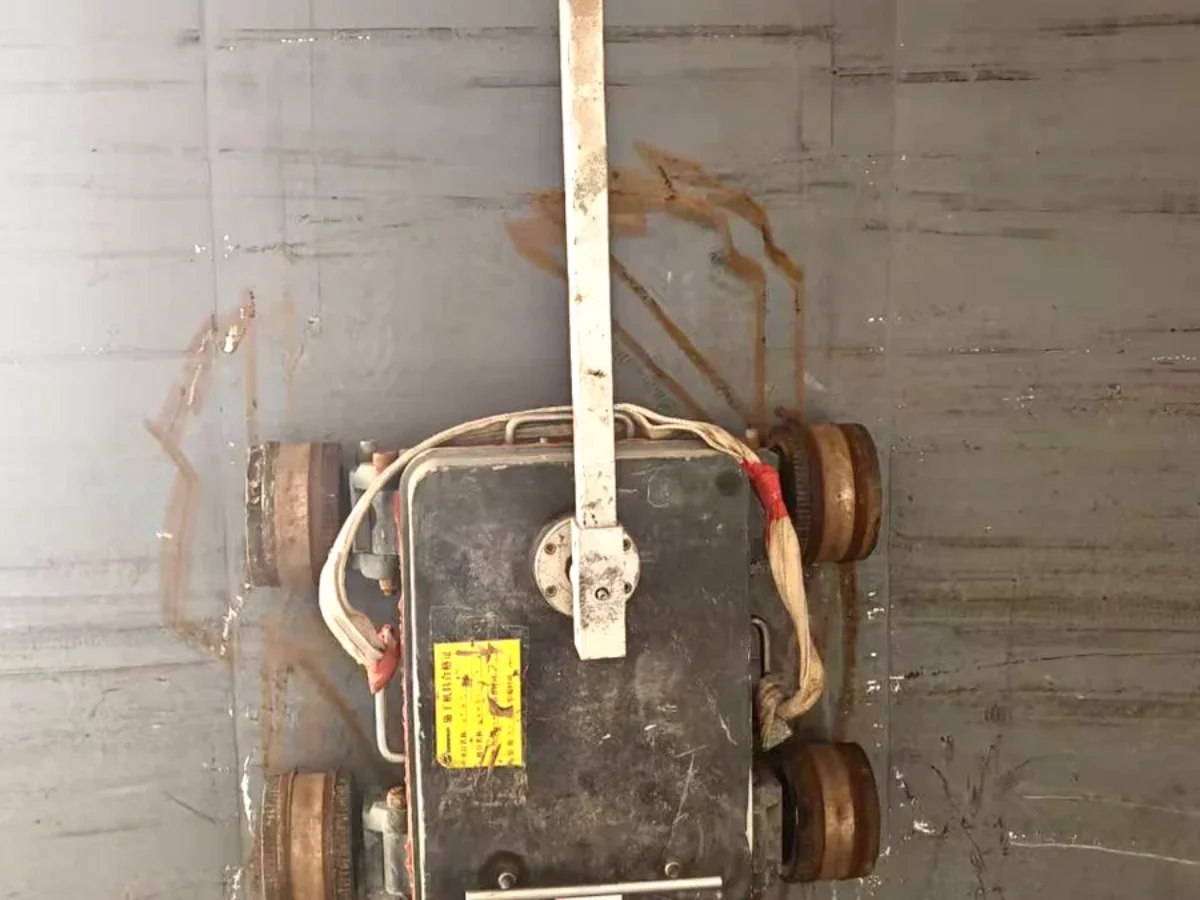
Robotic systems change this equation. A single magnetic-adhesion robot running abrasive blasting at 30 m²/h covers the same 2,800 m² in under 100 operating hours — approximately 5–6 shifts with a 2-person support crew. No scaffolding. No confined-space entry for blasting. No fall-protection rigging for vertical surfaces. The robot walks the wall.
Three Surface Preparation Methods — And When to Use Each
Not every tank needs the same treatment. The method depends on what you are removing and what coating system follows. Here is how the three main approaches compare:
| Method | Best For | Surface Result | Speed | Key Trade-off |
|---|---|---|---|---|
| Abrasive Blasting | Heavy corrosion, mill scale, old coating removal before epoxy/polyurethane systems | Sa 2.5, 40–70 μm profile | ~30 m²/h | Requires abrasive recovery and dust collection system |
| Water Jetting (UHP) | Soluble salts, light rust, hydrocarbon residue — when dry blasting sparks are prohibited | Wa 2–2.5, flash rust risk | ~300 m²/h | No profile creation; coating adhesion depends on chemical bonding |
| Mechanical Scarifying | Spot repairs, weld seams, edge preparation — localized touch-up | St 2–3 (variable) | 2–5 m²/h | Labor-intensive; not suitable for full-tank coverage |
For most refinery and terminal tanks coming off a 10–15 year inspection cycle, abrasive blasting is the default choice — it creates the anchor profile that epoxy coatings need for 15+ year service life. Water jetting is gaining ground in gas-free environments where spark risk is zero-tolerance, but operators must apply the first coat within 4 hours before flash rust sets in.
Matching Equipment to Tank Type
Tank geometry drives equipment selection more than any other variable. A robot that works brilliantly on a 40-meter crude tank may be useless on a 5-meter diesel day-tank with internal heating coils. Use this decision framework:
| Tank Type | Key Constraint | Recommended Setup | Notes |
|---|---|---|---|
| Large crude storage (Ø30–60 m, H12–18 m) | Vertical wall height, floating roof internals | Abrasive blasting robot + cyclone recovery system | Full setup: robot ($58K) + blasting unit + dust collection ($20.5K). 2-person support crew. |
| Refined product tanks (gasoline, diesel, jet fuel) | Strict gas-free requirements, lighter coating systems | UHP water jetting robot | No spark risk. Add inhibitor to wash water to delay flash rust. 300 m²/h throughput. |
| Small day-tanks / buffer tanks (<Ø10 m, internal coils) | Tight access, internal structures | Compact robot + manual touch-up on obstructions | Robot fits through 600 mm manhole. Coils and baffles still need manual work. |
| Oily water / slop tanks | Heavy hydrocarbon residue, mixed solids | Water jetting for degreasing → abrasive blasting for profile | Two-pass approach. Degrease first to avoid contaminating blast media. |
| Spheres and bullets (LPG, NGL) | Curved geometry, limited footroom | Magnetic-adhesion robot, reduced speed | Minimum curvature diameter of 3 m for standard robots. Smaller spheres require custom end-effectors. |
Robot vs Manual: The Economics
Let us put numbers on a typical scenario: a 40 m × 12 m crude oil storage tank requiring full internal blasting to Sa 2.5 and a 3-coat epoxy system. Internal surface area: ~2,800 m².
| Cost Item | Manual (3-Person Crew) | Robotic (1 Robot + 2 Operators) |
|---|---|---|
| Scaffolding | $12,000–18,000 (erect + dismantle) | $0 (robot walks the wall) |
| Surface prep labor | ~140 person-hours × $35/h = $4,900 | ~200 person-hours × $35/h = $7,000 |
| Abrasive media | $2,500–3,500 | $2,000–2,800 (better recovery = less waste) |
| Coating application | Manual spray: $6,000–8,000 | Robot spray: $3,000–4,000 (100 m²/h, uniform thickness) |
| Confined-space safety | Gas monitor + attendant + rescue: $4,000–6,000 | $1,500–2,500 (reduced entry hours) |
| Total per tank | $29,400–39,400 | $13,500–16,300 |
At 2–3 tanks per year, the robot pays for itself within 12–18 months on scaffolding and safety cost savings alone — before accounting for faster turnaround and reduced production downtime.
Safety: Why Confined-Space Entry Should Be the Last Resort
API 653 inspection cycles force operators to open tanks — but opening a tank does not require putting people inside it for surface preparation. Confined-space incidents in the oil and gas sector remain stubbornly high, with atmospheric hazards (oxygen deficiency, H₂S, combustible vapors) accounting for over 60% of fatalities according to U.S. Bureau of Labor Statistics data. The NACE SP0188 standard for discontinuity testing recommends robotic methods where feasible to minimize human entry.
A robotic system eliminates the highest-risk activities:
- No entry for blasting: The robot deploys through the manhole on a tether. Operators remain outside, monitoring via onboard camera.
- Explosion-proof by design: Ex db ib IIB T4 Gb certification means the robot can operate in Zone 1 and Zone 2 areas where flammable gases may be present. Surface temperature never exceeds 135°C.
- 48V DC power: Low-voltage DC eliminates the electrocution hazard of portable 220V/480V equipment dragged across wet tank floors.
- Zero fall exposure: No scaffolding, no harnesses, no vertical work at height. The magnetic adhesion holds 70 kg payload on vertical walls with a 4x safety factor.
Five Questions to Ask Before You Buy
Not every magnetic robot fits every tank. Run through these before procurement:
- What is the smallest manhole on this tank? — Standard robots need 600 mm. If your tank has 500 mm manholes, verify clearance.
- Are internal structures (heating coils, support columns, floating-roof legs) obstacles or manageable? — Robots handle flat and gently curved surfaces. Coils and complex geometries still need manual touch-up.
- What is the substrate — carbon steel, stainless, or clad? — Magnetic adhesion only works on ferromagnetic steel. Aluminum and stainless tanks need vacuum-adhesion alternatives.
- Is the environment Zone 1 or Zone 2 classified? — Verify the robot’s Ex certificate matches the hazard zone. Ex db ib IIB T4 Gb covers most petroleum environments but not hydrogen or acetylene.
- What coating system follows? — Abrasive blasting (Sa 2.5 profile) for epoxy/urethane systems; water jetting (Wa 2) for surface-tolerant coatings. Don’t buy a blasting robot if your spec calls for water jetting.
The Bottom Line
Tank maintenance equipment selection is not about finding the most powerful machine — it is about matching the tool to the tank, the coating spec, and the operational constraints. A robotic system with modular end-effectors (blasting, painting, water jetting on the same chassis) gives operators the flexibility to handle multiple tank types without buying three separate machines.
The economics have shifted. At $82,400 for a complete blasting + painting system with dust recovery, the robot costs less than the scaffolding for two large-tank turnarounds. For operators maintaining fleets of 5+ tanks, the question is no longer “can we afford a robot?” — it is “can we afford to keep doing this manually?”
Frequently Asked Questions
What surface preparation standard can a wall-climbing robot achieve?
A magnetic-adhesion abrasive blasting robot achieves Sa 2.5 (near-white metal blast cleaning) per ISO 8501-1, with a surface profile of 40–70 μm per ISO 8503. This matches the requirements for high-performance epoxy and polyurethane coating systems specified in NACE No. 2 / SSPC-SP 10. The robot maintains consistent standoff distance and traverse speed, producing a more uniform profile than manual blasting — no operator fatigue, no variation between shifts.
Can the robot operate inside a tank with flammable vapors?
Yes — provided the robot carries the appropriate explosion-proof certification. The JT-1 system is certified Ex db ib IIB T4 Gb, suitable for Zone 1 and Zone 2 hazardous areas where ethylene, propane, and similar gas groups may be present. The maximum surface temperature is limited to 135°C (T4 class). For tanks that previously contained hydrogen or acetylene (IIC gas group), consult the manufacturer for alternative certification options.
How does abrasive blasting compare to water jetting for tank maintenance?
Abrasive blasting creates a mechanical anchor profile (40–70 μm) that epoxy coatings physically grip — essential for 15+ year coating service life. Water jetting removes contaminants and failed coating but does not create profile; coating adhesion relies on chemical bonding alone, typically delivering 8–12 year expected life. Blasting is slower (~30 m²/h vs ~300 m²/h for water jetting) but produces longer-lasting results. Decision rule: choose blasting when coating warranty matters; choose water jetting when speed and spark-free operation are the priorities.
What tank sizes and shapes can a magnetic robot handle?
Standard magnetic-adhesion robots operate on carbon steel walls with a minimum curvature diameter of 3 meters — covering virtually all API 650 storage tanks. The robot body measures 750 × 450 × 550 mm and passes through a 600 mm (24-inch) manhole, the standard access size. At 60 kg, it requires two people for deployment but no lifting equipment. Internal structures — heating coils, support columns, floating-roof legs — still need manual touch-up. The robot handles the ~85% of surface area that is unobstructed wall and floor plate.
What is the payback period for a robotic tank maintenance system?
For an operator maintaining 2–3 large storage tanks per year, the payback period is 12–18 months based on scaffolding elimination alone ($12,000–18,000 saved per tank turnaround). When factoring in reduced labor hours, faster turnaround (5–6 days cut from a typical 18–25 day schedule), and lower abrasive consumption (closed-loop recovery captures 90%+ of media for reuse), total cost savings reach 40–60% per tank. The robot chassis with modular end-effectors handles blasting, painting, and water jetting on one platform, avoiding separate equipment purchases for each process.
Can one robot handle both blasting and painting?
Yes. Modular end-effector design allows the same robot chassis to switch between abrasive blasting (~30 m²/h) and airless spray painting (100 m²/h) in approximately 15 minutes. The magnetic-adhesion drive system works identically for both operations. This eliminates the need for separate blasting and coating robots, cutting capital equipment cost and simplifying operator training. The same chassis also accepts a water jetting module for cleaning-only applications.
Explore Jingtao’s Tank Maintenance Solutions
JT-1 Wall-Climbing Robot — Modular blasting, painting, and water jetting platform. 60 kg, 600 mm manhole access, Ex db ib IIB T4 Gb certified.
Case Studies — See how operators are using robotic surface preparation to cut tank turnaround times.
Request a Quote — Tell us about your tank fleet and we will recommend the right configuration.
Related Resources
- Robots vs Workers: The Economic Ledger
- Magnetic vs Vacuum: Wall-Climbing Kung Fu
- Confined Space, Zero Risk: Tank and Hull Maintenance
Data sources: NACE SP0188-2023 (discontinuity testing), ISO 8501-1 (surface preparation standards), ISO 8503 (surface profile comparators), manufacturer specifications. Economic figures based on 2026 U.S. Gulf Coast contractor rates and a 40 m × 12 m crude oil storage tank typical of API 650 construction. Actual costs vary by region, tank condition, and local labor rates.
Need help choosing the right equipment?
Our engineers review your application and recommend the best fit — no obligation.