
9,848 Hours Off-Grid: A Gas Genset Long-Run Case
By Jingtao Energy · Case study
Opening
Most generator case studies are written on commissioning day. The unit is clean, the load bank is connected, the photograph is taken, and nobody hears about the machine again.
This one is written after 9,848 running hours.
That is the whole point. A generator that runs for a week on a test bench proves that it starts. A generator that has logged 9,848 hours at an off-grid oilfield proves something different: that the gas it was fed, the load it carried, and the way it was maintained were good enough to keep it turning, day after day, in a place where nobody drives past with a spare part.
The photograph below is a generator controller, not a demo screen and not a test sheet. It is the unit's own hour meter, read on 27 October 2026. Everything in this article hangs off those numbers.
The evidence
This is what the controller showed on 27 October 2026, exactly as the machine recorded it.
| Reading | Value | What it means |
|---|---|---|
| Run hours | 9,848 h | The unit has actually run this long. Not “available for”, not “installed since” — running. |
| Energy generated | 1,626,863 kWh | Roughly 1.63 million kWh delivered to the field. |
| Starts | 154 | The unit has been started 154 times. It cycles; it is not a machine switched on once and left. |
| Average output | ≈165 kW | Energy divided by run hours. A derived figure, and we say so. |
| Frequency setting | 60 Hz | Set for the receiving standard at this site. |
| Status line | “Gens normal running” | No active alarm at the moment the photograph was taken. |
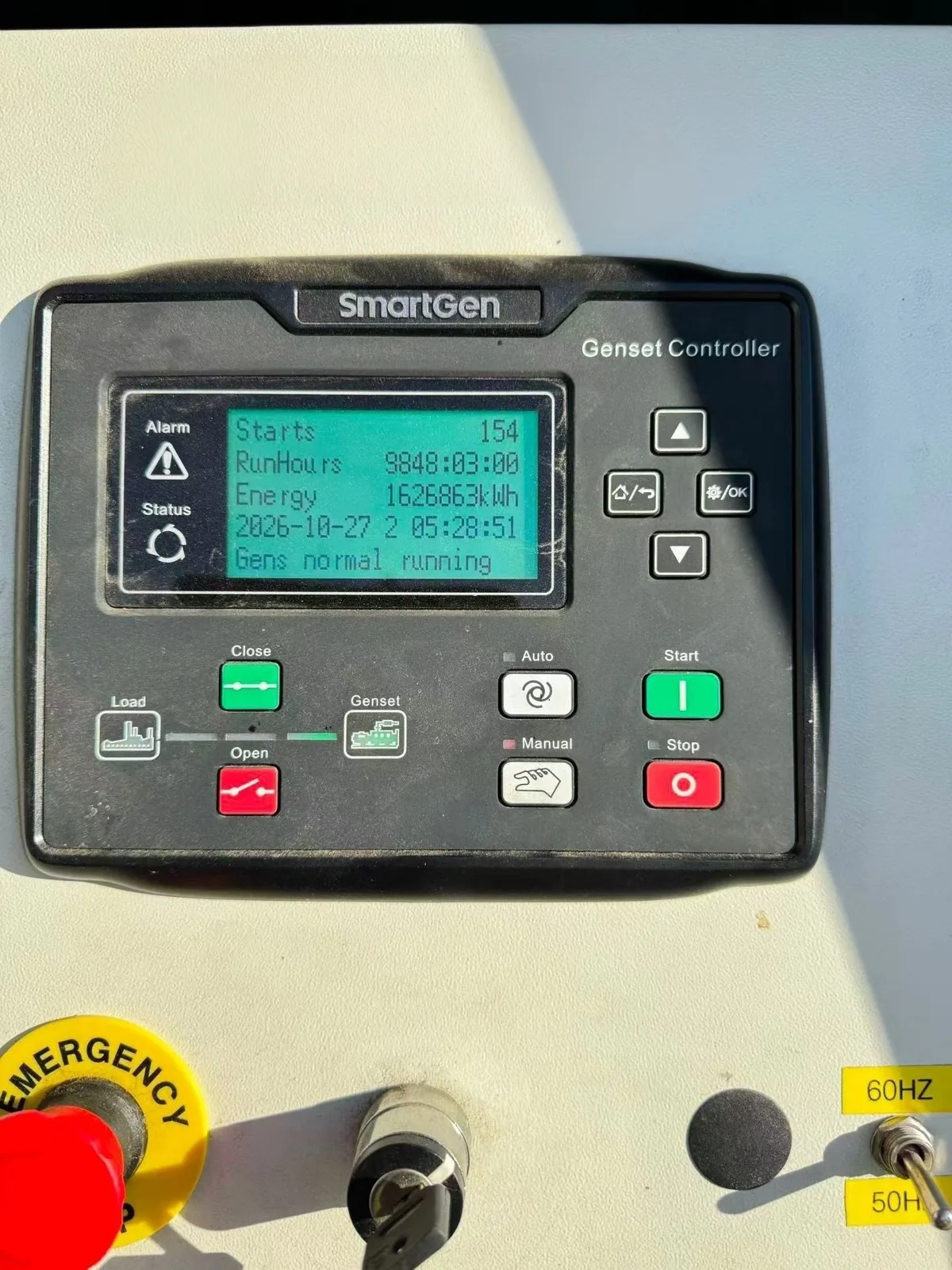
Two rows deserve more than a glance. Average output is not a number the controller prints directly; it is 1,626,863 kWh divided by 9,848 hours, roughly 165 kW, and we label it derived because that is what it is. The starts counter at 154 says this is a working unit on a real load, not a base-load machine left running untouched. And the status line is the least dramatic row, which is exactly why we show it: “Gens normal running” is what you want a controller to say at hour 9,848.
Why this site needs generation
The field is not connected to a grid. That single fact changes the economics of everything else on site. Artificial lift runs on electricity. Instrumentation runs on electricity. The camp runs on electricity. In a northern off-grid oilfield there is no utility to call and no feeder to tap.
At the same time, the well produces gas alongside the oil — associated gas — and that gas has nowhere to go. Historically the answer was a flare tip: burn it off and be done with it. The gas has a value problem, not an availability problem. There is plenty of it; what is missing is somewhere useful to put it.
So the site holds two problems that cancel each other out: it needs power it cannot buy, and it is burning fuel it cannot sell. A gas generator set closes that loop — the associated gas is conditioned, fed to an engine, and turned into electricity at the point of use. One waste stream becomes the site's power supply.
What raw associated gas does to an engine
Associated gas is not pipeline gas. It comes up the wellbore with the crude, carrying whatever the reservoir and the gathering system happen to throw at it: water vapour, heavier hydrocarbon fractions, fine solids, and occasionally compounds that will eat a combustion chamber if given the chance. Supply pressure swings with the well, not with what the engine would prefer.
Feed that straight into a gas engine and the failure mode is predictable. Water condenses in the fuel train and washes lubrication where it should not be. Heavy ends drop into liquid droplets that foul valves and wet the cylinder. Solids score the parts they pass. Pressure swings make combustion unstable, and an engine that stumbles is an engine that knocks, and an engine that knocks is an engine that shortens its own life.
None of this is a reason not to use associated gas. It is a reason to treat the gas before the engine sees it: water removed, heavy ends dropped out, solids filtered, pressure regulated. The conditioning skid is not an accessory; at this duty it is the difference between a machine that logs nine thousand hours and one that logs a few hundred before it starts losing power and eating plugs.
The installation
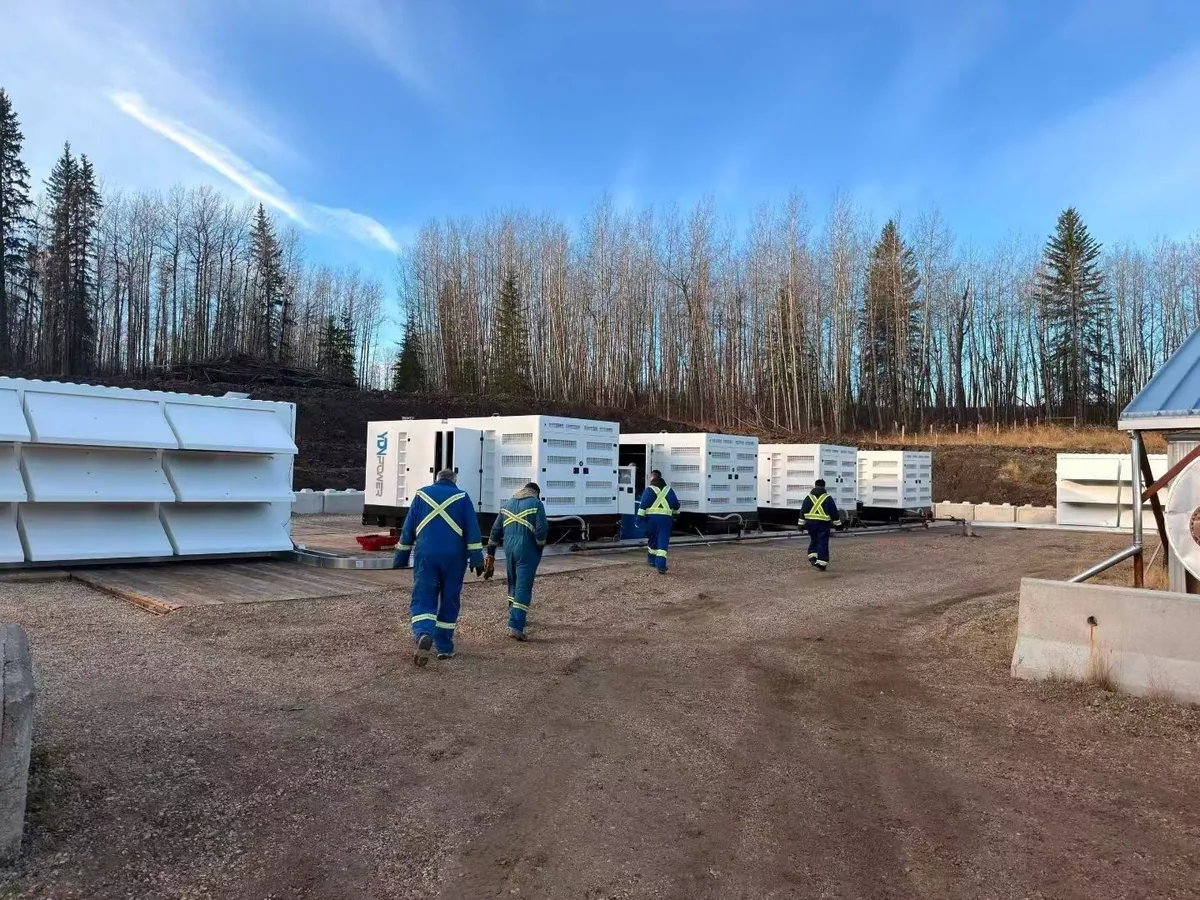
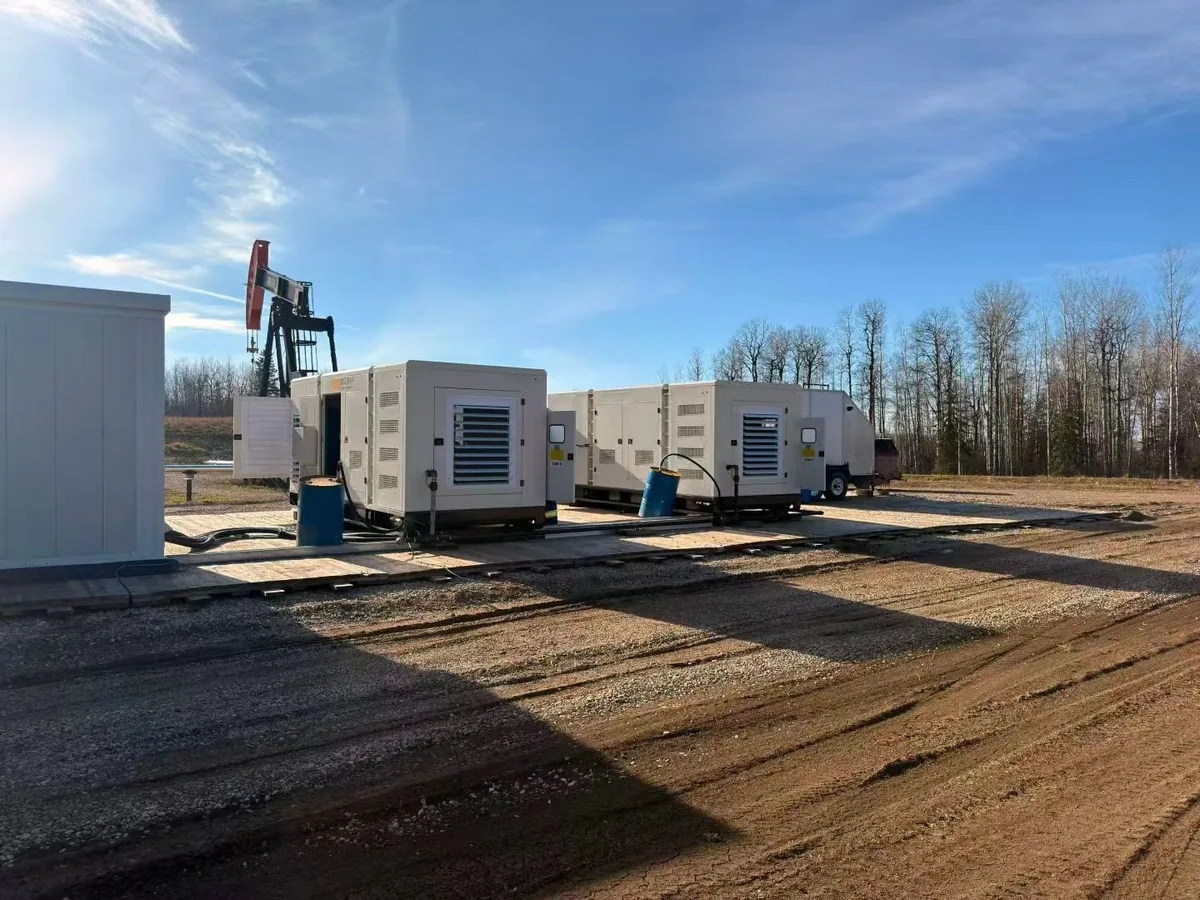
Four containerised generator sets sit side by side on a timber deck beside the wellpad, next to a beam pumping unit. Each enclosure carries the engine, alternator, control panel and cooling system in one transportable package. That is what makes an off-grid site practical: the unit arrives as a box, is lifted onto a prepared pad, connected to the gas line and the load, and starts.
Three details in the photographs matter more than they first appear.
The deck. Timber matting keeps the units out of ground frost and melt water. In a northern field the foundation problem is not the weight of the machines; it is the ground moving twice a year, freezing and thawing. A rigid slab cracks under that cycle; a timber deck floats with the ground and can be re-levelled.
The enclosure. Cooling and combustion air pass through louvres. In this climate the radiator and water system are packaged inside the container so nothing freezes while a unit sits on standby. The coldest start is the design case, not the average day.
The control panel. One controller handles start/stop, load switching, alarms and hour metering. That is also why the run-hour figure in this article exists at all: the data is logged by the machine, not by us.
Load profile
Most people ask about rated power. The more useful number in this photograph is the average output, and it is roughly 165 kW.
Rated power is what the machine can do for a while. Average output is what it actually did over its whole life — every idle minute, every ramp, every cold start. Energy divided by run hours does not flatter the machine; it understates capability, because it already includes every moment the engine was not at full load.
An engine that sits in the middle of its load band for years is the least dramatic and most commercially important operating pattern a generator can have. It is not being asked to sprint; it is being asked to hold a steady, useful output without being thrashed.
The starts counter says the site does cycle the machine. One hundred and fifty-four starts over the run means the unit is started and stopped in response to a real, varying load, not left running flat out against a load bank. The control logic is doing real work — shedding, restarting, following demand. A steady average over a cycling load is what an off-grid oilfield actually looks like.
What 9,848 hours means operationally
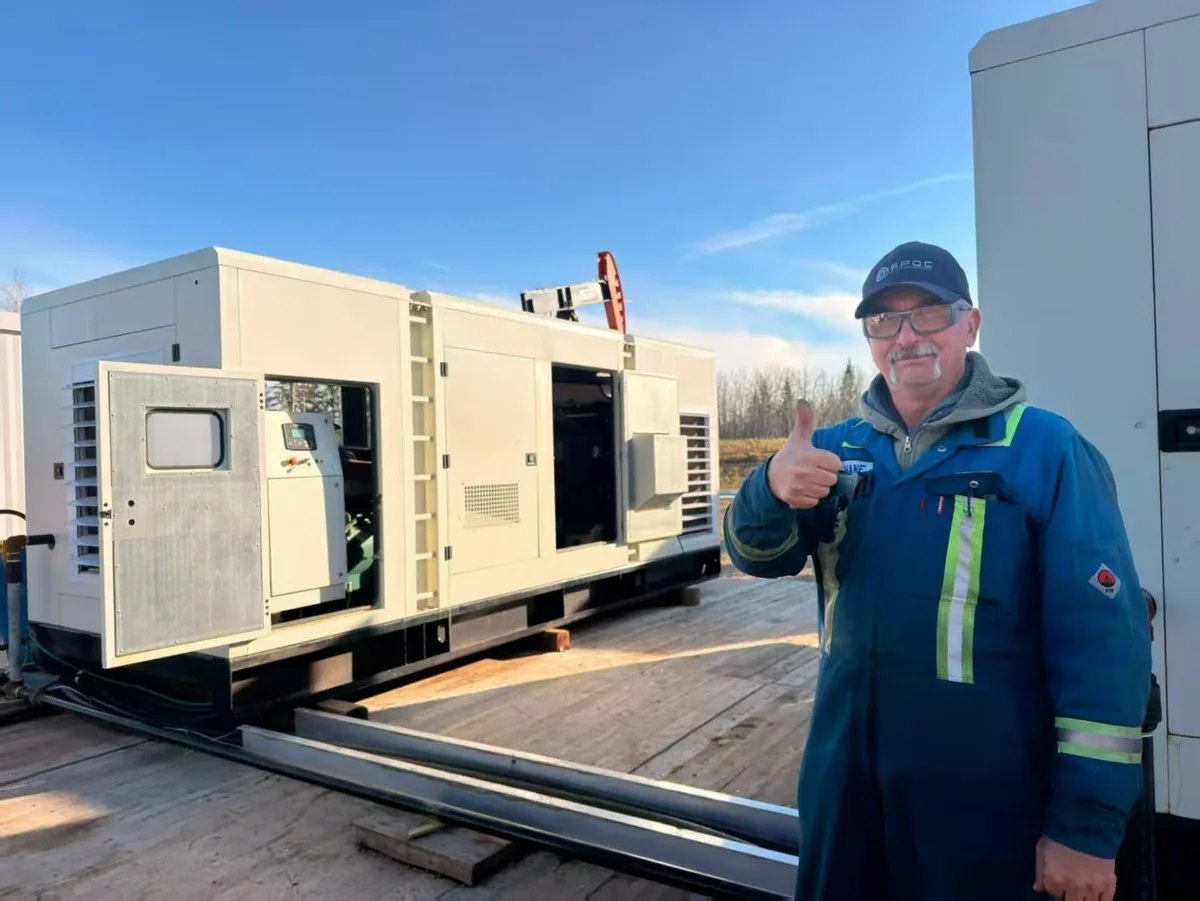
Nine thousand hours is not won by the engine alone. Three things decide whether a site like this reaches it.
Gas quality. The conditioning skid upstream has to keep doing its job for every one of those hours. If water or heavy ends get through, the engine pays for it slowly, then all at once. Gas quality is not a commissioning item; it is a continuous obligation.
Load discipline. The unit averages about 165 kW rather than running flat out, and it is started and stopped as the field needs it. Generators held at moderate, steady load outlast generators cycled hard between idle and overload. The 154 starts say the site is not asking the machine to do anything clever — just to start when called, carry the load, and stop clean.
Spares and response. This is the unglamorous part. Filters, plugs and oil, changed on time, by someone who knows the machine, with parts kept on site rather than in a warehouse days away. A service interval you cannot actually meet is not a service plan. The unit that logs nine thousand hours is the one whose filters were changed before they were due, including the times nobody photographed it.
The economics, written as a formula
The business case for burning associated gas on site is simple enough to write down, with no figure attached, because the figure belongs to the site, not to us.
On one side of the ledger, the field gets electricity. Before the gensets, that electricity either did not exist or had to be made another way — typically by trucking in and burning a liquid fuel, the most expensive way to make power when you are far from a road. On the same side, the associated gas stops being a waste stream: gas to a flare produces nothing, while gas through an engine produces the power the site was already paying for. The waste stream and the power demand are one problem in two forms.
On the other side sits what it takes to keep the loop closed: the machines themselves, the gas conditioning skid, and the ongoing care — filters, oil, parts and people.
The decision reduces to one comparison: the value of the electricity, plus the value of not flaring, against the outlay to build and run the loop. Every site answers differently, which is why we print the formula rather than a figure. The formula is the honest part.
What this case does not prove
A set of photographs and a controller reading prove a narrow thing, and we will say what they do not prove.
They do not prove the same result in a desert at extreme heat, where the cooling system faces the opposite problem. They do not prove anything about sour gas — gas carrying sulphur compounds — unless it is treated first, and treatment is a separate engineering question. They do not prove anything about high-altitude sites, where thinner air derates the engine. They do not prove anything about a load profile the unit was never asked to carry.
Altitude, ambient temperature, gas composition and load profile all move the outcome. That is why a site assessment comes before a quotation, not after. If a supplier tells you one successful installation transfers everywhere, the installation is not the thing they are selling.
If you are sizing a similar site
Four inputs decide the configuration, and none of them is a number we can guess for you.
Gas available per day, and its composition. This sets the ceiling on what you can generate and decides the conditioning scope. The gas analysis is the first document, not the last.
The electrical load, and whether it is steady or cyclical. A field that runs one beam pumping unit around the clock is a different design from a camp that spikes at mealtimes and in winter.
The ambient temperature range. The coldest start is the design case. Engines, batteries, coolant and enclosures are all specified to the worst morning, not the average one.
Whether the site will ever be grid-connected. Oversizing for a grid that arrives in three years is a common and expensive mistake; the set right for the interim may be exactly wrong the day the line arrives.
Size to the gas you actually have and the load you actually carry, and the configuration mostly decides itself.
Handover and who answers at 2 a.m.
A machine that runs for nine thousand hours does not do it by itself. Somewhere there is a commissioning record, and someone who knows the machine well enough to answer the phone when it is dark and cold and the controller has thrown an alarm nobody has seen before.
That is what a handover actually is — not a set of keys and a manual, but a documented operating envelope (gas pressure, load limits, alarm behaviour) plus the spares and the people to act on it. A remote site needs a response path that works at 2 a.m.: the local operator who knows the machine, backed by a remote engineer who can read the same controller data and say what it means.
The controller in these photographs is the handover. Every start, every hour, every kilowatt is logged by the machine and can be read back remotely. When the site calls, the first question is not “what happened” — it is “what does the unit say happened”. A generator that records its own history is a generator you can support from a thousand kilometres away.
Frequently asked questions
How long do containerised gas gensets last in off-grid duty?
Engine life is set by load profile, gas quality and how maintenance is actually done, not by calendar age. A unit held at moderate, steady load and fed clean, conditioned gas runs for years before major work; the machine here is still well short of that point at 9,848 hours. The honest answer depends on the site, which is why we ask for the gas analysis and the load curve first.
Can associated gas be used directly, straight from the well?
Not raw. Associated gas carries water vapour, heavy hydrocarbon fractions and solids, and its supply pressure moves with the well. Water condenses in the fuel train, heavy ends foul valves, solids score parts, and pressure swings make combustion unstable. The gas must be conditioned first — water removed, heavy ends dropped, solids filtered, pressure regulated — and the scope is sized from the gas analysis, not a rule of thumb.
What happens when the field load is lower than the unit rating?
Part-load operation is normal; this site averages about 165 kW rather than running at its rating. Engines run happiest mid-band. Too light and combustion quality falls off; too hard and you trade engine life for output. Multi-unit sites use load-following control for exactly this reason — shed units when the load drops, bring them back when it climbs — rather than holding one oversized machine at low load.
Is 60 Hz or 50 Hz available?
Both. The controller in the photograph is set to 60 Hz because that is the receiving standard here; the same platform is built at 50 Hz for other regions. The frequency setting is a configuration choice, not a different machine. The selector on the panel exists precisely so the set is matched to the site, not the other way around.
How is a containerised unit transported to a remote site?
As a standard containerised package, by road, rail or sea, with lifting points on the frame so a crane can set it straight onto the pad. Site preparation is a level, drained base — timber or concrete — plus the gas connection and cable entry. No building to erect, no foundations to pour. The photograph shows the result: four units side by side on timber matting, connected and running.
Why does the timber deck matter so much in a northern field?
Because the ground in a cold region moves. It freezes and heaves, then thaws and settles, twice a year. A rigid concrete slab cracks under that cycle; a timber deck floats with the ground and can be re-levelled. It also keeps the units out of spring melt water. The foundation problem here is not the weight of the machines — it is the ground refusing to stay still.
What does 154 starts tell you about how the site runs?
That the unit is cycled against a real, varying load rather than left running flat out. One hundred and fifty-four starts over the run means it starts when the field needs power and stops when it does not — load-following control in practice. Every cold start, ramp and shutdown is already inside the average-output figure, so the number you see is the whole story, not a flattering slice.
What is the biggest mistake people make when sizing a similar site?
Sizing for a grid that has not arrived yet, or for a gas supply that is not actually there. Oversizing for a future grid connection wastes capital and leaves an engine running lightly, which shortens its life. Sizing to a gas rate the well cannot sustain leaves the site short when it matters most. Size to the gas you actually have and the load you actually carry today.