Electromagnetic Wax Prevention for Oil Wells: Field Data on Workover Frequency
At a Glance
| Metric | Value |
|---|---|
| Wells deployed | 800+ units, 260+ wells documented |
| Workover/cleaning interval | From every 7-10 days to 30+ days (Yumen Y4-6) |
| Units installed in 2024 alone | 400+ (Qinghai Oilfield dominant) |
| Longest-running unit | 10 years (installed 2014) |
| Power draw | 650 W per unit |
| Field strength / range | 60-80 mT / ≥1,500 m |
| Chemicals | None — physical method |
The most under-counted cost of paraffin is not the chemical bill. It is the workover. This case study looks at wax prevention through the frequency lens: how often a well must be shut in, cleaned, and returned to service — and what happens to that number when electromagnetic (EM) prevention is installed. The field data comes from 800+ units deployed across China’s major onshore basins since 2014, with the pattern now extending overseas through CNPC and Sinopec EPC projects.
The Problem Nobody Puts on the Spreadsheet: Workovers
Wax management is usually budgeted as a treatment line: chemicals per month, hot oil per quarter, scraping runs as needed. The line that rarely gets its own column is the workover frequency — how often a well must stop producing so crews can go downhole and remove what accumulated. That is where the real money sits, because a wax-driven intervention carries the full cost of an intervention: rig or workover unit mobilization, crew time, fuel, and every barrel of deferred production while the well is down.
A high-wax rod-pump well on a 7-10 day cleaning cycle is not a maintenance nuisance — it is a permanently interrupted production asset. Every cleaning run is a small workover. Multiply that across a field of 100+ rod-pump wells and the frequency number becomes the operating budget. The conventional response — chemical programs, hot oiling, mechanical scraping — manages the symptom at the frequency it is already at. None of them change the interval itself.
What a Workover Really Costs
The cost structure of a wax-driven intervention has four layers, and only the first one shows up in the treatment budget:
Direct intervention cost — the crew, equipment, and consumables for each cleaning or scraping run.
Deferred production — the barrels not produced while the well is shut in, which no budget line captures until year-end.
Mobilization in remote fields — in fields 200 km from the nearest service base, getting a crew to the well often costs more than the treatment itself.
Risk exposure — every intervention puts personnel on location and downhole tools in the well; fewer interventions means fewer chances for an incident.
The industry’s own literature treats wax deposition as a recurring production-loss problem across vertical and deviated wells, with removal typically scheduled around mechanical scraping and thermal or chemical treatment [¹]. The frequency is the variable nobody optimizes — because the tools available historically only removed wax; they did not prevent its return.
The One-Time Fix Installed Inside a Scheduled Workover
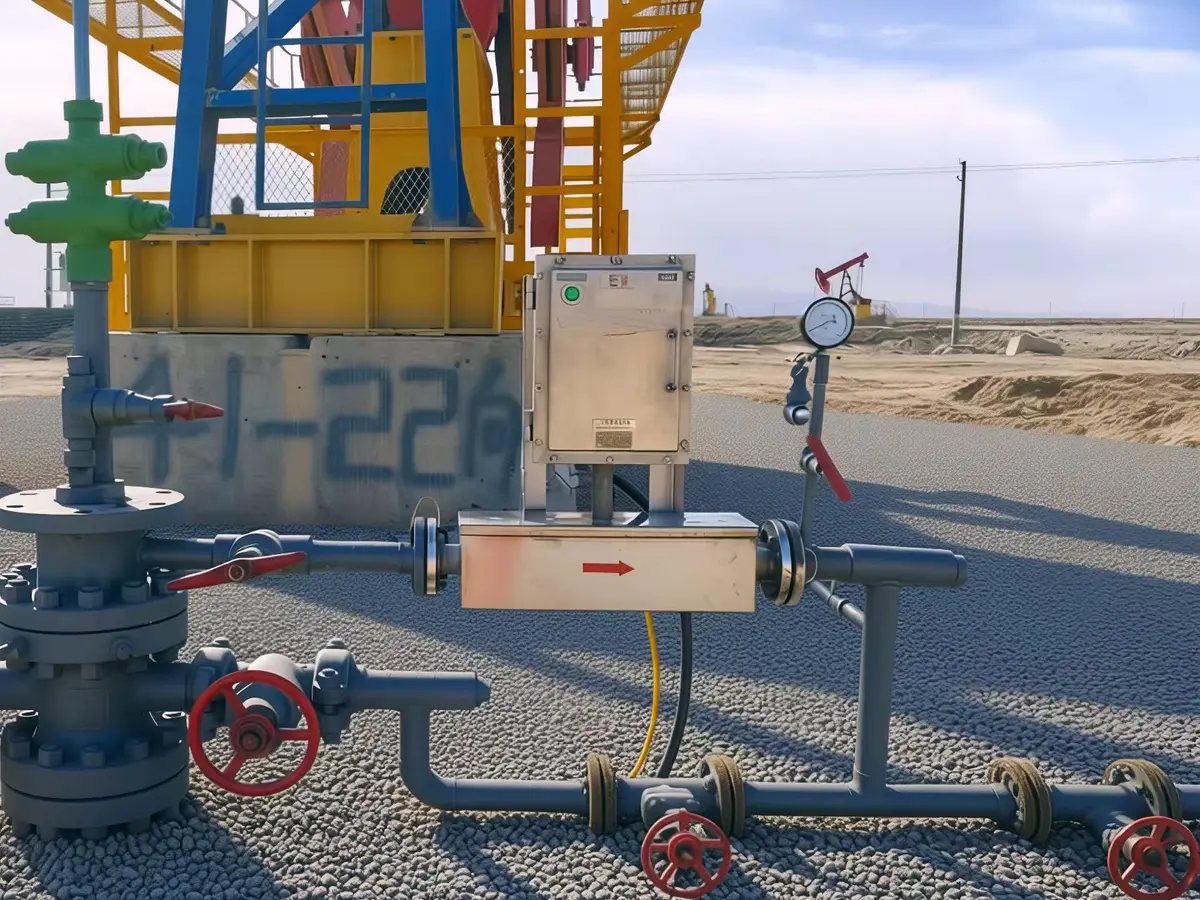
Electromagnetic prevention changes the frequency directly. The system mounts on the wellhead flowline — a compact electromagnetic coil exposing produced fluid to a sweeping low-frequency magnetic field before it enters the surface pipeline. Three physical effects act in parallel: wax crystal nucleation is suppressed (lowering the wax appearance temperature by 3-5°C), precipitated micro-crystals stay dispersed in the oil instead of adhering to the pipe wall, and hydrogen-bond perturbation keeps the fluid mobile. Laboratory testing at China University of Petroleum confirmed wax solubility increases by over 5.5× under field exposure, and the magnetic memory effect persists for more than 4 hours after the fluid leaves the coil.
Installation is designed to ride a scheduled workover — which makes the retrofit economics clean: a two-person crew completes the install in 2-3 hours (shut in, clean the flowline, insert the coil via flanged or clamp connection, energize, restart). The unit draws 650 W, runs 24/7 with no consumables, and the only failure mode observed in 10 years of field history is an isolated power-supply module fault, field-replaceable in under 30 minutes. Once installed, the well’s wax-control cost becomes a capital line, not a recurring service line.
The physics behind it is not new — Soviet researchers documented magnetic effects on crude crystallization in the 1960s — but the engineering that makes it deployable at a wellhead is: compact semiconductor-driven coils (1990s onward), full-frequency sweeping that cycles the entire effective band for real crudes (C18-C60+ chain lengths), and a gradient algorithm that allocates energy to the frequency windows where a given well’s wax responds most strongly. Jingtao Energy scaled this into China’s oilfields and ruggedized it for Qinghai’s winters and Xinjiang’s +50°C summers.
Field Data: What the Frequency Numbers Say
The cleanest frequency data point comes from Yumen Y4-6, a well whose paraffin required cleaning every 7-10 days. After installation, the well ran stable for more than a month without intervention — the cleaning interval stretched from single-digit days to 30+ days, and the stabilization pattern held. That is not a one-well anecdote; it is the mechanism the whole fleet runs on:
| Field / Well | Before | After |
|---|---|---|
| Yumen Y4-6 | Cleaning every 7-10 days | Stable 30+ days, no intervention |
| Qinghai (1st-5th production plants) | High-altitude, severe cold, recurring wax work | Largest deployment base; 400+ units in 2024 alone |
| Shengli offshore platform | Marine salt-spray environment | Marine-climate housing, uninterrupted operation |
| Xinjiang (Tarim & others) | Desert heat, +50°C ambient | High-temperature configuration in service |
| Yanchang | 85%+ water cut | Effective viscosity reduction at high water fraction |
The scale behind the pattern: the deployment base grew from roughly 260 documented wells to 800+ units, with 400+ units installed in 2024 alone. The longest-running unit has been in continuous service since 2014 — ten years — with no recorded coil burnout, magnet degradation, or housing breach in any configuration. The failure record across the fleet is a single recurring item: an occasional power-supply module fault, replaceable in under 30 minutes.
The economics follow the frequency. When cleaning intervals stretch from days to weeks, the avoided cost of each cancelled intervention — crew, fuel, mobilization, deferred production — accumulates monthly, and the comparison stops being “chemical vs. magnetic” and becomes “recurring service vs. one-time capital.” The full cost comparison is in our lifecycle cost analysis: EM vs. chemical over five years.
Well Screening: Which Wells Qualify
Not every well is a candidate — and saying so is part of the engineering honesty. The system performs best on rod-pump (beam pump) wells with moderate to high liquid rates. Wells screened out during pre-deployment assessment:
Free-flowing (self-flowing) wells — the gas fraction interrupts magnetic field continuity.
Wells with excessive gas fraction.
Extreme asphaltene-rich crude — above ~10% asphaltene or wax appearance temperature above 52°C.
Wells already on electric submersible pumps or with insufficient energy.
Before installation, Jingtao requests a wax sample, basic PVT data, and the operator’s current cleaning frequency and cost — the same data used to estimate the frequency improvement. The screening criteria are detailed in the 800-well deployment case study.
The Overseas Path: Following EPC Projects
Direct overseas deployment is still building, and we do not pretend otherwise. The system currently reaches international fields the way Chinese oilfield technology usually does — indirectly. When CNPC or Sinopec wins an international development contract, the EM wax prevention units ride along as part of the production facility package. That path has already placed units in Oman (PDO project), prepared a trial in Russia (Gazprom), and established a Nigerian entry via local agent, with Iran under active discussion.
People Also Ask
Does electromagnetic wax prevention stop workovers entirely?
No — it removes wax-driven interventions as a recurring event. Workovers driven by other causes (pump failure, sand, scale) are outside the system’s scope. What changes is the frequency: the wax-driven cleaning cycle stretches from days to weeks, which is what removes the recurring cost line.
How long does an EM wax prevention unit last?
The longest-running unit has been in service since 2014 — ten years — with no recorded coil burnout or magnet degradation. The only failure mode observed across the 800+ unit fleet is an isolated power-supply module fault, replaceable in under 30 minutes.
What does electromagnetic wax prevention cost per well?
The commercial structure is a one-time capital cost per wellhead rather than a recurring chemical bill. The economic case is driven by the frequency change: every cancelled cleaning or intervention saves its full cost — crew, fuel, mobilization, and deferred production. The payback period depends on the well’s current cleaning frequency and local costs; Jingtao provides a same-week assessment from the well’s wax sample, PVT data, and current cleaning record.
Which wells are not suitable for EM wax prevention?
Free-flowing wells, wells with excessive gas fraction, and wells producing extreme asphaltene-rich crude (above ~10% asphaltene or wax appearance temperature above 52°C) are screened out. Rod-pump wells with moderate to high liquid rates are the primary fit.
Frequently Asked Questions
How does electromagnetic wax prevention reduce workover frequency?
The wellhead-mounted coil exposes produced fluid to a sweeping low-frequency magnetic field (60-80 mT) that suppresses wax crystal nucleation, keeps micro-crystals dispersed in the oil, and disrupts hydrogen bonding — so wax stops accumulating on the pipe wall. Field data shows cleaning intervals stretching from every 7-10 days to 30+ days (Yumen Y4-6), which removes the recurring intervention cycle entirely.
What data anchors back the 800+ well figure?
The deployment base grew from roughly 260 documented wells to 800+ units across China’s major onshore basins, with 400+ units installed in 2024 alone and Qinghai Oilfield as the dominant base. The longest-running unit has been in service since 2014. The Yumen Y4-6 well documented the 7-10 day to 30+ day interval change.
Can EM wax prevention be installed on an offshore platform?
Yes — a dedicated marine-climate housing provides corrosion protection for salt-spray and high-humidity environments, already deployed on Shengli Oilfield’s offshore platforms in Bohai Bay. Core parameters (650 W, 60-80 mT, ≥1,500 m effective range) are identical to land units; only the enclosure changes.
What is the difference between electromagnetic prevention and chemical wax control?
Chemical control is a continuous operating expense — pour-point depressants and dispersants are injected year-round. EM prevention is a one-time capital install that removes the recurring line: no consumables, no waste stream, 650 W of electricity. The five-year lifecycle comparison is in our EM vs. chemical LCC analysis.
How does Jingtao deploy outside China?
Overseas deployment follows CNPC and Sinopec EPC projects — units ride along as part of the production facility package when a Chinese national oil company wins an international development contract. This has placed units in Oman (PDO project) and Nigeria (via local agent), with a Gazprom trial in preparation and Iran under discussion.
Eliminate the Workover Line Item
Send your well parameters — wax appearance temperature, current cleaning frequency, flow rate, and well type — and our engineering team will assess technical fit and estimate the frequency improvement within a week.
Request a Quote — provide your well data for a technical assessment and commercial proposal within one week.
Download Brochure — full technical specifications, dimensional drawings, and field case library.
Related: Electromagnetic Wax Prevention product page · 800-well case study · Wax prevention at scale (blog)
[¹] “Preventing and removing wax deposition inside vertical wells: a review”, Journal of Petroleum Exploration and Production Technology (Springer) — https://link.springer.com/article/10.1007/s13202-019-0609-x