800+ Wells, Zero Chemicals: Electromagnetic Wax Prevention at Scale
Jingtao Energy’s electromagnetic wax prevention system has been deployed on over 800 oil wells across China’s major onshore basins — from Shengli on the east coast to Qinghai on the Tibetan Plateau, from Xinjiang’s desert fields to Changqing’s tight-oil plays. Every unit runs on physics alone: no chemical injection, no hot oil circulation, no mechanical scraping. The result is a maintenance window that stretches from days to months, with near-zero operating cost.
1. At a Glance
| Metric | Value |
|---|---|
| Wells deployed | 800+ |
| Field strength | 60–80 mT |
| Power consumption | 650 W per unit |
| Effective depth | ≥ 1,500 m |
| Magnetic memory | > 4 hours |
| Operating temperature | > 90°C |
| Continuous runtime | 24/7, zero chemicals |
| Longest-running unit | 10 years (installed 2014) |
2. The Challenge
Paraffin deposition is one of the oldest and most recurring problems in oil production. As crude flows from the reservoir toward the surface, temperature drops and pressure decreases. Wax molecules precipitate out of solution, crystallize on the pipe wall, and progressively choke the flow path. Left unchecked, a producing well can go from full output to plugged solid in under a week.
The Cost of Conventional Wax Management
Chemical programs require continuous injection of pour-point depressants and wax dispersants — year-round operating expenditure that never goes away. Hot oil or hot water circulation ties up a workover rig, consumes fuel, and disrupts production for hours per cycle. Mechanical scraping is labor-intensive and exposes crews to HSE risk with every trip. In remote fields — 200 km from the nearest service base — the logistics cost of chemical delivery or workover mobilization often exceeds the treatment cost itself.
For a field with 100+ rod-pump wells, even a modest wax problem translates into a multi-million-dollar annual operating line item that never improves. The industry needed a one-time install that eliminates the operating cost entirely.
3. The Solution
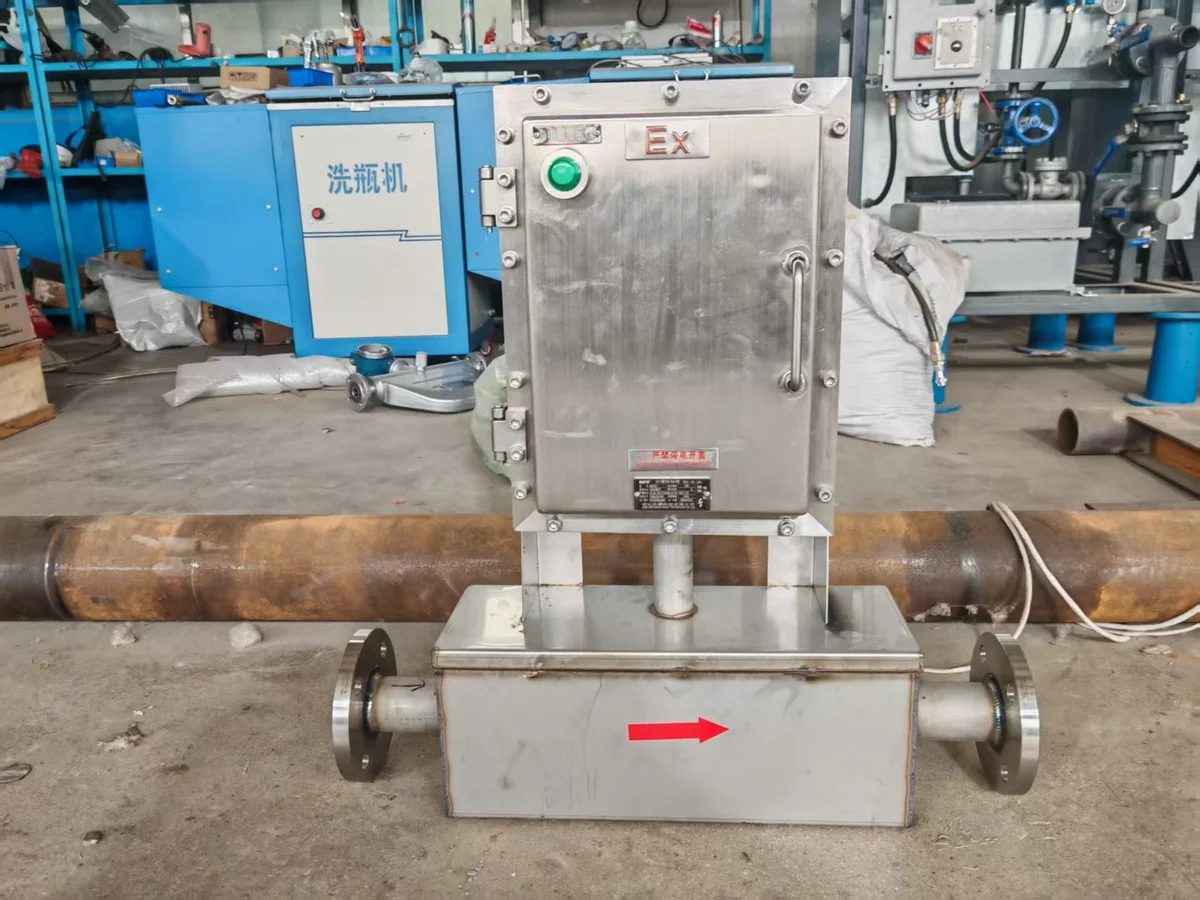
The Jingtao Energy EM wax prevention system mounts directly onto the wellhead flowline — a compact electromagnetic coil that exposes the produced fluid to a sweeping low-frequency magnetic field before it enters the surface pipeline. No chemicals. No moving parts. No daily human intervention.
How the Physics Works
Three well-documented mechanisms act in parallel when crude oil passes through a controlled magnetic field:
- Anti-magnetic effect — wax crystal nucleation is suppressed, lowering the wax appearance temperature by 3–5°C.
- Magnetically induced colloidal suspension — precipitated micro-crystals remain dispersed in the oil phase instead of adhering to the pipe wall.
- Hydrogen-bond perturbation — the field disrupts intermolecular forces that drive wax aggregation, keeping the fluid mobile.
Laboratory testing at China University of Petroleum confirmed wax solubility increases by over 5.5× under field exposure (Test Report No. JTDX-2023-WAX-07, 2023). The magnetic memory effect persists for more than 4 hours after the fluid leaves the coil — long enough to reach the gathering station even at low flow rates.
Full-Frequency Sweeping vs. Fixed-Frequency
First-generation EM devices used a single fixed frequency, which worked well for waxy crudes within a narrow carbon-number range. Real crude is a distribution — C18 through C60+, each chain length responding to a different resonance window. Jingtao Energy’s system employs full-frequency sweeping that cycles through the entire effective band, combined with a gradient algorithm that allocates more energy to the frequency bands where the well’s specific wax composition responds most strongly. This closed-loop optimization runs autonomously on an MCU control board — no PLC, no network connection required.
4. Implementation
Deployment Process
A typical installation takes a two-person crew 2–3 hours from shutdown to restart:
- Shut in the well and clean the flowline of existing wax (hot wash or mechanical scraping).
- Cut a section out of the wellhead discharge line and insert the EM coil unit via flanged or clamp connection.
- Tighten all fittings and verify pressure integrity — rated to 2.5, 4, or 6 MPa depending on wellhead conditions.
- Connect 380 V power, energize the coil, and restart production.
The unit draws 650 W — less than a small household microwave. It runs 24 hours a day, 365 days a year, with no consumables and no scheduled maintenance beyond an occasional visual inspection. The only failure mode observed in 10 years of field history is an isolated power-supply module fault, replaced in under 30 minutes.
Three Housing Configurations
| Configuration | Application | Key Feature |
|---|---|---|
| Marine climate housing | Offshore platforms, coastal fields | Corrosion-resistant enclosure for salt spray and high humidity |
| Land explosion-proof housing | Classified hazardous zones | EX-certified enclosure meeting GB 3836 standards |
| Standard housing | Conventional onshore wells | Weatherproof steel enclosure with dual-side heat sinks |
All three configurations share the same core — 650 W, 60–80 mT field, ≥ 1,500 m effective range — and are available in DN50, DN80, or DN100 flow diameters to match any wellhead piping spec. The system is inherently modular: swap the housing to match the environment without touching the internals.
Well Screening
Not every well is a candidate. The system performs best on rod-pump wells with moderate to high liquid rates. Free-flowing (self-flowing) wells, wells with excessive gas fraction, and wells producing extreme asphaltene-rich crude (> 10% asphaltene, wax appearance temperature > 52°C) are screened out during the pre-deployment assessment. Before installation, Jingtao Energy requests a wax sample, basic PVT data, and the operator’s current cleaning frequency and cost to confirm technical fit and estimate the economic case.
5. Results
Field Data at Scale
The system has accumulated over a decade of operational data across China’s most demanding basins. The deployment base grew from roughly 400 units in 2024 to over 800 units in 2026, with the majority of growth concentrated in Qinghai Oilfield, where low ambient temperatures and high paraffinic crude create one of the toughest wax-fighting environments in the world.
| Oilfield | Conditions | Outcome |
|---|---|---|
| Qinghai (1st–5th Plants) | High-altitude desert, severe winter cold | Largest deployment base; 400+ units installed in 2024 alone |
| Shengli — Offshore | Marine platform, salt-spray exposure | Marine-climate housing; uninterrupted operation |
| Xinjiang (Tarim & others) | Desert heat, +50°C ambient | Enhanced heat-sink configuration; meets high-temperature spec |
| Yumen Y4-6 | Paraffin required cleaning every 7–10 days | Stable production > 1 month post-installation without intervention |
| Yanchang | 85%+ water cut | Effective viscosity reduction even at high water fraction |
| Changqing & Jilin | Tight oil, low permeability | Deployed and operating |
Reliability Track Record
- Longest continuously running unit: 10 years (installed 2014, still operational).
- Only reported failure mode: occasional power-supply module fault, field-replaceable in under 30 minutes.
- No recorded coil burnout, no magnet degradation, no housing breach in any configuration.
- MCU-based control board eliminates PLC complexity — fewer components, fewer failure points.
Economic Impact
Because the system eliminates the recurring operating cost of chemical injection or periodic workovers, the economic case is straightforward. In fields where paraffin buildup previously required cleaning every few days, the avoided cost of chemicals, fuel, labor, and deferred production typically recovers the capital outlay within the first year. After that, the well operates at near-zero incremental cost for wax control. The system has been strongly adopted by CNPC and Sinopec operating companies, who value the combination of 24/7 protection and hands-off operation in remote locations where sending a crew is half the battle.
6. Why This Matters
The jump from 400 units to 800+ units is not just a larger number — it signals an industry shift in how operators think about wax management. For decades, paraffin was treated as a service problem: you paid for chemicals, you paid for hot oil trucks, you paid for slickline crews. It was a recurring line item, not a solvable engineering challenge.
From Recurring Cost to Capital Decision
Electromagnetic prevention reframes the problem entirely. Instead of budgeting for wax control every year, an operator makes a one-time capital decision during a scheduled workover, then removes the line item from future budgets. For fields with 50, 100, or 500 rod-pump wells, the cumulative savings scale linearly — every new installation permanently reduces the field’s operating cost baseline.
A Technology With Roots in Cold War Physics
The underlying principle was discovered in the 1960s by Soviet researchers who observed that crude oil exposed to a magnetic field exhibited altered crystallization behavior. The physics was sound, but the engineering was not: 1960s electromagnets were massive, power-hungry, and impossible to deploy at the wellhead. The breakthrough came in the 1990s, when advances in semiconductor manufacturing enabled compact, high-efficiency magnetic coils that could be packaged into a pipe-mounted device weighing under 100 kg. Jingtao Energy scaled this technology in China’s oilfields, refining the frequency-sweeping algorithm and ruggedizing the hardware for everything from Qinghai’s −30°C winters to Xinjiang’s +50°C summers.
Global Reach Through National Oil Company EPCs
While Jingtao Energy does not yet deploy directly in overseas fields, the system follows CNPC and Sinopec EPC projects abroad. When a Chinese national oil company wins an international development contract — in the Middle East, Africa, or Central Asia — the EM wax prevention units ride along as part of the production facility package. This indirect path has already placed units in Oman (PDO project), Russia (Gazprom trial in preparation), and Nigeria (via local agent), with Iran under active discussion.
People Also Ask
What is electromagnetic wax prevention?
Electromagnetic wax prevention is a physical treatment method that applies a controlled low-frequency magnetic field (60–80 mT) to crude oil at the wellhead. Jingtao Energy’s system uses full-frequency sweeping to suppress wax crystal nucleation, keep micro-crystals suspended in the oil phase, and disrupt hydrogen bonds that cause aggregation — all without chemicals.
How much power does an electromagnetic wax prevention unit use?
Each Jingtao Energy unit draws 650 W of continuous power — less than a small household microwave. At typical industrial electricity rates, this translates to only a few dollars per month in operating cost.
What is the payback period for electromagnetic wax prevention?
Operators typically recover the equipment cost within the first year through avoided chemical purchases, fuel savings, reduced workover mobilization, and deferred production. After payback, the incremental cost of wax control is effectively zero.
How long does an electromagnetic wax prevention system last?
The longest-running Jingtao Energy unit has operated continuously for 10 years since 2014. The system is designed as a fit-and-forget device with no scheduled maintenance and no consumables.
7. Frequently Asked Questions
Q: How does electromagnetic wax prevention work without chemicals?
A low-frequency magnetic field (60–80 mT) is applied to the crude oil as it passes through a coil mounted on the wellhead flowline. This field triggers three physical effects simultaneously: it suppresses wax crystal nucleation (anti-magnetic effect), keeps any micro-crystals that do form dispersed in the oil rather than adhering to the pipe wall (magnetically induced colloidal suspension), and disrupts the hydrogen bonds that drive wax aggregation. These are purely physical mechanisms — no chemical injection, no consumables, no waste stream.
Q: What well types are suitable for EM wax prevention?
The system is designed for rod-pump (beam pump) wells with moderate to high liquid production rates. It can tolerate some associated gas but is not recommended for free-flowing (self-flowing) wells where the gas fraction disrupts the magnetic field continuity. Wells with extreme asphaltene content (> 10%) or wax appearance temperatures above 52°C are screened out during pre-deployment assessment. A simple wax sample and basic production data are enough to confirm technical suitability.
Q: How long does installation take and what maintenance is required?
A trained two-person crew can complete a standard installation in 2–3 hours: shut in, clean the flowline, cut and insert the coil unit, tighten flanges, connect power, restart. The system is designed as a fit-and-forget device. There is no scheduled maintenance calendar. The only failure mode observed in over 10 years of field history is an isolated power-supply module fault, which is field-replaceable in under 30 minutes with a single spare part. No coil burnout, no magnetic degradation, and no housing breach have been recorded across the 800+ installed base.
Q: How does the economic payback compare to chemical programs?
Chemical wax control is a continuous operating expense — you pay for chemicals every month, forever. EM prevention is a one-time capital cost that replaces that recurring line item. In fields where paraffin previously required cleaning every few days, operators typically recover the equipment cost within the first year through avoided chemical purchases, fuel savings, reduced workover mobilization, and deferred production that would have been lost during cleaning downtime. After payback, the incremental cost of wax control is effectively zero — only the 650 W of electricity, which costs a few dollars per month at any industrial power rate.
Q: Can the system be used on offshore platforms?
Yes. A dedicated marine-climate housing provides corrosion protection for salt-spray and high-humidity environments. This configuration has been deployed on Shengli Oilfield’s offshore production platforms in Bohai Bay and is available for any offshore operator. The core parameters — 650 W, 60–80 mT, ≥ 1,500 m — are identical to the land-based units; only the external enclosure changes.
Ready to Eliminate Wax-Related Downtime?
Send your well parameters — wax appearance temperature, current cleaning frequency, flow rate, and well type — and our engineering team will assess technical fit and provide a same-week proposal.
Request a Quote
Download Brochure