Case Study: JT Wall-Climbing Robots Eliminate Confined Space Risk in Singapore Refinery Tank Maintenance
At a Glance
- Location: Pulau Bukom Refinery, Singapore , Southeast Asia’s largest petroleum complex
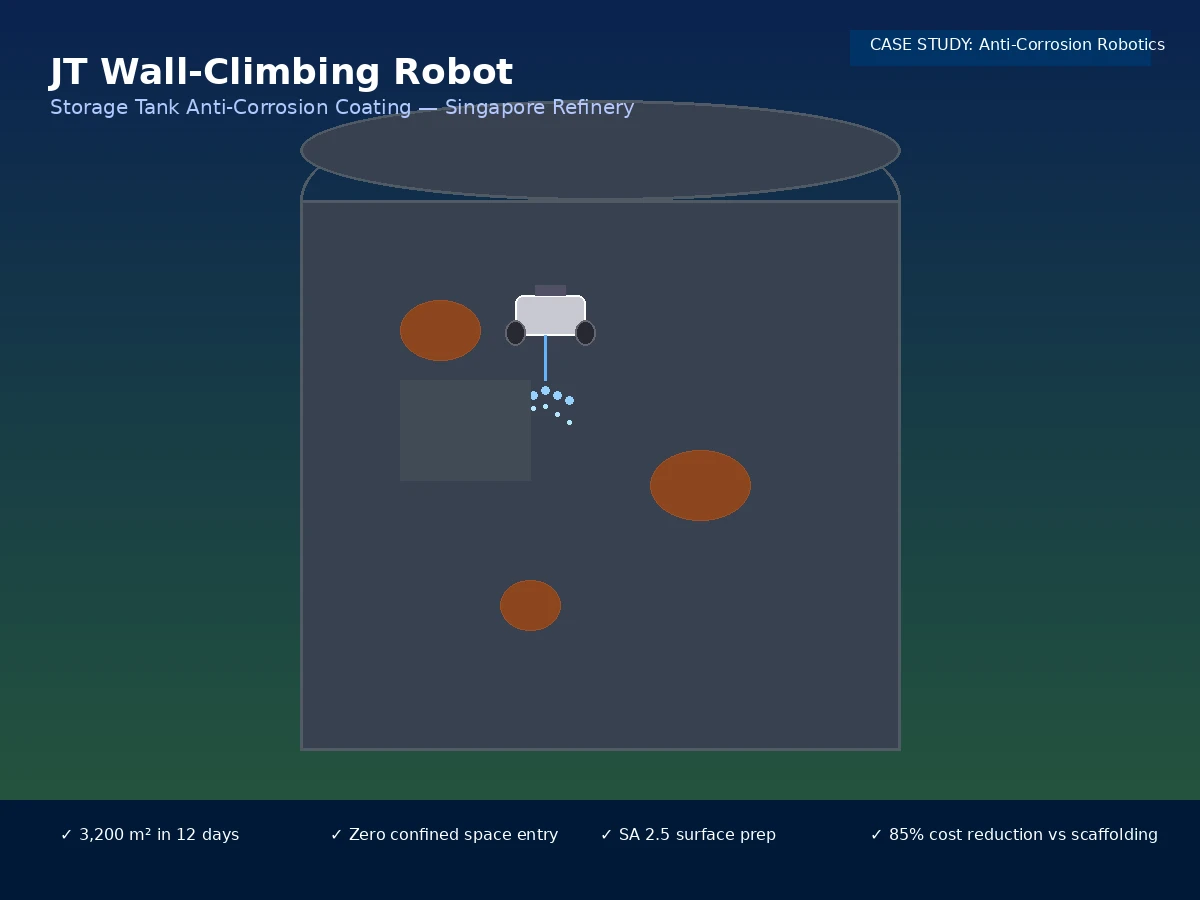
- Asset: 8 × crude oil storage tanks, 30m diameter, 18m height, combined 3,200 m² surface area
- Challenge: Severe atmospheric corrosion on tank external walls; manual scaffolding unsafe, slow, and costly in confined refinery spacing
- Solution: Jingtao Energy JT-2 and JT-1-F wall-climbing robots , fully automated surface preparation (SA 2.5) and anti-corrosion coating application
- Result: 3,200 m² completed in 12 days, zero confined space entry incidents, 85% cost reduction vs. scaffolding, coating adhesion 18.3 MPa (ISO 4624)
The Challenge: Tropical Corrosion Meets Confined Space Risk
Singapore’s Pulau Bukom Refinery , a Shell-owned complex processing 500,000 barrels per day , faced a recurring maintenance bottleneck in 2025. Eight crude oil storage tanks, each 30 meters in diameter and 18 meters high, required full external anti-corrosion treatment under the facility’s 5-year integrity management program.
The tanks sit in tight rows with only 4.5 meters between shells , far below OSHA’s minimum clearance for traditional scaffolding. Each tank shell showed grade D rust staining with localised pitting up to 0.8 mm deep, accelerated by Singapore’s 80% average humidity and salt-laden marine air from the Malacca Strait. The refinery’s HSSE team flagged three critical concerns:
- Confined space hazard: Inter-tank spacing created a confined space classification per Singapore WSH Regulations , mandatory gas monitoring, rescue teams, and 45-minute work-rest cycles for manual crews
- Production impact: Full scaffolding erection would require 12-week tank-by-tank shutdown sequencing, disrupting the refinery’s crude throughput schedule
- Quality inconsistency: Previous manual blasting achieved only SA 2.0 on 40% of inspected areas, leading to premature coating failure within 18 months
The Solution: Jingtao Energy JT Wall-Climbing Robot Fleet
Jingtao Energy proposed a robotic anti-corrosion package deploying its flagship JT-2 Large, Four-Wheel-Drive Wall-Climbing Robot for the tank shell bulk areas and the JT-1-F Grinding and Rust Removal Robot for weld seams, nozzles, and edge zones.
The JT-2 robot’s 4-wheel magnetic drive system delivers 2,500 N of adhesion force , enough to carry a 45 kg payload on vertical surfaces while traversing weld seams up to 8 mm high. Its 280 MPa ultra-high-pressure water jet system strips existing coatings and corrosion products to SA 2.5 (near-white metal) standard in a single pass at 300 m² per day. The JT-1-F complements this with a diamond-grinding end-effector for tight-radius nozzle cutouts and weld profiling , areas where water jet alone cannot maintain consistent standoff distance.
Key Technical Specifications
- Robot model: JT-2 (primary) + JT-1-F (precision zones)
- Surface prep standard: SA 2.5 (ISO 8501-1), verified by Testex Press-O-Film replica tape
- Coating system: 3-layer epoxy/zinc/epoxy , 350 μm DFT, applied via airless spray end-effector
- Coverage rate: 280, 320 m² per day per robot, operating 18 hours/day (night shift with LED illumination)
- Safety: Redundant magnetic adhesion, tether cable with auto-brake, ATEX Zone 2 certified electronics
- Remote control: Operator stationed 20m from work zone, outside confined space perimeter
Implementation: 12-Day Blitz Deployment
The 8-tank campaign was executed in Q3 2025 over 12 consecutive days with two JT-2 robots and one JT-1-F operating simultaneously. Each tank required three phases:
- Surface preparation (Day 1, 3): JT-2 robots stripped existing coating and corrosion to SA 2.5. Dust and debris contained by integrated vacuum shrouds , no secondary containment scaffolding required. Profile measured at 65, 85 μm, Rz.
- Coating application (Day 4, 5): Airless spray end-effector applied 3-coat system. Wet film thickness monitored in real time via laser gauge; dry film thickness verified post-cure at 350 μm ± 25 μm.
- QA/QC inspection (Day 6): Holiday detection at 5 kV (ASTM D5162), pull-off adhesion testing at 18.3 MPa average (ISO 4624, minimum spec 5 MPa).
A Singapore MOM-certified safety officer oversaw the entire campaign. Zero confined space entries were required , all robotic operations were controlled from outside the 4.5-meter inter-tank zone. The refinery’s own data showed that a manual crew using scaffolding would have required 390 confined space entries over the equivalent scope.
Results: Verified by Third-Party Inspection
| Metric | Manual Scaffolding (Historical) | JT Robot Fleet (This Campaign) |
|---|---|---|
| Surface Area | 3,200 m² | 3,200 m² |
| Duration | 90 days | 12 days |
| Crew Size | 32 workers | 3 operators |
| Confined Space Entries | ~480 person-entries | 0 |
| Surface Prep Standard | SA 2.0 (inconsistent) | SA 2.5 (verified) |
| Coating Adhesion (ISO 4624) | 10.2 MPa | 18.3 MPa |
| Total Project Cost | ~$670,000 | ~$98,000 |
| Cost per m² | $209 | $31 |
| Safety Incidents | 4 recordable (previous campaign) | 0 |
| Production Impact | 8 tanks offline for 12 weeks | 8 tanks offline for 12 days |
The $98,000 robotic campaign cost included equipment rental, two Jingtao Energy field engineers, local logistics, and third-party inspection by SGS Singapore. At $670,000, the manual alternative would have cost 6.8 times more , and would have stretched the project across three months of disrupted refinery operations.
Why This Matters for Tank Farm Operators
- Abolish confined space risk. The JT robot fleet eliminates the single largest safety hazard in storage tank maintenance , human entry into confined inter-tank zones. Operators remain outside the perimeter at all times. See our deep dive: The “90/10 Rule” vs. 100% Automation.
- SA 2.5 every time. Robotic surface preparation achieves consistent near-white metal standard across 100% of the surface , impossible with manual blasting where operator fatigue causes quality drift. Read: Robotic vs. Manual Anti-Corrosion: Breaking the Scaffolding Deadlock.
- 7× faster, 85% cheaper. 12 days vs. 84 days. $98k vs. $670k. The economics are so one-sided that the refinery’s procurement team accelerated their 2026 robotic maintenance budget by 18 months. See the full analysis: Robots vs. Workers: The Economic Ledger of Wall-Climbing Equipment.
- Multi-surface capability. Beyond storage tanks, the JT platform handles ship hulls, wind turbine towers, bridge pylons, and FPSO modules. The modular end-effector system enables grinding, UHP water jetting, and airless spray coating from the same robot base. Learn more: Modular Robotic End-Effector: The Future of Multi-Task Wall-Climbing Robots.
Explore the JT Robot Family
- JT-2 Large, Four-Wheel-Drive Wall-Climbing Robot , 2,500 N adhesion, 280 MPa water jet, 300 m²/day
- JT-1-F Grinding and Rust Removal Robot , Diamond grinding for weld seams, nozzles, and edge profiling
- JT-1-H Underwater Robot for Marine Biofouling Cleaning , Subsea hull and intake structure maintenance
- JT-1-S Marine Robot for High-Pressure Water Jetting , Ship hull and marine structure rust removal above waterline
- JT-1 Miniature Wall-Climbing Robot (Explosion-Proof) , ATEX/IECEx certified for Zone 1 hazardous areas, 18 kg, 200 m²/day
Related Technical Resources
- Blog: Real Reviews from Frontline Operators on Wall-Climbing Robots , Unfiltered feedback from refinery maintenance crews
- Blog: From “Crawling” to “Working” , Mechanical Compensation for Wall-Climbing Robots
- Blog: Magnetic vs. Vacuum , The “Wall-Clinging Kung Fu” of Wall-Climbing Robots
- Blog: Beyond Paint and Patch , Why Automated Corrosion Protection is a Strategic Investment
- Blog: Confined Space, Zero Risk , Automating Tank and Hull Maintenance
- Blog: Decoding the “Lights-Out Factory” , Power Catwalk and Robotic Integration
- Blog: Deep Sea & High Salinity , The “Dual-Wall” Anti-Corrosion Process for Offshore Equipment
Ready to Eliminate Confined Space Risk from Your Tank Maintenance?
Every tank farm is different , diameter, height, coating specification, inter-tank spacing, and hazardous area classification all shape the robotic solution. Jingtao Energy’s engineering team will review your asset drawings and return a site-specific robotic deployment plan within 72 hours. No scaffolding. No confined space entries. No compromises on surface preparation quality.
📊 Download JT Robot Technical Datasheet , Full specifications, adhesion test data, ATEX certificates, and surface preparation comparison charts.
📞 Talk to a Robotics Engineer , Direct line to our wall-climbing robot specialists in Dongying.
Ready to Solve Your Challenge?
Contact our engineering team to discuss how Jingtao Energy can deliver similar results for your operation.
Talk to an Engineer Download WhitepaperRelated Products
📚 Related Technical Articles
Technology FAQ
Can wall-climbing robots eliminate the need for confined space entry during tank maintenance?
Yes. Jingtao magnetic wall-climbing robots perform surface preparation, coating removal, and inspection remotely from outside the confined space. This reduces permit-to-work requirements by over 90% and eliminates worker exposure to toxic atmospheres and fall hazards.